
Employees of Lucid‘s Saudi Arabian operations have arrived at the company’s Arizona factory for training assignments, according to public posts written by the employees themselves and reviewed by EV.
The company has not announced the group, its size, or the rotation length. One of the engineers mentioned he had just started “a 6-month training assignment.”
In a blog post dated April 12 and signed by Faisal Sultan, President for the Middle East, the executive recalled the partnerships with Saudi Arabia’s Human Resources Development Fund and the National Automotive and Vehicles Academy in King Abdullah Economic City.
“Some participants get to train in both Saudi Arabia and at Lucid’s U.S. facilities before bringing their expertise back home, so ‘Made in Saudi’ means built to a single global standard,” Sultan said.
“AMP-2 is more than a manufacturing site,” the executive said in the same blog post. “It’s a symbol of the Kingdom’s transformation, creating thousands of jobs and empowering a new generation of Saudi talent to shape the future of mobility.”
The posts reviewed by EV place it in motion at the only US plant Lucid operates — a plant where the company eliminated 705 Arizona positions and an entire production shift in June.
Lucid told investors on the August 4 call that production and deliveries would fall below current consensus estimates, and that external forecasts did not yet reflect the lower near-term output following the cut to its manufacturing workforce.
“In particular, I want to stress how current consensus estimates for production and deliveries are based on operating models that no longer reflect the figures we anticipate today,” Napoli stated.
“Consequently, based on our ongoing assessment, production and delivery figures are expected to come in below current consensus estimates,” he continued. “Specifically, production in Q3 and Q4 is expected to be below Q2 levels, reflecting AMP-1 transition from two shifts to a single shift configuration through year-end.”
What the Posts Say
Four posts published over the last days describe assignments at Advanced Manufacturing Plant 1 in Casa Grande.
Osama Alharthy, a Mechanical Engineer at Lucid, wrote that he had “officially started a 6-month training assignment” at the Casa Grande facility, describing work in drive unit and powertrain operations and saying he would bring practices back to Lucid Motors Middle East.
Talal Alsulami, a Facility Electrical Engineer at Lucid Motors Middle East, described joining AMP-1 for an assignment within Operations “alongside my role as a Facility Electrical Engineer at KAEC” — the Saudi plant.
Abdulhadi Bareedah, an industrial engineer, wrote that he had begun a training program under the Lucid Future Talent scheme after working in the Operational Excellence department at AMP-2, the Saudi plant, and framed the assignment as bringing expertise back to the Kingdom’s industrial sector.
A fourth post, by Mohammed Zaini, describes starting training at AMP-1 in quality engineering; the visible text does not state a Saudi affiliation, and his position within the rotation cannot be established from the post alone.
Each of these is a self-description rather than a company statement, and the titles, durations and departments are as the individuals gave them.
The Group Photograph
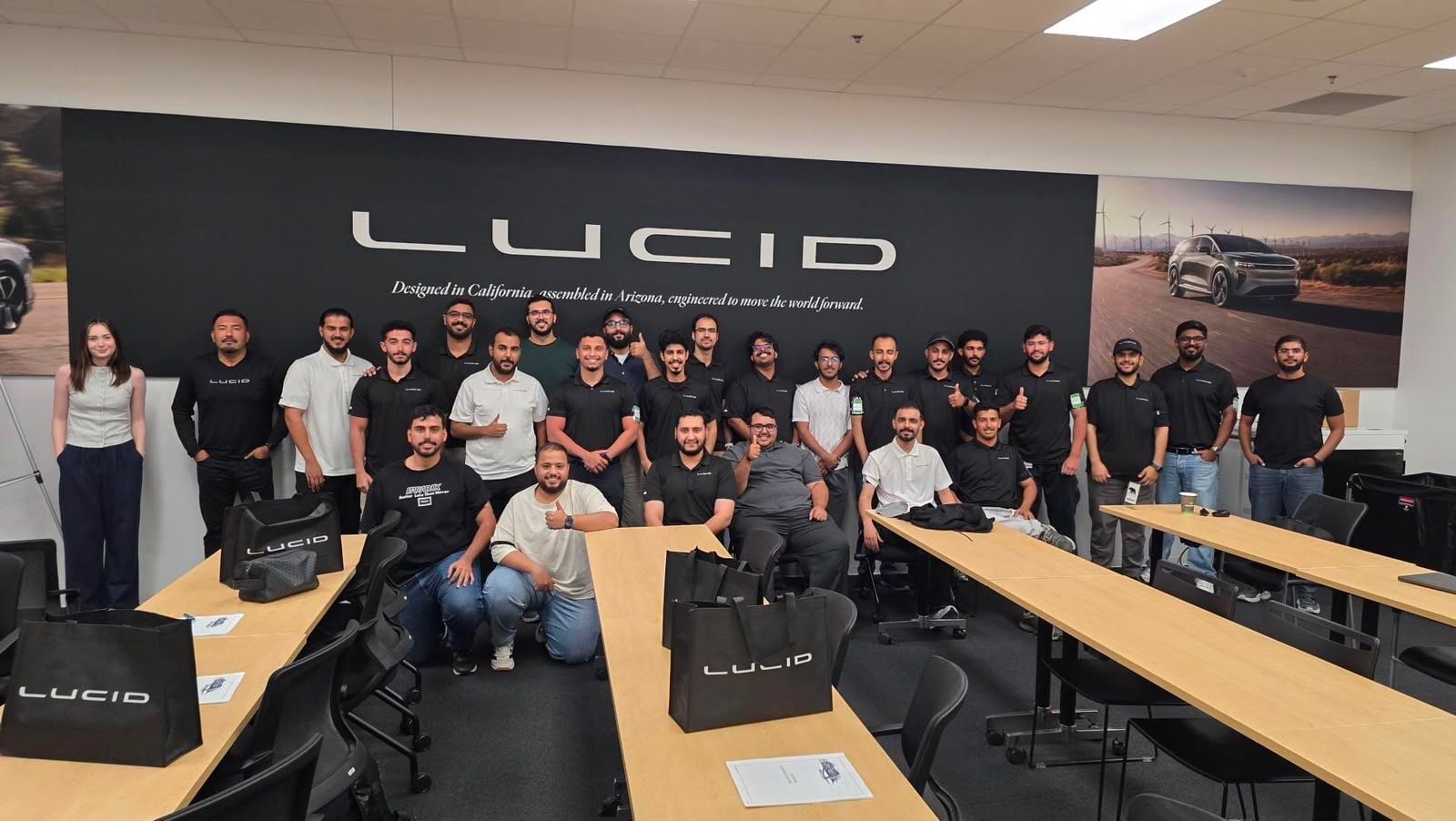
A group photograph taken in the same room — a conference space with a Lucid wall graphic and branded tote bags on the table — appears in two of the four posts, published by different people.
About 20 people are visible in the frame.
A headcount taken from a photograph is approximate, does not establish the size of the cohort, and cannot distinguish participants from Casa Grande staff attending the same session.
The Plant They Arrived At
AMP-1 has been running at a fraction of its capacity.
The Casa Grande site has been rated at 90,000 vehicles a year since the second phase was commissioned in January 2024, and Lucid produced 4,774 vehicles in the second quarter — an annualized rate of about 21.2% of that figure.
As reported by EV, a drone flyover in July found the lots around the plant still full of unsold Gravity SUVs.
Whether a training rotation places any meaningful load on that plant is not something the posts answer, and a single shift running at a fifth of nameplate leaves considerable room on the line.
The Program
Lucid Future Talent is not new and is not confidential.
The scheme was described by Sultan to Arab News in 2023 as a program run with the Human Resources Development Fund to prepare Saudi talent for jobs in the Kingdom, and Lucid‘s own job listings for the program specify six or twelve months of intensive on-the-job training for Saudi graduates in fields including mechanical, electrical and industrial engineering.
Sultan told Arab News in December that Saudis accounted for about 70% of the company’s workforce in Saudi Arabia and that the rate was expected to rise as AMP-2 expands.
The Timeline Being Trained For
The assignment lengths land on a schedule that has moved twice.
Lucid said in April that construction of the complete build unit factory at King Abdullah Economic City was on track to finish by the end of 2026, with capacity designed to scale to roughly 150,000 vehicles a year.
On the August 4 earnings call, chief executive Silvio Napoli said AMP-2 would be “ready for production in early 2027” and “ready to run midsize production in the second half of the year,” pushing the Cosmos start from late 2026 by approximately a year.
A six-month assignment beginning in mid-August ends around February 2027, roughly when Napoli says the factory is due to be ready.
In its second-quarter statement the company said manufacturing systems across stamping, body, paint and final assembly were being installed and commissioned at the 1.36 million square metre site ahead of production trials, with hiring underway and headcount increasing.
The staffing effort has been visible for months at senior level, with the company hiring a 30-year Ford manufacturing veteran, Kel Kearns, as Senior Operations Director for AMP-2 in June, two days after confirming the Arizona cuts.
What the Job Board Shows
A capture of the company’s careers site taken on Wednesday and reviewed by EV, filtered to Saudi Arabia, lists at least 22 open positions, 18 of them inside the Manufacturing Division.
The figure is a floor rather than a total: the page runs past the bottom of the capture in the middle of the Quality Division, and the filter used selects roles tagged to the country rather than to Jeddah or Riyadh, both of which appear as separate location tags on Lucid postings elsewhere.
The composition is more informative than the count.
Five of the openings sit in Stamping Operation — a material handler, a tandem line team leader, a tandem line press operator, a production team lead and a CAD engineer — and two more sit in Body Manufacturing.
Neither function is required to run a semi-knocked-down line, which reassembles kits shipped from Arizona.
The press operator posting asks for one to three years of stamping experience, “preferably with Schuler Tandem Servo Presses,” and the senior dimensional quality technician role covers inspection of body-in-white components using coordinate measuring machines and laser trackers.
Those are the job descriptions of a plant that intends to form its own metal, matching the company’s second-quarter statement that stamping, body, paint and final assembly systems were being installed and commissioned.
Eight further openings sit in General Assembly, weighted toward maintenance — a maintenance manager, a maintenance planner and three senior maintenance technicians — alongside two paintless dent repair technicians, with a mechanical and an electrical repair technician listed under Global Mfg.
A maintenance-heavy mix is characteristic of a plant being commissioned rather than one running at rate, though the listings carry no start dates and a posting is not a hire.
Among the General Assembly vacancies is a production shift manager in Saudi Arabia — a shift being staffed in the Kingdom two months after Lucid eliminated one in Arizona to align production with demand.
Why the Kingdom Matters to the Numbers
Saudi Arabia supplied $98.2 million of second-quarter revenue against $284.4 million from the United States, taking the US share of the top line to 70.2% from 82.0% a year earlier.
Related-party revenue — the line that captures sales to the Saudi government — reached a record $96.2 million in the quarter, and former CFO Taoufiq Boussaid told the August call the government had committed to purchase more than 4,000 vehicles during 2026 and annually through 2032.
Filings imply roughly 1,080 vehicles went to the government in the second quarter alone.
Set against the 2022 agreement to buy up to 100,000 vehicles over a decade, the pace remains behind: the company’s Middle East arm posted, then deleted, a milestone of more than 5,000 vehicles delivered in the Kingdom over four years.