
Lucid has delayed the Cosmos, the midsize crossover that carries its route to volume: production will now begin in the second half of 2027 at the AMP-2 plant in Saudi Arabia, chief executive Silvio Napoli said on Tuesday’s earnings call.
The new target is about a year behind the “late 2026” start the company had maintained until Tuesday’s call.
The new timeline came in Napoli’s prepared remarks: AMP-2 will be “ready for production in early 2027” and “ready to run midsize production in the second half of the year,” with the Cosmos as “the first vehicle produced at” the new factory and “the first model from our midsize platform.”
Set against the company’s standing late-2026 language — which had already vanished from Tuesday’s earnings release — the statements move the program’s start by approximately a year.
Neither Napoli nor the release used the word delay as the dates did the announcing.
Napoli, who visited the Jeddah-area site in April in his second week as chief executive and said he was “impressed by the progress achieved despite the geopolitical situation,” described a plant with all buildings functional and manufacturing systems in installation and testing across stamping, body, paint and final assembly, ahead of production trials.
He was equally specific about what Lucid does not control.
Readiness, he said, has two components: the factory itself — “within our control” — and the surrounding supplier base and infrastructure needed for a sustained ramp.
Saudi authorities are advancing road, water, electrical and telecom infrastructure, he said, while the company is “evaluating supply localization timelines” and “identifying actions to mitigate potential delays.”
The formulation acknowledges, without quantifying, that the ecosystem around the plant is the schedule’s open variable. “This does not change our commitment to the kingdom,” he added.
The program itself is under review.
With a strengthened team, Napoli said, a “comprehensive review of the program” is underway that “will implement any changes needed to ensure a successful launch” — and he attached the launch to a quality gate rather than a date: “midsize will launch only when every process and quality requirement have been met.”
The company, he said, “will not repeat the mistakes of the past” by “bringing a product to market before it is ready” — language that echoed, nearly verbatim, his earlier confession that Lucid had launched products “before they were ready.”
The new chief technology officer, who took up the role in July promising to “remove bottlenecks”, inherits the review.
The strategic weight on the car was restated in full.
The midsize platform “remains an essential element” of the strategic plan, Napoli said — “that’s why it must be one of our must-wins” — and the company remains confident in the program as a “core enabler to scale, improve unit economics, and ultimately profitability.”
The Cosmos is also a named component of the company’s largest commercial commitment: the April Uber expansion specified at least 35,000 vehicles including “Lucid Midsize vehicles,” making any timeline statement a robotaxi-timeline statement as well.
The Saudi-first production plan lands alongside a shrinking Arizona footprint — the earnings release’s fine print discloses the elimination of the second production shift at AMP-1 — and a delicate Saudi information environment.
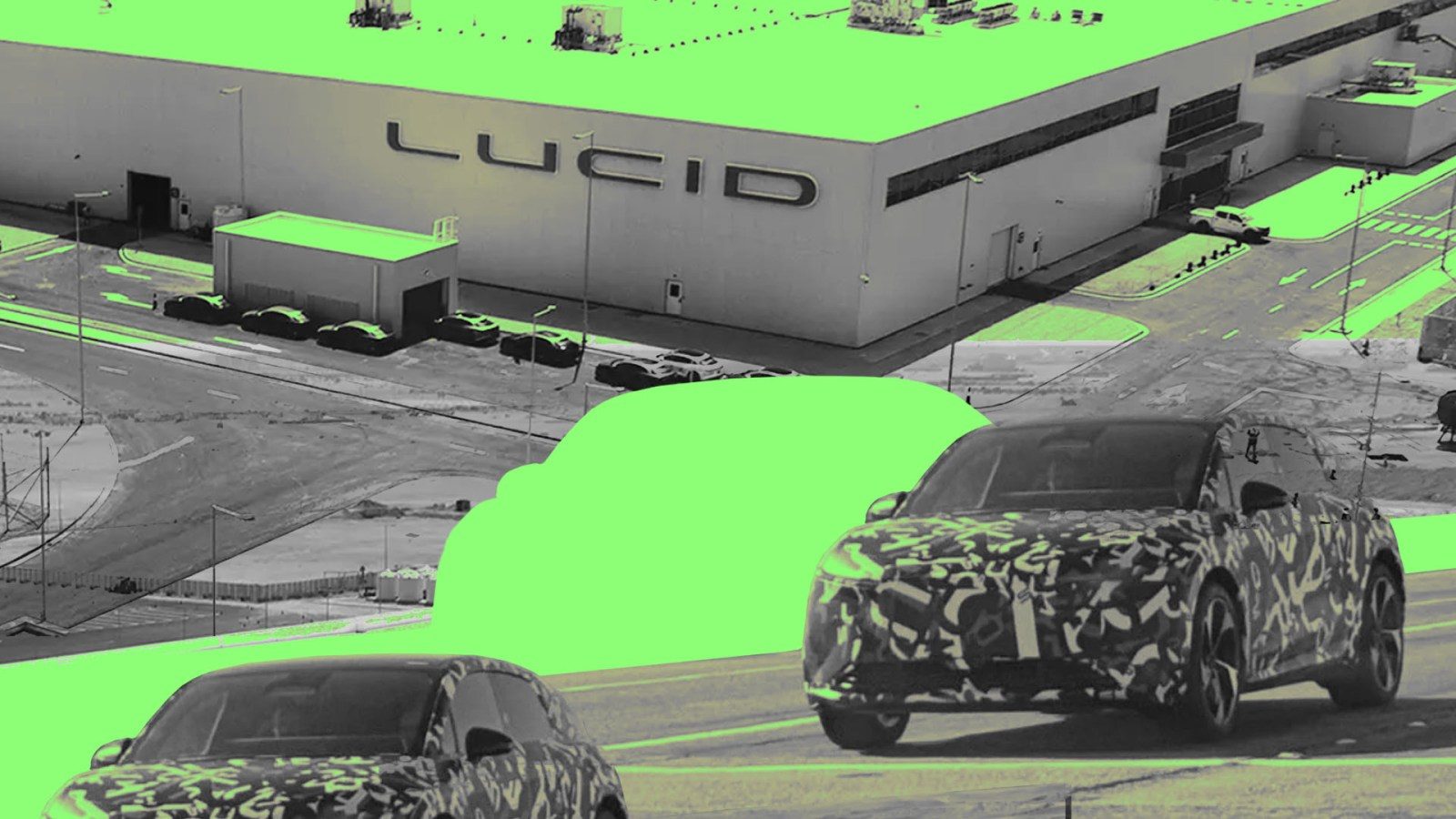
Lucid‘s third model has been visible for weeks.
The Cosmos was recently photographed testing at Lucid’s former Nikola facility in Coolidge, Arizona, in mid-July, ahead of what had been flagged as a summer unveil.
The model is going through “all the certifications,” Napoli said in the call — including both internal and external.
“To do it well, it takes time,” the chief executive warned.