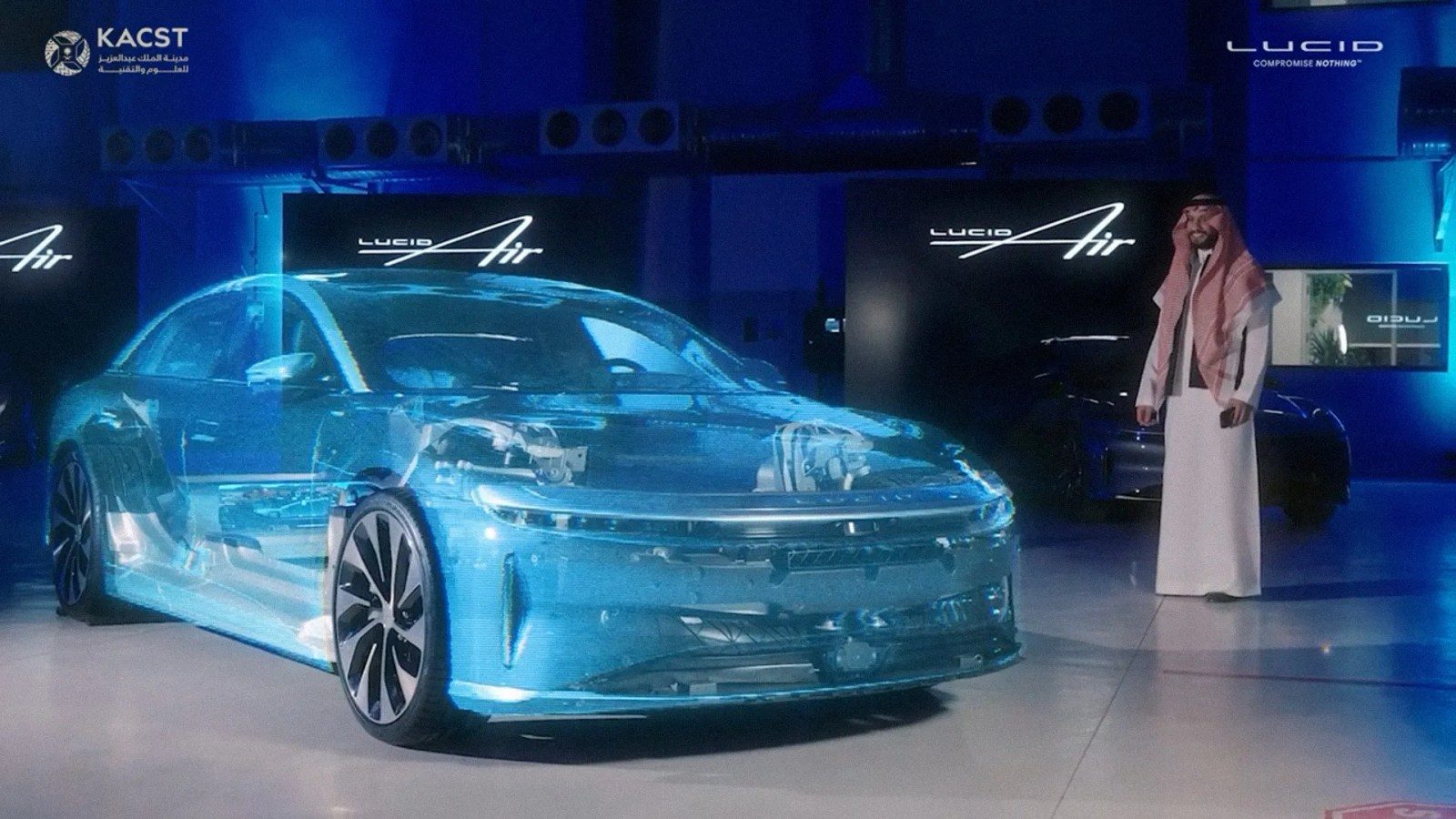

Buried in the parentheses of Lucid Motors‘ income statements sits the first evidence that the Saudi government’s landmark vehicle order is finally being fulfilled at the pace promised when the deal was signed four years ago.
Revenue from related parties — a line that tracks vehicle sales to the government under the EV Purchase Agreement — reached a record $96.2 million in the second quarter, according to filings published this week.
The count behind that figure depends on the price assumed per vehicle.
Against the roughly $88,700 in vehicle-sales revenue Lucid generated per delivery last quarter — $350.6 million of vehicle revenue across 3,953 vehicles, excluding regulatory credits, services and other non-vehicle items — the government’s $96.2 million implies roughly 1,080 cars in three months, according to EV calculations.
Treating the related-party figure as vehicle sales is supported by the company’s own disclosures.
The line sits within total revenue, but the proxy statement’s figure for net vehicle sales under the EV Purchase Agreement matches 2025’s full-year related-party revenue to the dollar, indicating the government line consists effectively entirely of cars.
Annualized, the second quarter’s pace works out to between roughly 3,800 and 4,300 vehicles — a quarterly rate rather than a guaranteed full-year run-rate, but one that for the first time straddles the commitment, and likely an understatement given the agreement entitles the purchaser to the lower of US and Saudi retail pricing.
Chief financial officer Taoufiq Boussaid put the official number on the trajectory during Tuesday’s earnings call, saying in the call that the government has “committed to purchase more than 4,000 vehicles during 2026 and annually through 2032.”
For the first time since the agreement was announced, the disclosed revenue and the stated commitment describe the same reality.
The 2022 Deal
The Saudi government agreed in April 2022 to purchase up to 100,000 vehicles over ten years, with a firm order for 50,000 units and an option for 50,000 more.
Order quantities were expected to range from 1,000 to 2,000 vehicles annually before rising to between 4,000 and 7,000 units per year starting in 2025, Lucid said at the time.
The current pace reaches the bottom of that band a year after the ramp phase was scheduled to begin, catch-up rather than on-schedule delivery.
The filings show how far behind that schedule the program ran.
Related-party revenue totaled $45.6 million in the third quarter of 2024 and $40.8 million in the fourth, then collapsed to $5.1 million in the first quarter of 2025 as the company navigated the Gravity production transition.
Purchases rebuilt gradually through last year — $30.2 million in the second quarter, $34.3 million in the third, $74.4 million in the fourth — but the full-year 2025 total of $144.0 million still came in below 2024’s $174.2 million.
Three years into a contract that was supposed to be delivering 4,000 to 7,000 vehicles annually by 2025, government purchases were shrinking year over year as recently as last autumn.
However, the 2026 inflection is clear.
First-quarter related-party revenue of $38.4 million ran more than seven times the depressed prior-year figure, and the second quarter’s $96.2 million more than tripled year over year.
Half-year revenue of $134.6 million has already reached 93.4% of all of 2025 — in six months.
The Line That Confirms the Buyer
The identification of the related-party line with the government order is not an inference.
Lucid’s proxy statement discloses that the company recognized net vehicle sales of SAR 540.2 million, approximately $144.0 million, under the EV Purchase Agreement during 2025 — matching the year’s related-party revenue to the dollar.
The agreement itself, signed with the Government of Saudi Arabia as represented by the Ministry of Finance in August 2023, superseded the original 2022 letter of undertaking, and the government’s entities and beneficiaries qualify as related parties.
The Public Investment Fund holds roughly 56.9% of the company’s stock.
Receivables tell the same story from the balance sheet: amounts due from related parties climbed to $186.6 million at the end of June from $120.5 million at the end of 2025, suggesting deliveries are running ahead of collections as the ramp accelerates.
Former interim chief executive Marc Winterhoff signaled in January that fulfillment of the 50,000-unit order would accelerate in 2027 once the midsize model reaches production at the Saudi plant — meaning the current Air and Gravity purchases represent the floor, not the ceiling, of the government’s intake.
What the Pace Means for the Order Book
At 4,000 vehicles per year through 2032, the government would absorb roughly 28,000 units over the remaining seven years of the commitment.
The roughly 5,000 vehicles the deleted anniversary post celebrated over the agreement’s first four years leave about 45,000 of the firm’s 50,000-unit order outstanding.
Closing that gap is precisely the role of the acceleration Winterhoff described for 2027, when the midsize model built at the Saudi plant is expected to lift the government’s intake well above the 4,000 floor.
The near-term arithmetic still underscores why the pace matters to a company that delivered 3,953 vehicles globally last quarter: a single customer running at the committed rate would represent roughly a quarter of current volume, indefinitely.
The dependence cuts both ways.
Under the agreement’s terms, the purchaser may reduce the minimum quantity by the number of vehicles in any order Lucid declines or fails to deliver within six months, and holds sole discretion over the additional 50,000 units.
Retail demand in the Kingdom offers little cushion: the second quarter’s geographic disclosures show nearly all Saudi revenue flowing through the government line — a pattern already visible when Saudi revenue quadrupled sequentially a year ago.
This year’s Ramadan campaign leaned on cash incentives of up to $12,000 to move metal.