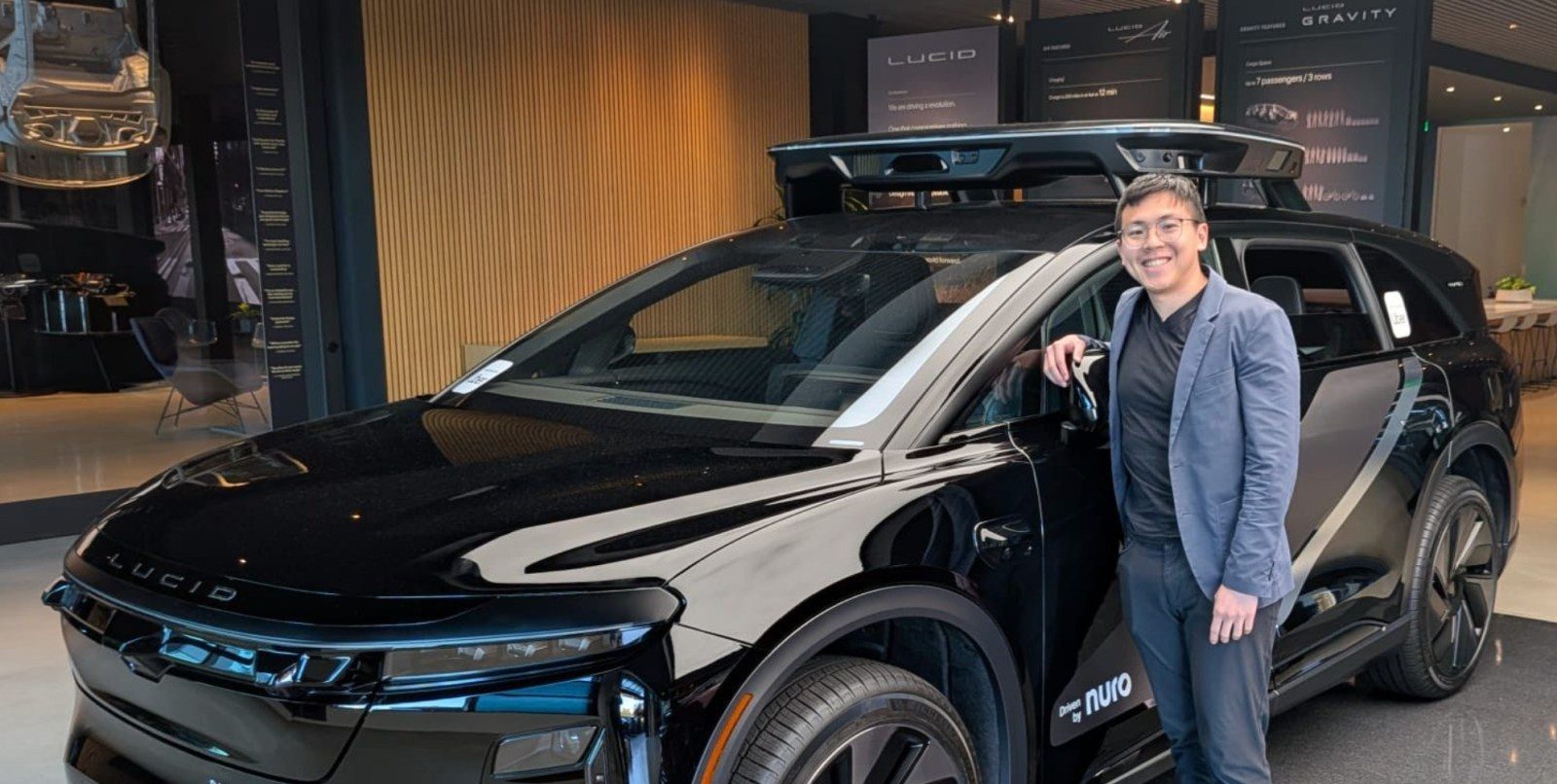

An engineer who stood in for the chief engineer of Lucid‘s robotaxi programme in reviews with external partners on the Lucid-Nuro-Uber project has left the company for Nvidia, a few months before the service’s planned launch in the San Francisco Bay Area.
Andrew Chen said on Monday that he left Lucid on August 26 after what his profile records as two years and five months, the last four of them as Senior Vehicle Integration Engineer and Assistant Chief Engineer (Functional) of “the Chief Engineering team for the Lucid-Nuro-Uber Rideshare program.”
Lucid, Nuro and Uber named the Bay Area as the first market in October 2025 and have held to a late-2026 launch, with Houston to follow in mid-2027 from a planned depot.
Chen has joined Nvidia as a Senior Product Program Manager on the Language Processing Unit (LPU) team.
“It was not easy saying goodbye to something I poured so much into (the car was like my baby), nor to the incredible people who helped make it a reality,” he wrote. “I’ve always joked that there was never a boring day at Lucid.”
What He Says He Did
Chen describes his path into the programme as running “from leading vehicle builds to joining the Chief Engineering team to help shape vehicle design and drive cross-functional alignment across engineering, supply chain, manufacturing, and quality to bring the fleet closer to production.”
In the role he held from May to August, Chen writes that he “represented the Chief Engineer in system-level design and product specification reviews,” where he “notably guided the design of the physical architecture, aeroacoustic, and SW strategy to optimize user experience and cost.”
On his LinkedIn profile, he adds that “acted as the Chief Engineer proxy in high-stakes design reviews with external partners,” and that he “successfully navigated and began initial negotiations on late change requests while ensuring vehicle requirements and timelines and budget remained uncompromised.”
Additionally, he says he “managed the PV build,” the production-validation vehicles that CEO Silvio Napoli told analysts on August 4 were being assembled at Lucid’s Coolidge, Arizona pilot site ahead of “regular vehicle production in Q4” and a launch “in late 2026,” and that he led alignment across systems engineering, manufacturing, supply chain and quality “to architect and execute the launch vehicle build phase,” resolving “last minute deviations” to “enable on-schedule fleet production.”
External partners include Nuro, which supplies the driving system, and Uber, which will operate the service and has committed to at least 35,000 vehicles, though Chen does not name them concretely.
Nvidia
Nvidia is not a bystander to the programme Chen left.
The Gravity robotaxi’s onboard computer is Nvidia’s DRIVE AGX Thor, listed in Lucid’s January CES release as the “high-performance compute” behind Nuro’s Level 4 system and integrated on the Casa Grande line alongside the sensor halo, as EV reported in July.
Lucid’s ties to Nvidia extend beyond the robotaxi.
In October 2025, the two companies announced that the midsize lineup would carry two DRIVE AGX Thor computers running Nvidia’s DriveOS for consumer Level 4 driving, with a DRIVE AV roadmap for the Gravity starting at eyes-on, point-to-point driving.
The Gravity’s hands-free highway driving, released in June as DreamDrive 2 Pro, is a separate step, and Nvidia and Uber announced the same day a target of 100,000 Level 4 vehicles from 2027 across a group of carmakers that named Lucid alongside Stellantis and Mercedes-Benz.
The Language Processing Unit is the Groq 3 LPU inference chip Nvidia unveiled at GTC on March 16, the first product of its $20 billion licensing and talent deal with Groq, sold in LPX racks of 256 chips that entered full production in late August, with first customer shipments slated for late in the third quarter.
The Timeline
Nuro’s California permits allow driverless testing of the Gravity robotaxis and drivered passenger pilots, and paid driverless rides still require a DMV deployment permit and CPUC authorisation.
Napoli put the engineering fleet at “nearly 100 vehicles across the San Francisco Bay Area and Houston” on August 4, a figure the partners have used since the spring, and said production-validation deliveries had begun in July.
Before the Robotaxi
Chen joined Lucid in April 2024 as a technical project analyst in vehicle test, “dropped into the deep end on my first day with the Gravity Betas,” and spent his first sixteen months on what his profile lists as the “Gravity Export Program (EU & ME),” where he “optimized vehicle allocation for the Gravity exports program by understanding the test plans.”
Gravity EU Safety Rating
His post describes the work as having “managed vehicle build and validation for EU and KSA, including a month-long deployment to Saudi Arabia and turning around the Euro NCAP program to achieve a 5-star rating.”
The Gravity’s five-star rating was published on November 19, 2025, with scores of 83% for adult occupants, 93% for children, 80% for vulnerable road users and 85% for safety assist.
He moved to technical program manager in vehicle test in August 2025 and to the same title in Chief Engineering in December, before the robotaxi role in May.