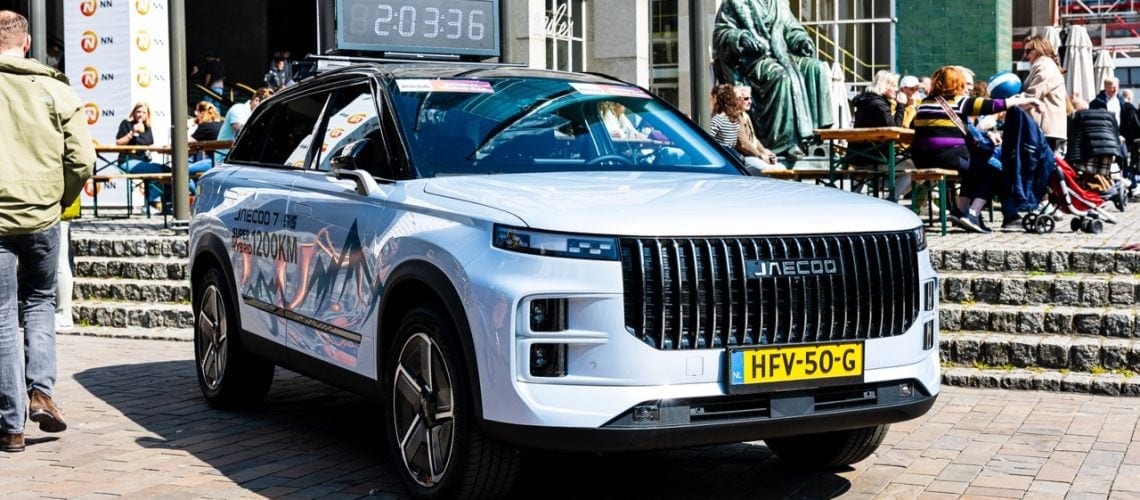

Univé, the Dutch cooperative insurer that says it has more than 1.8 million members, published research this week setting out which new car brands it will and will not cover.
Fourteen brands are affected, and the criteria are the availability of parts, technical repair information and qualified repair shops, not vehicle quality.
Registration data published by the trade association BOVAG shows the cohort Univé has restricted or excluded accounted for 1,013 of the 28,066 new passenger cars registered in the Netherlands in July, equivalent to 3.6% of the market.
A year earlier the same fourteen brands accounted for 289 registrations out of 28,818, or 1.0%.
Across the seven months to July 31 the cohort registered 6,121 vehicles against 1,691 in the same period of 2025, lifting its share from 0.8% to 3.0% while the total Dutch market contracted 4.1% to 202,469 units.
The classification therefore lands on the fastest-growing group of brands in a market that is otherwise shrinking.
What Univé Published
Five brands are restricted to third-party liability cover, the legal minimum in the Netherlands: Dongfeng, Lucid, Firefly, Nio and Zeekr.
Nine are excluded entirely: Hongqi, Changan, Voyah, KGM, Leapmotor, VinFast, Jaecoo, MHero and Omoda.
Lynk & Co can be fully insured, and Univé cites the brand alongside BYD and Tesla earlier as evidence that newcomers can build local infrastructure quickly.
The insurer states the classification is not a judgment on country of origin or vehicle quality, and that its acceptance policy can change.
Univé’s own analysis of RDW licence-plate registrations counts 88 car brands currently active in the Dutch passenger car market, sixteen of which arrived in the past five years and which together accounted for 2.4% of all new registrations over that period.
That five-year average sits below the 3.0% share the fourteen restricted or excluded brands alone hold in 2026, though the two figures cover different brand populations and different windows.
Where the Line Falls
The two tiers behave in opposite directions.
The five brands restricted to third-party cover registered 1,076 vehicles in the seven months to July, down 8.0% from 1,169 a year earlier, held back by Dongfeng‘s decline to 95 from 365 and Nio Inc.‘s to 47 from 74.
The nine fully excluded brands registered 5,045 against 522, a near tenfold increase driven almost entirely by Leapmotor, Omoda & Jaecoo.
Univé’s harshest classification therefore covers the fastest-expanding names, while the milder one covers a group in contraction.
The excluded list is also not uniform in scale.
Hongqi has registered nothing in the Netherlands in 2026 against 24 in the year-earlier period, VinFast has registered nothing against five, and MHero does not appear as a separate line in the BOVAG tables at all, falling within the 1,973 units reported under other brands.
Three of the nine excluded brands are therefore effectively absent from the market Univé is assessing.
Country of origin does not sort the list either.
XPeng registered 142 vehicles in July and 666 year to date, up 9.4%, and appears on neither list, as do MG at 1,661 units and BYD at 4,379.
Chery
Chery itself appears on neither list, while its Omoda and Jaecoo brands are both fully excluded.
Jaecoo registered 248 vehicles in July and 1,875 in the year to July 31, against 29 and 41 in the same periods of 2025, with the J7 at 131 and 1,345, the J5 at 71 and 378 and the J8 at 46 and 152.
Omoda registered 142 and 834, against four and 13 a year earlier, split between the Omoda 5 at 115 and 493 and the Omoda 9 at 27 and 341.
Chery-branded models added a further eight units year to date.
Taken together, the group’s two excluded brands registered 390 vehicles in July and 2,709 year to date, ahead of Leapmotor on both measures.
Chery Netherlands is the only affected manufacturer to have replied publicly.
A spokesperson told Automotive Online that Chery, Omoda and Jaecoo currently hold the necessary parts and accessories in stock at a parts and accessories centre in Schiphol-Rijk, and that repairs and accident damage can be handled quickly.
The company conceded a temporary delay in the availability of certain parts before the summer, said the backlog has been cleared and inventory restored, and pointed to first-half sales above expectations.
Chery then shifted responsibility to the data layer, saying the parts lists and inventory data in the systems insurers and repairers use have not been fully updated, so a repairer may be unable to see whether a part is available or what it costs.
The importer said it is working with those providers to update the systems.
If a material share of the perceived shortage is stale catalogue data rather than absent inventory, the insurers restricting cover are acting on the same faulty information, and no insurer has been asked to respond to that.
The infrastructure claims are checkable in part.
Omoda and Jaecoo launched in the Netherlands in September 2025, counted 25 Dutch locations by February with a plan to reach at least 30 by the end of 2026, and say more than 30,000 parts are held at the Schiphol-Rijk warehouse.
The importer names Allianz as its insurance and service programme partner, and offers private lease through OJ Mobility, a venture with Ayvens in which insurance, maintenance and repairs sit inside the monthly payment.
Omoda and Jaecoo reported 2,328 RDW registrations in the first half of 2026 against 2,319 on the BOVAG series, a nine-unit divergence between the two Dutch data sources.
Leapmotor
Leapmotor registered 362 vehicles in July and 2,211 in the year to July 31, against 58 and 387 in the same periods of 2025, a year-to-date increase of 471.3%.
By model in July and year to date, the B10 accounted for 131 and 888, the T03 for 116 and 776, the C10 for 102 and 502 and the B05 for 13 and 45.
Leapmotor is the highest-volume single brand on either Univé list, though not by a wide margin, since Jaecoo also registers in four figures.
The brand is distributed in Europe through Leapmotor International, the joint venture in which Stellantis holds 51%, which gives it access to Stellantis dealer and service infrastructure.
Stellantis Financial Services, the group’s Dutch finance arm and a joint venture between Banque PSA Finance and Santander Consumer Finance, also sells a Leapmotor-branded motor policy in the country.
The terms published on its own Leapmotor site promise repair with original parts and retention of the factory warranty, no deductible where the car is repaired by an approved repairer under three- or four-star cover, replacement transport as standard after 72 hours and optional round-the-clock international breakdown assistance.
Autobahn, which first flagged the contradiction, described the policy as carrying up to thirty days of replacement transport, a term that does not appear on the insurer’s own page and appears closer to the separate Leapmotor private lease product.
Zeekr
Zeekr is restricted to third-party cover at Univé, excluded by National Academic and named by Promovendum.
The brand registered 220 vehicles in July against 140 a year earlier, up 57.1%, and 902 year to date against 697, up 29.4%.
Growth is concentrated in the 7GT, which contributed 109 units in July and 203 year to date from a zero base, and the 7X at 87 and 509.
The 001 accounted for 11 and 111 and the X for 13 and 79.
Nio and Firefly
Nio Inc. registered two vehicles in the Netherlands in July, one EL6 and one Firefly, against 20 in July 2025 of which 17 were ET7 sedans.
Year to date the group has registered 47 vehicles against 74, a decline of 36.5%, and Firefly accounts for 39 of the 47, or 83.0%.
The Nio brand itself has registered eight vehicles in seven months, four EL6 and four EL8, with the ET5 and ET7 at zero.
The practical effect is that the restriction covers a brand registering roughly one vehicle a month, and a sub-brand that is the group’s only meaningful source of Dutch volume.
Nio operates in the Netherlands through Nio House Amsterdam and has had a Dutch presence since 2022, and Firefly began European deliveries last year.
Lucid
Lucid registered four vehicles in July and 32 in the year to July 31, comprising 24 Gravity SUVs and eight Air sedans.
That compares with five and 33 in the same periods of 2025, when only the Air was on sale, and follows a first half in which the Gravity accounted for 22 of 28 units.
Lucid is the only American brand on either list.
Univé published on August 18.
Earlier on Thursday, Lucid announced Munsterhuis Autobedrijven as its first Dutch retail partner, to operate a dedicated sales site in Hengelo with authorised aftersales and service at the same location.
EV exclusively reported the deal on June 10, seventy-one days before the announcement, and had earlier revealed Wackenhut as the first European partner in February.
Munsterhuis runs five body-repair sites across the eastern Netherlands holding repair certifications from several manufacturers, and handles service and body repair for Ferrari, Lotus, Jaguar and Land Rover.
The group became one of only two Dutch Lotus dealers in 2025.
The Unnamed Example
Univé described a case in which a small crack in a front suspension component led to a total loss declaration, because the available repair instruction required the entire body to be replaced.
The insurer attributed the case to an American electric model that entered the Dutch market a few years ago, and named neither brand nor model.
The Brands Univé Cites as Proof
Lynk & Co, the only brand Univé says can be fully insured, registered 184 vehicles in July against 314 a year earlier, a decline of 41.4%, and 1,553 year to date against 1,698, down 8.5%.
BYD registered 626 and 4,379, more than doubling year on year from 299 and 2,055.
Tesla registered 359 and 6,969, down 19.0% and 4.9%.
The three brands presented as evidence that newcomers can build repair infrastructure are therefore moving in three different directions commercially, which is consistent with Univé’s argument that the assessment is about repair capability rather than sales performance.
Univé Is Not Alone
National Academic does not insure electric vehicles from Hongqi, Dongfeng, Nio, Voyah, Zeekr, Leapmotor and Firefly, citing limited parts availability and insufficient repair information.
Promovendum applies similar reasoning, declining certain Chinese electric brands where parts or repair information are inadequate, with a list covering Leapmotor, Nio with Firefly, Dongfeng, Voyah and Zeekr.
Allianz and Centraal Beheer told RTL Z they exclude no brands.
The lists differ between insurers, which means insurability is a function of the underwriter rather than a fixed property of the brand.
The Trade Response
The Dutch retail motor trade has pushed back.
A dealer told BNR Nieuwsradio the warning was “zwaar overtrokken”, or heavily overblown, in a segment published on the evening of August 18 and updated the following morning.
BOVAG, which supplies the registration data underpinning any assessment of these brands’ scale, acknowledged in the same coverage that Chinese newcomers in particular have start-up problems.
The trade association is therefore both the source of the market data and a party to the dispute over what the data means.