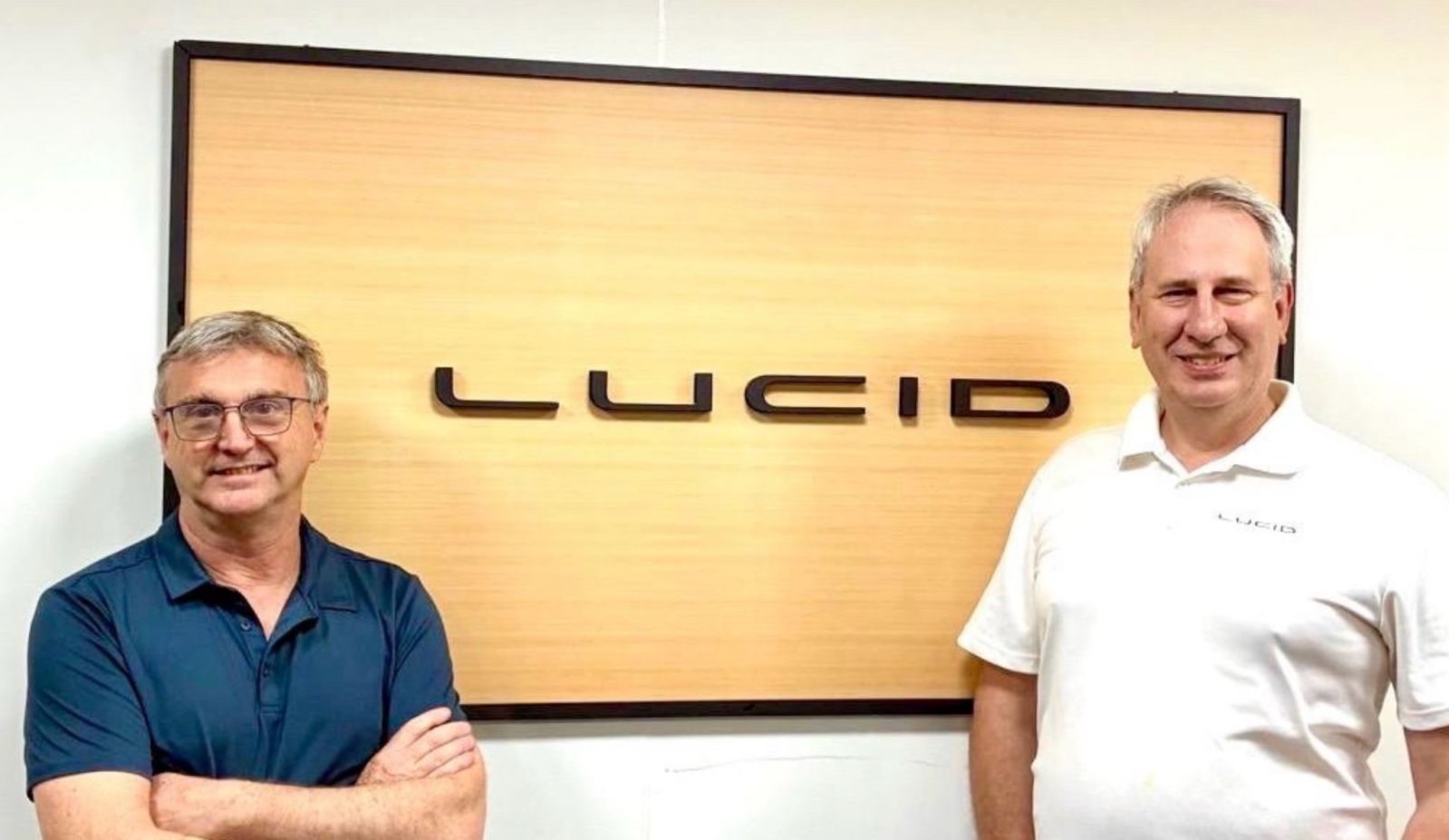

Lucid has hired a 30-year Ford manufacturing executive to run its Saudi Arabian car plant, where the company plans to begin building its cheapest model by the end of the year.
Kel Kearns is joining as senior operations director for AMP-2, Lucid‘s plant in King Abdullah Economic City, according to a LinkedIn post by Adrian Price, the Senior VP who leads Lucid‘s operations.
Price said Kearns brings “a wealth of global manufacturing expertise” to a facility preparing to begin full production of the Cosmos, the midsize SUV central to Lucid‘s plan to reach the mass market.
The hire was announced 48 hours after Lucid confirmed deep cuts at its only US factory — as exclusively reported by EV on early Monday.
Kearns’s Background
Kearns has spent his career building and running vehicle plants.
He worked three decades at Ford, most recently running the carmaker’s Blue Oval City EV complex in Tennessee, and before that leading joint ventures in Thailand with Mazda and in China with Changan.
His earlier postings included leading the design and construction of a greenfield vehicle and engine plant in Sanand, India, a project valued at more than $1 billion.
Most recently, Kearns spent two years as chief executive of Amplify Cell Technologies, the battery-cell venture in Byhalia, Mississippi, backed by Cummins, Daimler Truck, PACCAR and EVE Energy.
Saudi Plant Upgrade
Lucid opened AMP-2 in September 2023 as Saudi Arabia’s first car factory, though it began as a semi-knockdown operation, reassembling Air sedans from kits shipped out of Arizona with capacity for about 5,000 vehicles a year.
The company is now rebuilding the site as a complete-build-unit factory, adding digital-twin software from Rockwell Automation to lift designed capacity toward 150,000 midsize vehicles a year, and 155,000 across the wider complex by 2029.
Construction of the full-build factory is due to finish by the year’s end.
AMP-2 will then become Lucid‘s second full production plant alongside its Casa Grande factory in Arizona, known internally as AMP-1.
Lucid trains some Saudi staff at its US sites before they return to King Abdullah Economic City, part of a localization push with the kingdom’s vocational training agencies.
Saudi Arabia’s Public Investment Fund owns about 57% of Lucid and has invested more than $9 billion since 2018, including a $550 million investment in April as part of a $1.05 billion capital raise.
The plant anchors the kingdom’s Vision 2030 plan to build a domestic car industry and to make 30% of new vehicle sales electric by the end of the decade.
The kingdom is drawing other carmakers to the same economic zone, with Hyundai planning a local plant and the domestic startup Ceer preparing its first model.
For now, Lucid is the only carmaker producing vehicles in the kingdom.
Cosmos Production
Lucid plans to begin production of the Cosmos at AMP-2 by the end of this year, with a slow ramp through 2027 and full capacity targeted for 2028.
The company’s third model will be built only in Saudi Arabia at first, unlike the Air and Gravity that roll off the Casa Grande line, with US output following six to 12 months later.
Priced from about $50,000 at its cheapest trim, the Cosmos is meant to carry Lucid beyond its low-volume luxury sedans and into the mass market, where it will meet the Tesla Model Y.
Chief financial officer Taoufiq Boussaid has said the Saudi sequencing lets Lucid source some components from China without the tariffs that would apply to US assembly.
The Cosmos rides on a new midsize platform and Lucid‘s in-house Atlas drive unit, with a public debut planned for this summer and a second midsize model, the Earth, due about a year later. Management has positioned the SUV as the company’s primary catalyst toward profitability.
Cosmos output will not contribute meaningfully to 2026 volumes, and Lucid has suspended its full-year delivery guidance of 25,000 to 27,000 vehicles.
At its first Investor Day in March, the company set out a path to 100,000 vehicles a year by 2028, a target that rests on the midsize platform.
Faisal Sultan, Lucid‘s president for the Middle East, has said the project is “on time.”
Lucid has strengthened its Saudi finance team and installed more than 100 chargers across the kingdom as the launch approaches.
Cuts at Home
In the same week as the Kearns announcement, Lucid told state regulators it would cut 705 jobs, most of them at Casa Grande, by eliminating the factory’s second production shift for the Air and Gravity.
The reduction forms part of a roughly 18% cut to the company’s US workforce, about 1,500 jobs, to be completed by the end of the third quarter.
The cut is Lucid‘s fourth formal workforce reduction since 2023 and its second this year, after a 12% global round in February that included 319 jobs at the Newark, California headquarters.
In the US, Lucid is trimming salaried and production roles while staffing the Saudi plant for the Cosmos.
Lucid has churned through senior leaders for two years, and its latest reductions followed the elimination of its chief operating officer role and the departure of its engineering and software chief.
Silvio Napoli, who formally took over as chief executive on June 1, has cast the cuts as a way to simplify the company and sharpen execution.
Lucid posted a net loss of about $1 billion in the first quarter on revenue of $282.5 million, up about 20% from a year earlier, and delivered 3,093 vehicles, down 42%, after a 29-day stop-sale on the Gravity.
The Public Investment Fund has funded the company through repeated capital raises.