
Revenue Lucid Motors generated in Saudi Arabia nearly tripled year over year to $98.2 million in the second quarter, reaching 24.2% of total revenue and reshaping a geographic mix that the United States had dominated since the company’s first deliveries, a new SEC filing reveals.
The Kingdom’s contribution rose 173.5% from $35.9 million a year earlier and 133.8% from $42.0 million in the first quarter, according to the segment note in the 10-Q filed on Tuesday.
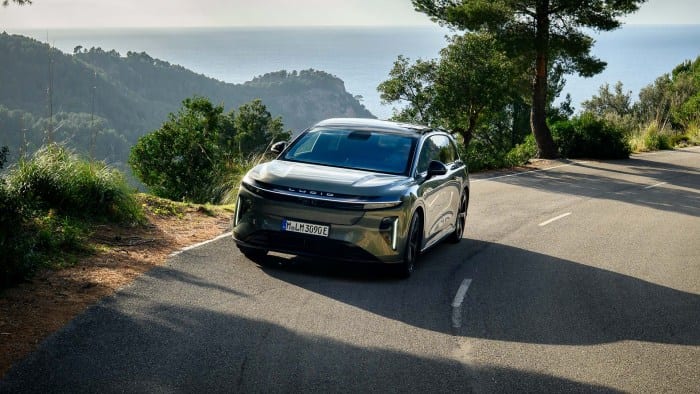
United States revenue also grew — up 33.7% year over year to $284.4 million on the Gravity ramp — but its share of the top line fell to 70.2% from 82.0% in the second quarter of 2025 and 79.8% in the first quarter of this year.
Nearly all of the Saudi surge appears to trace back to a single buyer.
Lucid separately reported $96.2 million of second-quarter revenue from related parties — a line that has historically tracked vehicle sales to the Saudi government under its EV Purchase Agreement — leaving only around $2 million of Kingdom revenue attributable to other customers.
Related-party revenue more than tripled from $30.2 million a year earlier, and receivables from related parties climbed to $186.6 million at the end of June from $120.5 million at the end of 2025.
Chief financial officer Taoufiq Boussaid, presenting his final quarter before handing over the role, confirmed the pace on Tuesday’s call, told analysts that the Saudi government has “committed to purchase more than 4,000 vehicles during 2026 and annually through 2032” under the existing agreement, subject to its terms.
Boussaid also noted that deliveries in the Middle East improved during the quarter, with the Gravity making up the majority of handovers globally.
At Air and Gravity transaction prices, annualized Saudi revenue of near $400 million implies a delivery run rate in the low thousands of units.
Lucid signaled on the call that volume growth has limits under the new regime, saying the company will continue to use incentive programs selectively but “will not buy volume at the expense of cash or vehicle economics.”
The rest of the map stayed small: the broader Middle East segment totaled $98.2 million — indicating negligible sales beyond Saudi Arabia.
“Other international” markets, covering Europe, contributed $13.9 million, up 214.4% from a year earlier, and Canada accounted for roughly $8.8 million of the North America total.
A Ramp Promised in 2022, Delivered in 2026
The Saudi government committed in April 2022 to purchase up to 100,000 vehicles over ten years, with a firm order for 50,000 units and an option for 50,000 more.
Order quantities were expected to range from 1,000 to 2,000 vehicles annually before rising to between 4,000 and 7,000 units per year starting in 2025, Lucid said when the agreement was announced.
The ramp arrived a year behind that schedule.
Under the agreement, the company recognized net vehicle sales of SAR 540.2 million, or approximately $144.0 million, during all of 2025, according to its proxy statement — a full-year total that Saudi revenue of $140.2 million in the first half of 2026 has nearly matched in six months.
Former interim chief executive Marc Winterhoff said in January that deliveries under the 50,000-unit order would accelerate in 2027 once the midsize model reaches production.
Accumulating receivables point in the same direction as the revenue line. Amounts due from related parties on Lucid’s balance sheet rose to $186.6 million at the end of June from $120.5 million at the end of 2025.
Customer, Owner and Lender
The revenue concentration deepens a relationship that already spans the company’s ownership, financing and manufacturing footprint.
Saudi Arabia’s Public Investment Fund holds roughly 56.9% of Lucid’s common stock following a $550 million Series C preferred purchase in April, and Prince Alwaleed bin Talal disclosed a separate 5.0% stake in late July that sent the shares sharply higher into the earnings print.
The AMP-2 factory in King Abdullah Economic City, meanwhile, has moved from construction into industrialization, with stamping, body, paint and final assembly systems being installed ahead of production trials.
Napoli, who visited Jeddah in his second week on the job and plans to return this month, said the factory itself is expected to be ready for production in early 2027 with Midsize output in the second half — a delay from the late-2026 start previously targeted.
The CEO named the Saudi plant one of four must-win projects alongside the robotaxi program, the Midsize platform and the $1.4 billion cash plan.
Saudi capital has also carried the company through a turbulent stretch: an April raise of roughly $1.05 billion included the $550 million Ayar preferred purchase alongside $200 million from Uber and a $300 million public offering, and the EV maker drew $800 million from a PIF-backed credit facility on July 6.
The drawdown came days before EV exclusively reported that adviser AlixPartners had presented going-private and Chapter 11 options to the board, a report the company denied while confirming the adviser’s engagement with a different scope.
Retail Demand in the Kingdom
Government purchases flowing through the related-party line say little about how many Saudi retail customers are buying the cars.
The second quarter sharpens that question considerably.
With $96.2 million of the Kingdom’s $98.2 million flowing through the related-party line, retail and fleet customers outside the government appear to have generated roughly $2 million of revenue — about two dozen vehicles.
Lucid has never disclosed the split between government and private demand in the Kingdom, and earlier this year the company deleted a social media post celebrating 5,000 Saudi EVs delivered over four years.
The cumulative figure that averages fewer than 1,300 units annually, against the roughly 4,000-per-year pace the government alone is now said to be running.
The company has leaned on aggressive promotions in the market, offering cash incentives of up to $12,000 on the Air and Gravity alongside interest-free financing during this year’s Ramadan campaign.
Saudi revenue quadrupled sequentially in the second quarter of 2025 but amounted to barely a third of today’s quarterly figure, while the United States supplied 82.0% of the top line.
The company reported a $1.03 billion quarterly net loss and negative stockholders’ equity on Tuesday.