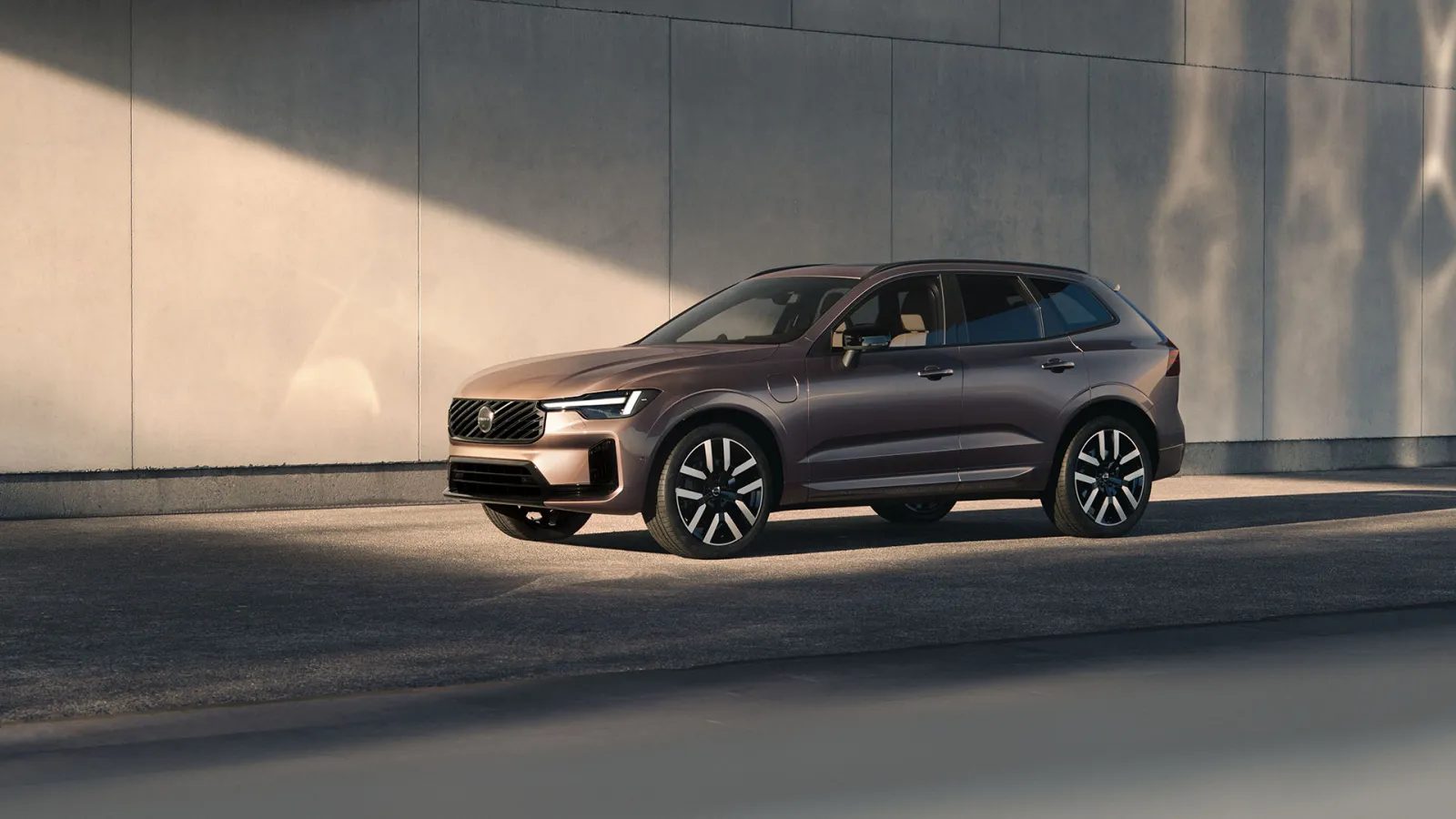

Volvo Cars launched long-range plug-in hybrid versions of its two best-selling SUVs on Tuesday, at a point when fully electric cars have pulled clearly ahead of plug-in hybrids in its own sales mix.
The new XC60 and XC90 carry claimed electric ranges of up to 200km (124 miles) and 160km (99 miles) on the WLTP cycle, more than two and a half times the current plug-in hybrid versions, which Volvo says comes from a larger floor-integrated battery and a more powerful motor.
Both models remain available as mild hybrids. Order books opened on Tuesday in selected markets and production begins later this autumn.
The company described them as “a key part of Volvo Cars’ bridge to a fully electric future.”
The Numbers Behind the Launch
Volvo sold 148,239 cars worldwide in the three months to August, down 7.4% from 160,160 a year earlier.
Fully electric sales rose 27% to 42,941, or 29.0% of the total. Plug-in hybrid sales fell 1% to 36,395, or 24.6%. Combustion and mild-hybrid models fell 23% to 68,903.
Electrified cars together reached 53.5% of sales, which Volvo says is the highest among legacy premium carmakers.
The two technologies were level at the start of the year. In the first quarter, fully electric cars accounted for 23.7% of sales and plug-in hybrids 23.6%, on total sales of 153,316, down 11%. Fully electric volumes rose 12% in that quarter.
By the summer the gap had opened to 4.4 percentage points, with the fully electric growth rate more than doubling from 12% to 27%.
Plug-in hybrid performance has been uneven rather than uniformly weak. It fell in the first quarter, grew in the second on strength in China, and was broadly flat in the latest window.
Volvo has reported a year-on-year decline in every rolling three-month period since adopting the reporting format in February, and the rate has steepened, from 5.5% in the period to May and 4.0% to July to 7.4% to August.
“Given the challenging market conditions in China and the US, we are prioritising protecting transaction prices over volume growth,” Chief Commercial Officer Erik Severinson said on September 2.
Long-Range PHEVs
Volvo described the cars as its first long-range plug-in hybrids “for the European and American markets”, a qualifier that matters.
The company already sells a long-range plug-in hybrid with 200km (124 miles) of electric range, the XC70, which it unveiled in September 2025 for China.
The range figures are preliminary and WLTP-based. Volvo has published no United States rating, and the American figure will be lower.
Volvo has also not published battery capacity, charging times, system output, acceleration figures or prices for either model.
A Week of Launches
Tuesday’s announcement came days after Volvo refreshed its 40 series, and the two are part of one programme.
Both carry the same redesigned front end and Thor’s Hammer Matrix LED headlights, the same 11.2-inch central screen replacing a smaller unit, the same Google Gemini integration, the same sensor and safety package including automatic emergency steering and a door-opening alert for cyclists, and the same 360-degree camera with 3D view.
Both opened order books with production starting this autumn.
The powertrain is the only element unique to Tuesday.
The 40 series announcement also confirmed that the EX40 will leave the United States, the third electric model Volvo has withdrawn from that market in a year after the EX30 in March and the EC40 after the 2025 model year. Only the petrol XC40 continues there.
So inside one week Volvo removed an electric car from the American market and added two long-range plug-in hybrids to it.
The Longer Bridge
The launch is the clearest product expression of a target Volvo has already abandoned.
The company said in 2021 it would sell only fully electric cars by 2030. In September 2024 it revised that to 90% to 100% “electrified” by then, a definition that counts plug-in hybrids.
Volvo’s own language on Tuesday was explicit. The new models “represent efficient investments in the company’s existing line-up, securing continued popularity for the coming years and extending the important bridge towards full electrification.”
CEO Håkan Samuelsson framed the cars alongside the all-electric EX60. “The XC60 is our best-selling model of all time, while the XC90 marked the beginning of our premium journey,” he said. “Now, as long-range plug-in hybrids, they build on those legacies and, together with the all-electric EX60, give us our strongest-ever electrified offering in the mid-size SUV segment. This means a path to full electrification for every customer.”
Volvo expects a significantly stronger second half and roughly break-even full-year results, resting largely on the EX60, which entered production in Gothenburg this spring.
For the full year 2025 the company sold about 710,000 vehicles, with electrified models at 46% of the mix and fully electric at 21%. Both shares have risen since.