
Lucid‘s Middle East arm said more than 5,000 of its vehicles had reached the roads of Saudi Arabia, then deleted the post — reviving questions about how the Saudi-backed EV maker is tracking against its largest customer’s commitment.
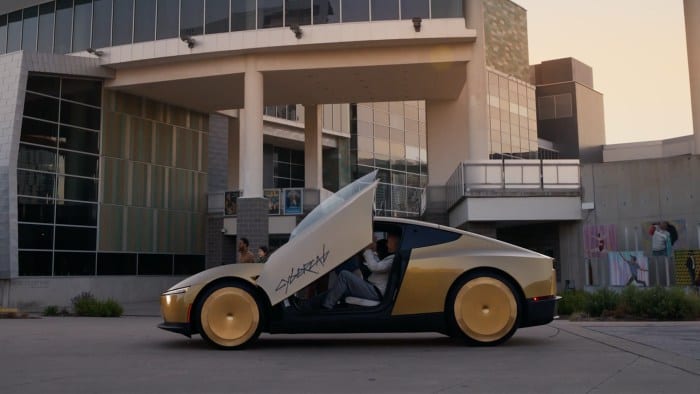
The Lucid Motors Middle East account marked the milestone on Monday, in an Arabic-language post that paired the claim with images of the Air sedan and Gravity SUV on a Gulf street.
“5,000 vehicles in the Kingdom and one journey towards the future of electric driving,” the company wrote on X.
The post no longer appeared on the account on Tuesday, indicating it had been deleted.
The wording still surfaced in search engine results checked by EV, and in a screenshot shared by the X user ‘john61640’, who used the figure to question Saudi demand and how far Lucid‘s deliveries lag the targets set years earlier.
The deleted post was a rare public data point on a Saudi order that the company otherwise rarely quantifies.
A Deal for Up to 100,000 Cars
In 2022, Saudi Arabia’s Public Investment Fund (PIF) announced an agreement for the government to buy 50,000 to 100,000 Lucid vehicles over a decade — 50,000 firm units plus an option for 50,000 more.
The purchase price was set at the lower of the Saudi or US retail price, plus logistics and import costs.
Deliveries were meant to begin at 1,000 to 2,000 cars a year and climb to between 4,000 and 7,000 a year from 2025.
On those terms, about 5,000 cumulative deliveries some four years on is modest.
The milestone equals 5.0% of the 100,000-vehicle ceiling, or one in ten of the firm 50,000-unit order.
Lucid has never disclosed how many of the committed cars it has delivered, and analysts at Cantor Fitzgerald have said they expect most of the order to be “back-loaded” toward later years.
Lucid has said the pace should quicken in 2027, once its cheaper midsize models arrive and the Saudi plant shifts to full production.
Revenue Breakdown
As Lucid does not break out deliveries by country, its revenue by geography is the clearest read on the Saudi business.
Saudi Arabia generated $161.8 million in 2025, down from $191.1 million in 2024, even as Lucid‘s total revenue rose.
The quarterly path swung widely — $7.5 million in the first quarter, $35.9 million in the second, $38.0 million in the third and $80.4 million in the fourth.
The neighbouring UAE contributed just $1.8 million for the whole year.
In the second quarter of 2025, high transaction prices implied Lucid delivered fewer than 100 cars to Saudi Arabia despite $35.9 million in revenue.
That pattern carried into 2026.
Lucid reported $38.4 million in related-party revenue in the first quarter, up from $5.1 million a year earlier, according to its SEC filing. The sum was about a seventh of Lucid‘s total revenue of $282.5 million for the quarter.
Owner and Customer
The Public Investment Fund owns about 56.9% of Lucid after an April share purchase, and has put more than $9 billion into the company since 2018.
The same government is Lucid‘s largest customer in the region. A share of what Lucid books as Saudi revenue is, in effect, the company selling cars to its majority owner.
Lucid lost $1.03 billion in the first quarter of 2026 and is burning through cash, sustained by repeated injections from the fund.
Last year, Saudi Arabia began taking Saudi-assembled Lucid vehicles for its embassies in some 19 countries, part of a drive to promote its “Made in Saudi” label, which Lucid was the first brand to join.
The Bigger Bet Is the Factory
The delivery milestone matters less than what the Kingdom is meant to become for Lucid.
Lucid assembles the Air and Gravity from imported kits at its plant in King Abdullah Economic City, its only factory outside the United States, opened in 2023.
The plant opened to assemble vehicles pre-produced in Arizona and is being transformed into a full production facility.
The company is rebuilding that site for full production of its midsize Cosmos crossover, due to start there late in 2026 and to scale toward 150,000 vehicles a year by 2029.
Saudi Arabia would then serve as an export hub for the Gulf, Europe and Asia — a far bigger prize than domestic sales.
Lucid is due to give a fuller account on August 4, when chief executive Silvio Napoli reports second-quarter results.