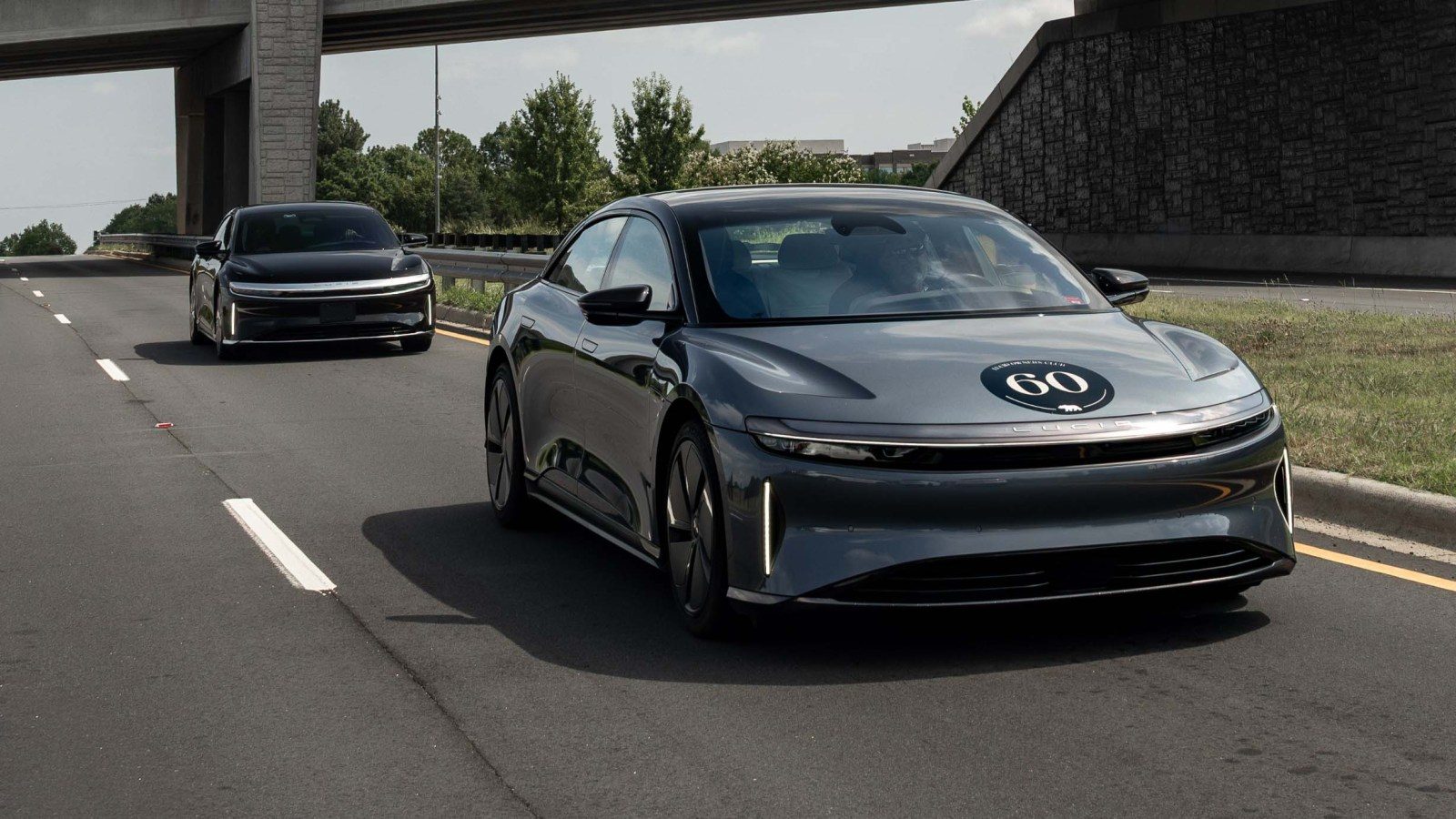

Lucid is recalling 27,185 Air sedans in the United States as an exterior lighting circuit can overheat, creating a risk of fire, the National Highway Traffic Safety Administration (NHTSA) said on Friday.
The agency has told owners to park the vehicles outside and away from structures until the remedy has been applied. The same fault can also cut exterior lighting, which the agency says raises the risk of a crash.
Lucid has released an over-the-air software update and has determined that 20,719 of the affected vehicles have already received it, according to NHTSA. The figures leave 6,466 outstanding, or 23.8% of the population.
It is the largest recall in the company’s history and can be fixed without requiring owners to take their EV to a Lucid service centre.
The Scale
Lucid has delivered 43,623 vehicles worldwide across all models since customer deliveries began in the fourth quarter of 2021 — 125 that quarter, then 4,369 in 2022, 6,001 in 2023, 10,241 in 2024, 15,841 in 2025 and 7,046 in the first half of this year.
The recall population is equal to 62.3% of that total, and covers one model in one market.
Set against the company’s own recall history, it is 2.5 times the previous largest Air campaign — the 10,816 vehicles covered in January over a rearview camera fault — and more than thirteen times the 2,039 cars in May’s inverter recall.
What Changes
Every previous Air recall has been narrower in one of two ways: confined to a model year range, or confined to a single drivetrain.
The driveline campaigns of the past year all targeted the Pure rear-wheel-drive variant specifically, because a single-motor car that loses its drive unit loses propulsion entirely, while a dual-motor Air retains a second.
The rearview camera campaigns were limited to vehicles carrying the AD02 package on particular software builds.
This one reaches the 2022 through 2026 model years, which is every Air Lucid has put into service in the market.
It is also the first Air campaign to carry a fire risk and a park-outside instruction.
NHTSA reserves that advice for defects where the agency judges a vehicle could ignite while unattended.
The remedy is software, which places it in the larger of the two clusters in Lucid‘s recall record.
About two-thirds of the Air’s campaigns have been resolved over the air rather than at a service centre — a pattern that has kept the cost of the company’s defect record low relative to the number of actions.
The Regulatory Record Behind It
This is the eighteenth vehicle recall campaign for the Air since deliveries began, on a count that treats expansions as separate actions.
Two clusters account for most of them.
Software faults fixed remotely: three rearview camera campaigns, a high-voltage interlock that could open contactors while driving, an adaptive cruise torque monitor, rear seat heaters, and a coolant heater that could cost windscreen defrost.
And Pure rear-wheel-drive hardware: a rear drive unit harness cut too short in 2024, half-shaft bolts recalled in October 2025 and expanded in March, and the Gen 4 inverter in May.
The Timing
Lucid reported second-quarter revenue of $405 million and a net loss that nearly doubled to about $1 billion as chief executive Silvio Napoli announced an operational reset built on $1.4 billion of identified cash-flow improvements.
In June the company cut approximately 18% of its US workforce and eliminated the second shift at its Casa Grande plant in Arizona, where the Air is built, affecting 705 positions in that state alone, for annualised savings of about $158 million.
Napoli has framed the turnaround around three priorities he calls cash and cost, customer and quality, and culture and team, and told analysts this month that the company had “not executed consistently,” citing missed commitments, products launched before they were ready, insufficient investment in service and slow responses to quality issues.
Lucid is majority-backed by Saudi Arabia’s Public Investment Fund.