

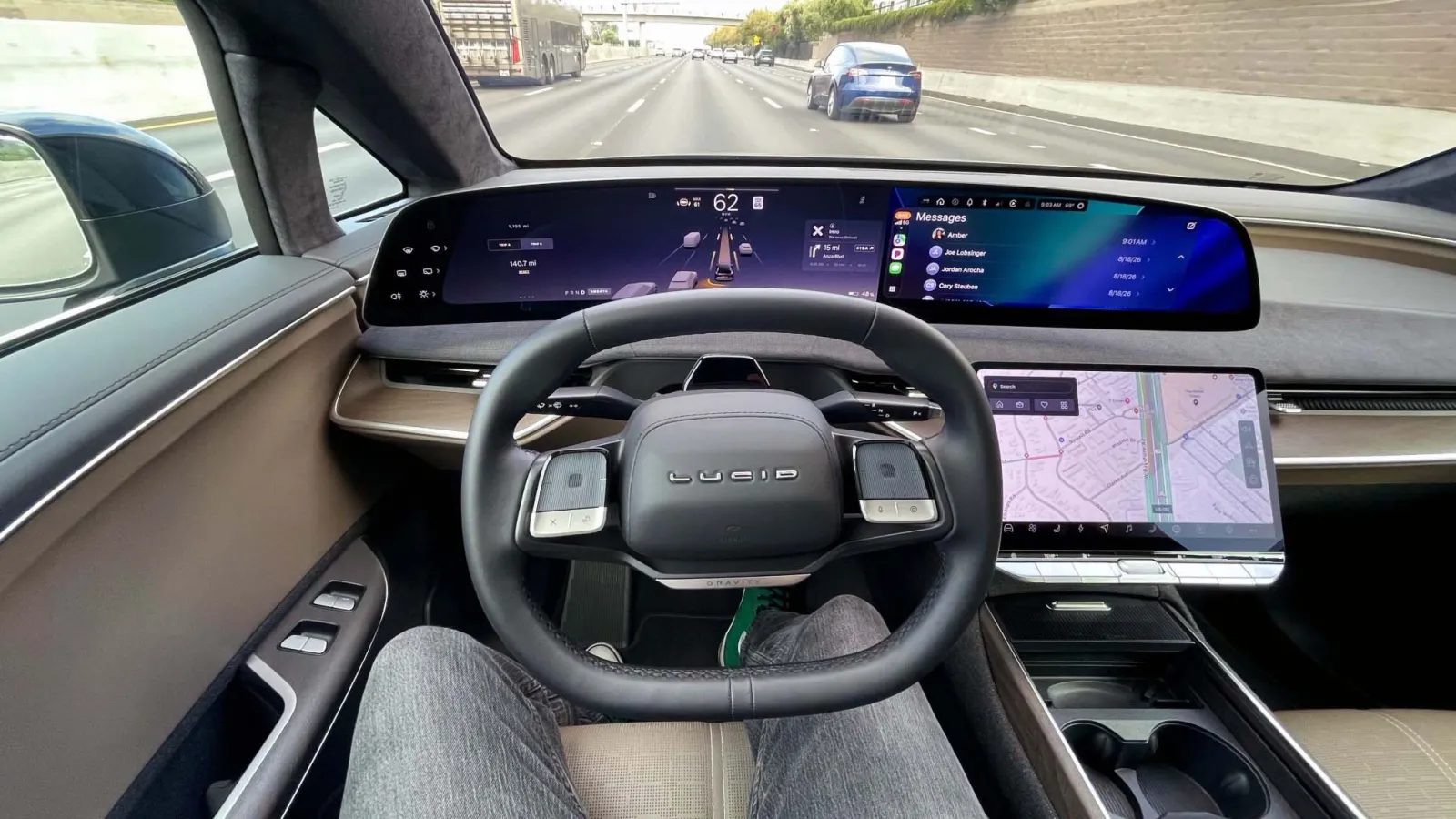

Munro Live, the media division of Munro & Associates, published its impressions of a Lucid Gravity on Monday, saying the SUV’s hands-free driving system “worked well” for the most part while noting that it appeared hesitant to change lanes in heavy traffic and disengaged on its own at times.
The firm said in a LinkedIn post that Lucid lent the vehicle while it was in California last week, and that its Creative Producer Eric Platzke and President Jordan Arocha spent time driving it.
It did not say how many miles they covered during testing.
In its review, Munro Live’s reviewers cited Gravity’s “level of practicality” of the three-row SUV.
“The Gravity itself also has some serious minivan vibes, and we mean that in a good way,” the company wrote. “With three rows, seven seats, and a ton of usable interior space, there’s a level of practicality here that you don’t always associate with a performance focused EV.”
Commenting on the hands-free feature, Munro Live wrote, “For the most part, it worked well, though we did experience a few instances where the system made mistakes.”
It described two behaviours after testing the 2027 model year Gravity. “There were a few moments where the system disengaged and quickly reengaged on its own, and it seemed hesitant to make lane changes in heavier Bay Area traffic.”
Munro did not identify the software version the vehicle was running.
The most recent Gravity release, version 3.6.4, went out on August 14, according to LucidTracker, an independent site that monitors over-the-air rollouts across owner-enrolled cars.
The preceding release, 3.6.3, completed its rollout after going out on July 31.
Munro Live’s post added that, “Overall, though, the system performed well during our time with the vehicle” while naming Tesla’s Full Self Driving software as the benchmark.
“Tesla FSD remains the benchmark in our experience, but it’s encouraging to see more automakers getting serious about hands free and increasingly automated driving,” the firm wrote, adding that more competition “should only push these systems to improve faster.”
The Feature
Lucid rolled out Hands-Free Drive Assist and Hands-Free Lane Change Assist to the Gravity in the UX 3.6 update on June 8, for vehicles equipped with DreamDrive 2 Pro.
When the driver signals, the system evaluates surrounding traffic and steers into the adjacent lane when conditions permit.
The Air sedan received the same features in July 2025, when Lucid said Gravity owners would get them “later this year.” The Gravity received them about ten months after the Air.
Lucid acknowledged the delay in January.
Then-Interim chief executive Marc Winterhoff told Bank of America’s Global Automotive Summit on March 17 that the feature was “a few weeks” away.
Days later the 2027 Gravity configurator listed it for the third quarter, a discrepancy Lucid corrected to the second quarter after EV raised it.
DreamDrive 2 Pro is a $6,750 option available from the Touring trim upward, and includes LiDAR within a 32-sensor array.
LucidTracker logs version 3.6.0 as released on June 3, five days before Lucid announced the hands-free features. The site’s dates for two earlier releases indicate the 3.4.1 version on January 28 and the 3.4.4 on March 3.
A Long-Running Relationship
Munro Live, the media division of Munro & Associates, has over half a million subscribers on YouTube.
It includes teardowns of the Air’s battery pack and rear motor, a review of the Sapphire, and a 54-minute powertrain breakdown with Lucid’s former Senior VP of Engineering and Digital, Emad Dlala, and its former chief engineer, Eric Bach.
A separate video on the Gravity-based robotaxi programme with Nuro and Uber was published seven months ago.
The connection between the companies runs in both directions.
Cory Steuben spent nearly two decades at Munro & Associates, rose to President and co-created the Munro Live channel.
He joined Lucid in September 2023 as Assistant Chief Engineer for the midsize platform and now serves as Director of Cost Engineering across the Air, Gravity and midsize programmes.
Steuben appeared on Munro Live in April as a Lucid executive, setting out the cost architecture of the Cosmos midsize SUV.
He has separately explained Lucid’s decision to skip full underbody gigacasting on that platform, a technique Munro’s own Tesla teardowns helped popularise.


