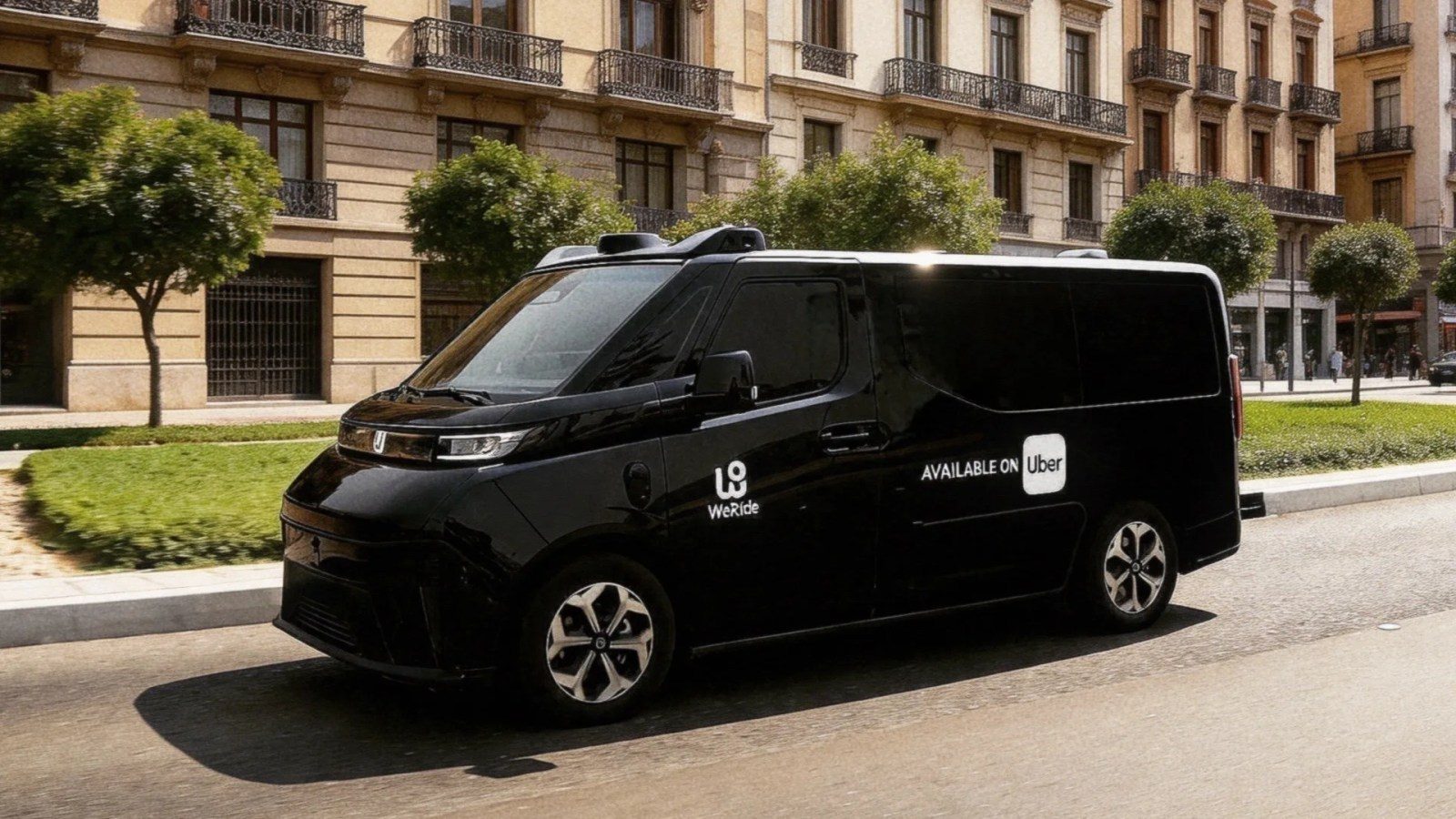

WeRide and Uber announced on Tuesday the launch of Spain’s first commercial robotaxi pilot in the Region of Madrid — a move that also represents their first joint European market entry.
Moove Cars Group’s AVOMO will handle fleet operations for the pilot.
The company already manages autonomous vehicle fleets for Uber in the United States and has a presence in four European countries, including Spain.
Rides will be available through the Uber app, with public operations expected to begin later this year. Madrid’s regional government, the Comunidad de Madrid, is collaborating on the launch.
Vehicle Operators
The fleet will initially include trained vehicle operators inside the cars.
WeRide, AVOMO, and Uber stated they are committed to adding hundreds of robotaxis as key performance milestones are met, including the expansion of fully driverless commercial service across core urban areas of the city.
The vehicles to be deployed are WeRide‘s Robotaxi GXR, the company’s latest-generation autonomous vehicle.
WeRide‘s GXR features an L4-level redundant drive-by-wire chassis architecture and a hidden B-pillar design.
The model is already operating in fully driverless commercial service in Beijing and across WeRide‘s Middle East fleet.
Fourth City Under 15-City Agreement
The rollout follows WeRide‘s asset-light operating strategy, under which local partners contribute fleet investment and platform support while WeRide provides the autonomous driving technology.
In Madrid, AVOMO will handle fleet operations — the same role it plays for Uber‘s autonomous vehicle programs in Austin and Atlanta, where it currently manages around 400 vehicles with a team of more than 200 specialists.
Madrid is the fourth city activated under WeRide and Uber‘s broader agreement to deploy robotaxis in 15 cities by 2030 and the fifth European market entry for the Chinese company.
The company has previously received autonomous driving permits in France, Switzerland, and Belgium, and has deployed vehicles across more than 40 cities in 12 countries.
Under the Uber partnership, WeRide plans to put tens of thousands of robotaxis on public roads globally.
The first three cities — Abu Dhabi, Dubai, and Riyadh — are all in the Middle East.
In February, WeRide and Uber announced a major expansion in the region, committing to deploy at least 1,200 robotaxis across the three Gulf cities by as soon as 2027.
WeRide had more than 200 robotaxis operating in the region at the time of that announcement.
The Abu Dhabi and Dubai services are already running fully driverless commercial operations, with Riyadh expected to follow.
In Abu Dhabi, the WeRide–Uber robotaxi service is averaging dozens of daily trips per vehicle and is on track to achieve breakeven unit economics, according to the February disclosure.
Europe’s Robotaxi Race
The Madrid announcement comes as the European robotaxi landscape is rapidly taking shape, with multiple companies racing to establish commercial operations across the continent.
Uber, Pony.ai, and Rimac-backed Verne announced a partnership in March to launch what they described as Europe’s first commercial robotaxi service in Zagreb, Croatia, with on-road testing already underway.
The program uses Pony.ai’s Gen-7 autonomous driving system deployed on the Chinese-made Arcfox Alpha T5 electric SUV.
Separately, Nvidia and Uber announced a partnership in March to expand autonomous robotaxi and delivery fleets across Europe using Nvidia’s Drive platform.
Stellantis has committed to delivering at least 5,000 Drive AV-equipped vehicles for Uber‘s operations under the deal.
Stellantis and Pony.ai have a separate agreement to build robotaxis for European deployment using Peugeot e-Traveller vans, with testing already underway in Luxembourg.
Uber is also preparing to test Level 4 robotaxis with Chinese startup Momenta in Munich later this year, while British AI driving company Wayve is preparing public road trials in London.
Nuro, the autonomous driving company behind Uber’s robotaxi program with Lucid Motors, recently announced it is opening its first European office in Germany’s Munich area.
Alphabet’s Waymo, which has surpassed 500,000 weekly rides across more than 10 US cities, has identified London and Tokyo as targets for 2026.
Tesla, which launched a Robotaxi service in the US nearly a year ago, is still awaiting regulatory approval of its Level 2 Full Self-Driving (Supervised) software in the Old Continent.
The company launched FSD (Supervised) in the Netherlands in April. The software has since been approved in Lithuania and Estonia.
Uber’s Autonomous Portfolio
The Madrid launch adds another node to Uber‘s rapidly expanding autonomous vehicle network.
The ride-hailing company has now committed more than $10 billion to purchasing thousands of autonomous vehicles and taking equity stakes in their developers.
Active commercial robotaxi operations on Uber‘s platform currently include Waymo in five US cities, WeRide in Abu Dhabi and Dubai, and Avride in Dallas.
Zoox is preparing to launch on the platform in Las Vegas this summer.
In the US, Uber has also struck separate robotaxi deals with both Lucid Motors and Rivian.
The Lucid–Nuro program has expanded its purchase commitment to at least 35,000 vehicles; while the Rivian deal involves plans to deploy up to 50,000 R2 robotaxis across 25 cities, backed by an Uber investment of up to $1.25 billion.
CEO Dara Khosrowshahi has said Uber aims to offer robotaxi services in more than ten countries by late 2026.