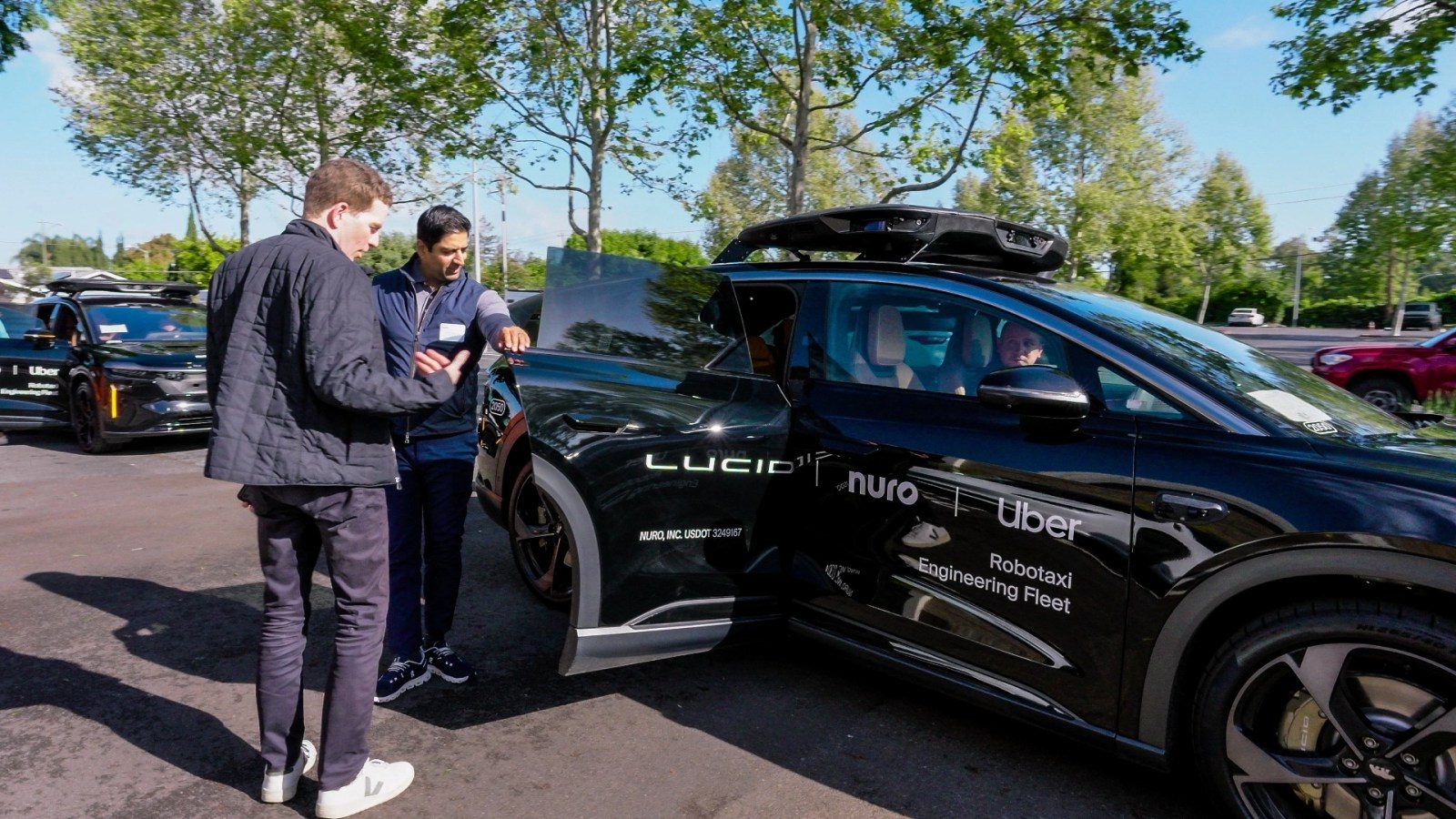

Autonomous vehicle startup Nuro has received approval to test Lucid Gravity robotaxis without a safety driver on California public roads, marking a key regulatory step for the premium robotaxi service it is developing with Uber.
The information was first revealed by Lucid‘s outgoing interim CEO Marc Winterhoff, during the company’s first-quarter earnings call and later confirmed by the California Department of Motor Vehicles (DMV) to TechCrunch.
According to the public agency, Nuro’s existing driverless AV permit was modified to include the Lucid Gravity.
Nuro has held a driverless permit in California for six years, but it previously covered only the low-speed autonomous delivery vehicles the startup operated before pivoting to licensing its technology to companies like Uber.
A Nuro spokesperson also told the outlet the company expects to begin driverless testing later this year — aligning with Lucid‘s estimates — but did not provide a specific timeline.
The updated permit does not, on its own, clear the path to a commercial launch.
Nuro must still secure a driverless ride-hailing permit from the California Public Utilities Commission and a separate deployment permit from the DMV before Uber can offer the service to paying customers.
For now, Nuro and Uber continue to test Lucid Gravity robotaxis in autonomous mode with a safety driver on board.
Last month, the testing was expanded to allow Uber employees to request rides through the Uber app in the San Francisco Bay Area — a step the companies described as a way to evaluate the full rider experience ahead of commercial launch.
Lucid Updates
Lucid‘s management revealed on Tuesday’s earnings call that the company has delivered 75 engineering vehicles to Nuro and Uber, with testing and mileage accumulation ongoing across several US cities.
Nuro first said in March that it had nearly 100 Lucid vehicles in its fleet, a number they have reiterated in mid-April.
It’s unclear whether Lucid’s figures apply only to the first quarter or to a longer period.
However, during Lucid’s debut Investor Day in March, then-interim CEO Marc Winterhoff said all engineering test vehicles for the program had been delivered.
The figures may also reflect differences in how the two companies count vehicles — Nuro’s figure likely includes vehicles at various stages of integration, while Lucid‘s number may refer only to units formally handed over.
Lucid said it remains on track for commercial robotaxi operations to begin in late 2026, though it acknowledged the scope of the initial launch — including whether it will be fully driverless — will depend on the pace of regulatory approvals.
When questioned by an analyst on whether the volume of Uber deliveries depended on certification, Winterhoff clarified that “it’s basically actually Nuro getting the certification.”
Engineering Fleet
Lucid delivered its first engineering prototype to Nuro in September, and by Nuro’s account the startup completed integration of its Level 4 systems on the first unit in under two months.
On-road testing began in the Bay Area in December, and vehicles from the fleet have since been spotted in Houston, though neither company has confirmed the Texas city as a test or commercial launch market.
Nuro operates a closed-course test facility in Las Vegas that replicates complex traffic scenarios, and the first Lucid robotaxi prototype was already running autonomously at that site by mid-July last year — before the program transitioned to public-road testing.
Expanded Deal
The driverless permit milestone arrives as Uber has significantly deepened its commitment to the Lucid-Nuro program.
In April, the ride-hailing company expanded its vehicle purchase commitment to at least 35,000 units — up 75% from the original 20,000 Gravity SUVs agreed in July 2025 — and invested an additional $200 million in Lucid, raising its total stake to $500 million and 11.5% of the company.
The expanded fleet will include both the Gravity and the upcoming midsize platform, after Uber COO Andrew Macdonald said at Lucid‘s Investor Day that the two companies were finalizing an agreement to deploy the midsize vehicle at volumes comparable to the Gravity program.
Uber also invested in Nuro as part of a $203 million funding round raised in August 2025 that included Nvidia, though the size of the ride-hailing company’s stake in the autonomy startup has never been publicly disclosed.
The commercial service is expected to launch in the Bay Area later this year, with fleet management handled by Hertz subsidiary Oro Mobility under a recently announced partnership.
Uber CEO Dara Khosrowshahi has framed the company’s aggressive dealmaking — which now spans commitments totaling more than $10 billion across multiple AV partners — as an effort to guarantee robotaxi supply ahead of what the company sees as an inflection point for autonomous ride-hailing.