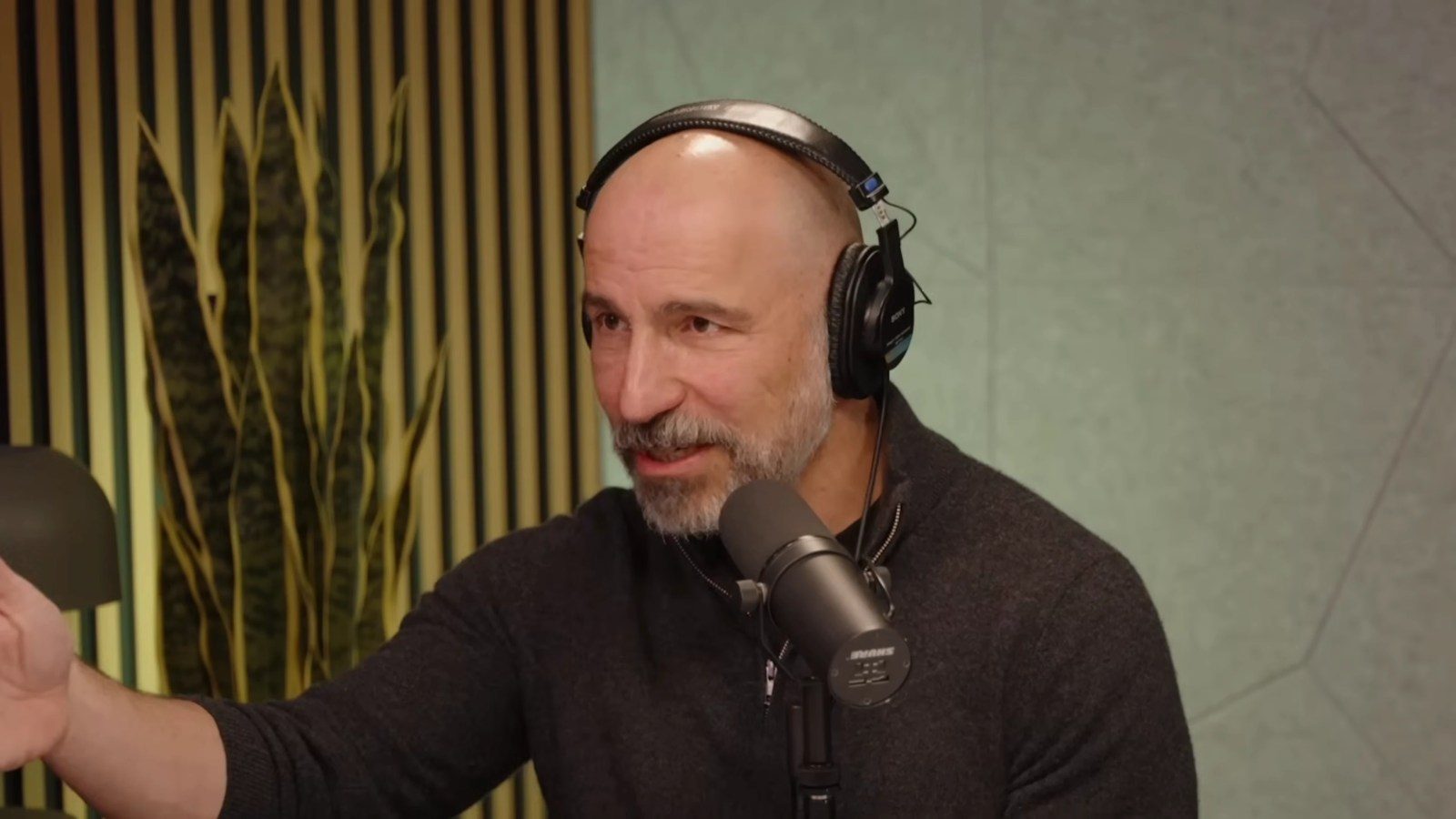

Uber‘s Chief Executive Officer Dara Khosrowshahi has offered his most direct public endorsement of Rivian‘s autonomous driving capabilities to date.
The CEO of the ride-hailing giant said on Tuesday that his company invested in the EV maker’s “equity” — not just its vehicles — because of the strength of founder RJ Scaringe’s engineering team.
“Obviously, they’ve got to deliver and based on everything that we’ve seen from RJ [Scaringe] and the team, putting together a first-class AI team, we’re confident that they can deliver on those R2s,” Khosrowshahi said in a new episode of The Verge‘s Decoder podcast.
The comments come just a day after Rivian disclosed in an SEC filing that it achieved Milestone #1 under its Subscription Agreement with Uber affiliate SMB Holding Corporation — triggering the first $300 million equity investment.
Rivian issued 19,553,911 Class A shares to SMB at $15.3422 per share on May 4, 2026.
Equity and Vehicles
Khosrowshahi clarified the structure of the Rivian deal when pressed on whether buying cars constitutes an investment.
“So we actually invested in Rivian equity and we’ve invested a number of our partners,” he stated. “Usually we will invest in our partners — in a Lucid, in a WeRide, in an AvRide, for example. So it is an investment, and it’s a vehicle commitment as well.”
The CEO noted that these investments are based on deliverables.
Uber agreed in March to invest up to $1.25 billion in Rivian through 2031.
The initial $300 million tranche — now closed — was contingent on the EV maker hitting the first of several undisclosed autonomous milestones.
Up to $950 million in additional tranches remain outstanding, tied to four further milestones.
The two companies plan to deploy up to 50,000 fully autonomous R2 robotaxis across 25 cities in the United States, Canada, and Europe, with the first phase targeting 10,000 vehicles in San Francisco and Miami in 2028.
An option for 40,000 additional units activates in 2030.
The R2 robotaxis will run on Rivian‘s in-house developed Level 4 autonomy system, built on a custom 5nm chip and a sensor suite that includes LiDAR, 11 cameras, and five radars — a fundamentally different bet on autonomous technology from the approach Uber is taking with its other major EV partner.
Undisclosed Milestones
The interviewer pushed Khosrowshahi on the vagueness of the publicly disclosed deal terms, reading directly from the press release — which states Uber‘s investment is “subject to the achievement of certain autonomous milestones by specific dates” — and asking what those benchmarks actually are.
“I could tell you but then I’d have to kill you,” the CEO joked, before offering examples of the kinds of milestones that are typical in Uber‘s autonomous partnerships — without confirming specifics for Rivian.
He described a progression that might include releasing in a market with a vehicle operator on board, then removing the safety operator after completing a safety case developed jointly with the autonomy provider, and finally delivering a certain number of vehicles that are capable of no-driver operation at an acceptable cost.
“Those are examples of deliverables that have to do with either capability or economics because ultimately this is about going to market with a product that’s proven to be a very, very popular product,” Khosrowshahi said.
The fact that Rivian achieved Milestone #1 in April — roughly six weeks after the Subscription Agreement was signed on March 18 — suggests the first benchmark was tied to an early-stage technical or regulatory target rather than full autonomous deployment.
The filing did not describe the nature of the milestone.
Lucid Expansion
The Rivian deal is one half of a broader strategy.
Khosrowshahi confirmed that Uber‘s relationship with Lucid Motors has grown substantially since the original July 2025 partnership.
Uber expanded its purchase commitment with Lucid to at least 35,000 vehicles in April — up 75% from the initial 20,000 Gravity SUVs — and invested an additional $200 million, bringing its total equity stake to $500 million and making it an 11.5% shareholder.
Unlike the Rivian programme, the Lucid robotaxis use Nuro’s Level 4 autonomy stack rather than an in-house system.
Autonomous on-road testing has been underway in the Bay Area since December, with the engineering fleet now comprising nearly 100 Gravity vehicles.
The commercial service remains on track to launch later this year.
The expanded fleet will include both the Gravity SUV and Lucid’s upcoming midsize platform, which Uber‘s President and COO Andrew Macdonald has described as essential for bringing autonomous ride-hail to the mass market at lower unit economics.
‘Not One Model to Rule Them All’
Khosrowshahi framed the multi-partner approach as a deliberate platform strategy rather than a hedged bet on which company will win the autonomy race.
“We believe that just like there isn’t going to be one foundation model to rule them all, there isn’t going to be one physical world foundation model to rule them all,” the CEO said.
He pointed to Waymo as an inspiration for the industry but noted that multiple companies — including WeRide, Pony.ai, Baidu, Nuro, Waabi, AvRide, and Wayve — are converging on the finish line.
Uber is already operating autonomous rides with Waymo in Austin and Atlanta and with WeRide in the Middle East.
The company has also partnered with Nvidia to support a broad global Level 4 ecosystem spanning passenger mobility, trucking, and delivery.
Last week, Uber added another layer to the ecosystem when it announced a fleet management partnership with Hertz through a newly created affiliate named Oro Mobility.
Khosrowshahi has told investors that the broader autonomous deployment will be partly financed by fleet management companies, institutional investors, and private credit.
“The whole system is going to financialize, just as you see data centres financialize as well,” the CEO said separately.
In total, Uber has now committed more than $10 billion to buying thousands of autonomous vehicles and taking equity stakes in their developers — a figure that includes more than $2.5 billion in equity investments and over $7.5 billion earmarked for fleet purchases.
“Just like we want every safe human driver on the platform, we want every safe robot driver on the platform, whether that’s a Waymo driver, or a Nuro driver, or an AvRide, or a WeRide,” Khosrowshahi concluded on Tuesday. “It’s a bet that we’re making, which is there won’t be one physical AI model to rule them all.”