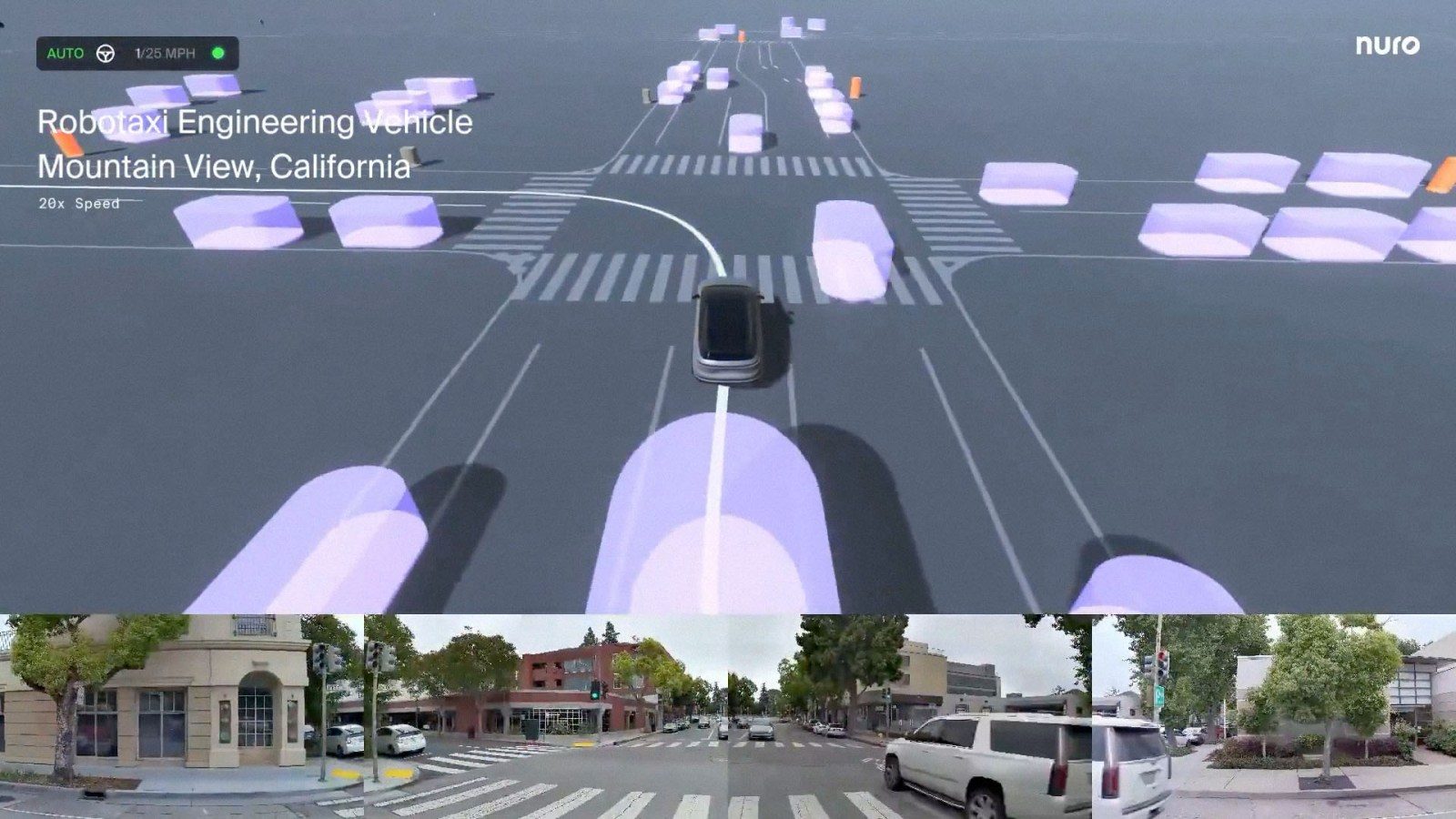

Nuro released footage on Wednesday showing one of its robotaxi engineering vehicles driving autonomously through busy intersections in downtown Mountain View, California, offering a fresh look at the urban capability of the system it is developing with Lucid and Uber.
The clip, posted to the autonomous vehicle startup’s account on X, pairs live multi-camera street footage with a top-down view of how the vehicle’s AI perceives its surroundings.
The simulation layer maps a planned path through intersections and turns, flags surrounding vehicles and pedestrians, and shows the car operating in autonomous mode at speeds between roughly 7 and 28 miles per hour.
“Training and testing, all day, every day,” Nuro wrote in the post, adding that it was “getting ready to bring autonomy to everyone.”
Below is the video shared by the AV startup.
Andrew Macdonald, Uber‘s President and Chief Operating Officer, reacted to the clip by commenting: “Steady progress! 💪 “
The Lucid program is only one of Uber‘s robotaxi bets.
The ride-hailing company hosts Waymo vehicles on its app and has struck separate deals with developers including Pony.ai, with its Rivian agreement alone worth up to 1.25 billion dollars for as many as 50,000 R2 robotaxis.
Uber‘s total robotaxi commitments now exceed 10 billion dollars across its various partners.
The Lucid vehicle runs on Nuro‘s autonomy software, and is destined for exclusive deployment on Uber‘s ride-hailing platform.
Nuro’s Own Backyard
The footage shows the vehicle threading through dense urban traffic, crosswalks and pedestrians, rather than the controlled proving grounds where the program began.
Nuro started the partnership’s closed-course work at its Las Vegas test facility, opened in 2021, before moving to public roads.
Autonomous on-road testing has been underway in the San Francisco Bay Area since December, led by Nuro using engineering prototypes supervised by human safety operators.
Wednesday’s video comes two weeks after Nuro announced its first European hub in Germany, a sign the partnership is already looking beyond its initial US launch market.
The Lucid-Nuro-Uber Program
The video is the latest marketing beat in a partnership first announced on July 17, 2025, when Uber, Lucid and Nuro unveiled a premium global robotaxi program to run exclusively on Uber’s platform.
Under the original deal, Uber committed to deploy 20,000 or more Lucid vehicles equipped with Nuro’s Level 4 autonomy over six years, and to invest 300 million dollars in Lucid alongside a multi-hundred-million-dollar investment in Nuro.
The arrangement assigns each company a distinct role. Lucid supplies the vehicle and integrates the autonomy hardware on its production line at the Casa Grande, Arizona factory.
Nuro supplies its Level 4 “Nuro Driver” system, which Uber has licensed, and leads all safety validation across simulation, closed-course and supervised on-road testing.
Uber owns and operates the fleet through itself or third-party partners, including Hertz subsidiary Oro Mobility, and designed the in-cabin rider experience.
Built on the Gravity
The robotaxi is based on the Lucid Gravity, which the company says required minimal modification to carry Nuro‘s sensor array, mounting on the existing roof rack points.
The system combines high-resolution cameras, solid-state LiDAR and radar for 360-degree perception, processed by Nvidia’s DRIVE AGX Thor compute platform.
A low-profile, roof-mounted Halo module houses part of the sensor suite and carries an LED display that shows a rider’s initials for identification and conveys trip status.
Inside, the Uber-designed cabin seats up to six passengers and includes interactive screens for climate, seating and music, a support contact and a pull-over request, alongside real-time visualizations of what the vehicle perceives and intends to do.
Two California Permits Clear the Path
The demonstration follows a pair of California regulatory approvals secured this month.
A few days after Lucid revealed that Nuro had received a permit to test driverless Gravity robotaxis in California, the AV tech company announced that it secured a second key state permit for deployment.
Nuro announced earlier this month that it had secured a California Public Utilities Commission (CPUC) Drivered Pilot Permit, allowing it to conduct pilot testing of autonomous passenger service with a safety driver while carrying passengers on public roads.
Nuro‘s California Department of Motor Vehicles (DMV) Driverless Testing Permit, which the company has held for six years, has been extended to also cover Lucid Gravity vehicles.
That extension was first disclosed by Lucid‘s outgoing interim CEO Marc Winterhoff during the company’s first-quarter earnings call earlier this month, and later confirmed by the California DMV.
Nuro‘s existing driverless permit previously covered only the low-speed autonomous delivery vehicles the startup operated before pivoting to licensing its technology to ride-hailing partners.
What the Permits Allow
The two permits allow the company to test driverless vehicles and, separately, to carry passengers during pilot operations.
Neither permit authorizes paid rides, and the CPUC Drivered Pilot Permit does not allow for driverless passenger operations.
It remains unclear whether driverless operations would still include someone inside the vehicle, in the co-pilot seat, for instance.
Speaking with TechCrunch earlier this month, and despite the DMV permit, Nuro spokesperson David Salguero reaffirmed the company’s timeline for driverless testing, saying it remains on schedule to begin later this year.
For now, Nuro and Uber are testing the Lucid vehicles in autonomous mode with a human safety operator in the driver’s seat.
Uber Deepens Its Commitment
Uber has been steadily expanding its commitment to the Lucid-Nuro robotaxi program.
The ride-hailing company increased its purchase commitment to at least 35,000 vehicles last month, up from the original 20,000 Gravity SUVs agreed under the July 2025 deal, while investing an additional 200 million dollars in Lucid and raising its total stake to 500 million dollars.
Uber has also formed a dedicated Autonomous Vehicle Services unit to support the program’s infrastructure, including fast-charging hubs at autonomous depots and a real-time fleet management system.
Commercial service is expected to launch in the San Francisco Bay Area in late 2026, the same target Lucid‘s management and Nuro have maintained since the partnership was announced.
Fleet Size and Testing Expansion
Nuro operates a fleet of “nearly 100 robotaxi engineering vehicles,” which Lucid‘s management revealed earlier this month are 75 Gravity SUVs.
The AV tech company first disclosed the “nearly 100” figure in March. During Lucid‘s debut Investor Day the same month, then-interim CEO Winterhoff said all engineering test vehicles for the program had been delivered.
Autonomous on-road testing has been underway in the Bay Area since December, with vehicles also spotted in Houston, though neither Lucid nor Nuro has publicly confirmed the Texas city as a testing or deployment location.
Last month, that testing was expanded to allow Uber employees to request an autonomous ride in a Lucid robotaxi through the Uber app.
The employee ride program began in the San Francisco Bay Area and includes a safety driver on board. Nuro described the rides as a way to evaluate the full rider experience, from requesting a ride in the app to pickup, the in-vehicle experience and drop-off, ahead of commercial launch.
A Second Mover Betting on Scale
Nuro, long known for autonomous delivery rather than passenger transport, has cast the program as a deliberate pivot into robotaxis, positioning itself as a “second mover” able to learn from rivals such as Waymo.
For Lucid, the deal extends its EV platform into a high-volume autonomous program beyond consumer sales. For Uber, it secures a premium, purpose-built fleet as the company stitches together autonomous supply across multiple partners.
The Mountain View footage, with its “coming soon” framing, is calibrated to keep that ambition visible while the technical and regulatory work continues.