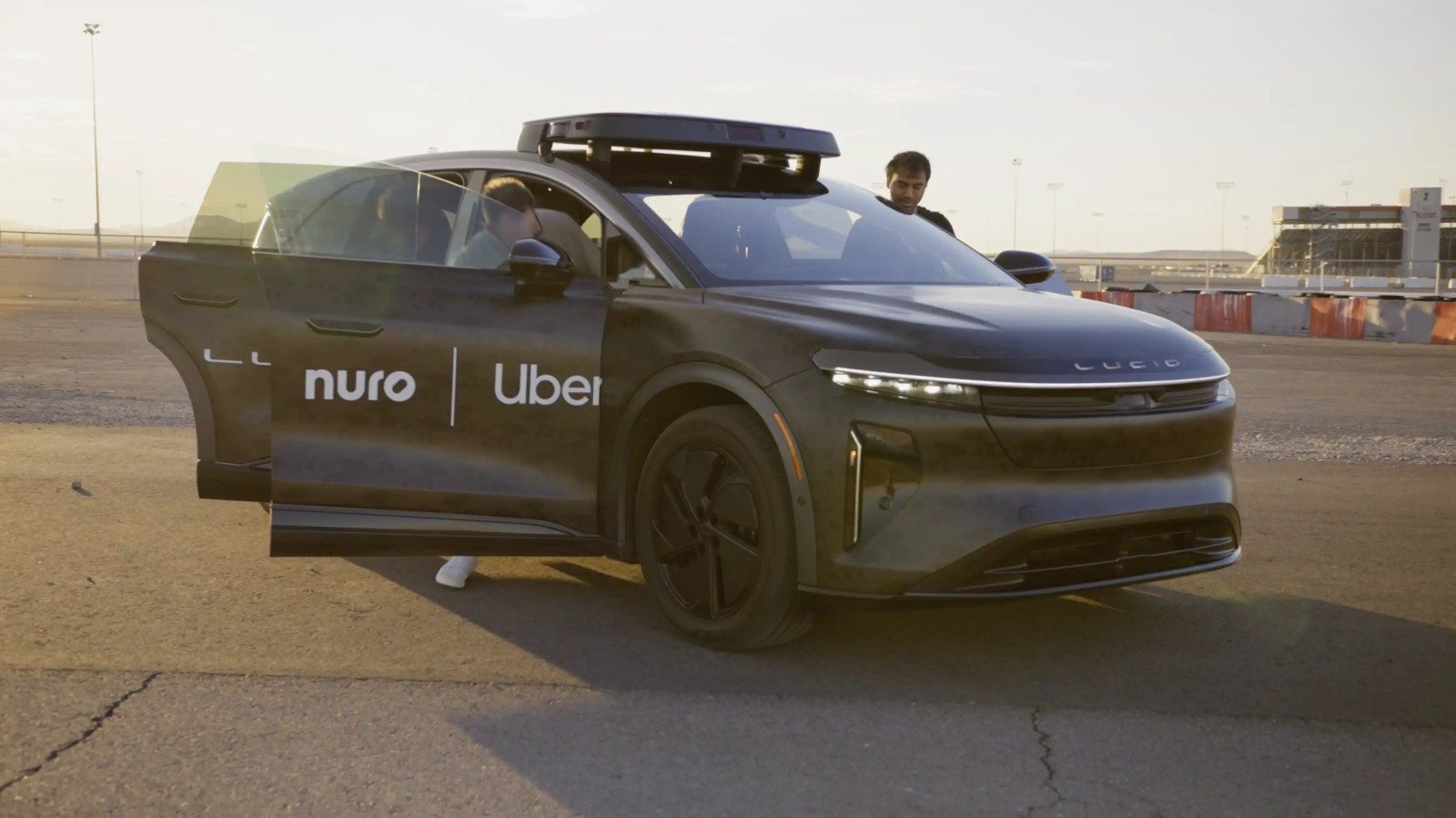

Lucid, Uber and Nuro named Houston as the second market for their robotaxi program on Wednesday, targeting a “mid-2027” launch that follows the service’s planned debut in the San Francisco Bay Area later this year.
The three companies will run the Houston service exclusively through Uber‘s network, with the city joining a roadmap that calls for dozens of additional markets over the coming years.
Houston becomes the second confirmed location for a program that pairs the Lucid Gravity SUV with Nuro’s Level 4 autonomous driving system and Uber‘s ride-hailing platform.
Nuro also brings local history to the market, having operated in the city since 2019 and run Level 4 autonomous testing on Houston public roads.
Testing Already in Place
Uber has secured a 50,000-square-foot depot and a dedicated charging pitstop in Houston, facilities the company described as the operational backbone of the program.
Those sites will handle charging, maintenance, repairs, cleaning and day-to-day fleet management for a service built on Lucid Gravity SUVs running Nuro’s autonomy.
Nuro is already conducting autonomous on-road testing with safety operators in Houston, mirroring the supervised testing under way in the Bay Area.
The robotaxi engineering fleet now spans nearly 100 vehicles across California and Texas, running 24 hours a day, seven days a week.
That fleet is set to grow further in the coming weeks as Lucid builds its first production-validation robotaxis at its Arizona factory.
Those production-validation cars will also support safety testing and homologation ahead of commercial service.
EV reported in April that a Nuro-equipped Gravity had been spotted testing in the Houston Heights, weeks before Wednesday’s official confirmation of the city as a launch market.
Execs Frame Houston Expansion
“Houston marks an important next step in our partnership with Lucid and Nuro,” said Sarfraz Maredia, Uber‘s Global Head of Autonomous Mobility and Delivery.
Andrew Chapin, Nuro’s chief operating officer, leaned on the company’s track record in the metro area, calling Houston “a city Nuro knows well.”
Chapin framed the sprawling region as a proving ground for whether the startup’s autonomy can generalise across different geographies and operating conditions.
Kay Stepper, Lucid‘s vice president of ADAS and autonomy, said the collaboration “continues to accelerate at a remarkable pace.”
Stepper added that the Houston launch next year would mark another major milestone in the program’s march toward commercial scale.
Escalating Commitments
The Houston news extends a partnership that has grown steadily since its unveiling.
Lucid, Uber and Nuro first announced the global robotaxi program in July 2025, combining Lucid‘s software-defined EV platform and factory integration, Nuro’s Level 4 universal autonomy stack, and Uber‘s ride-hailing network and fleet operations.
Uber opened the deal with a $300 million investment in Lucid and an initial commitment to buy at least 20,000 Gravity SUVs over six years.
That commitment grew sharply in April, when Uber raised its purchase pledge to at least 35,000 vehicles and added a further $200 million in equity, lifting its total stake to $500 million.
The expanded order also brought Lucid‘s upcoming Midsize platform into the fleet plan as a lower-cost workhorse alongside the Gravity.
The production-intent robotaxi, shown at CES in January, carries a roof-mounted sensor “halo” alongside high-resolution cameras, solid-state lidar and radar for 360-degree perception.
Regulatory Steps and a Widening Footprint
Autonomous on-road testing began in the Bay Area in December, and Lucid has since handed over its engineering test vehicles to Nuro and Uber.
In April, the partners opened test rides to Uber employees in the Bay Area through the Uber app, with a safety driver aboard.
Weeks later, Nuro secured a California driverless permit covering the Gravity, a key regulatory step toward removing the human operator.
Lucid has cautioned that the initial Bay Area service may not be fully driverless at the outset, depending on how quickly regulators sign off.
The program’s ambitions reach beyond the US, with Nuro opening its first European hub in Germany to broaden the conditions under which its system is validated.
Uber has also lined up fleet operators for the rollout, adding Hertz subsidiary Oro Mobility to manage the Lucid-Nuro vehicles.
Uber’s Bet
For Lucid, the robotaxi program represents a route to volume well beyond consumer sales, at a moment when its stock sits near record lows and its market value has fallen to roughly $1.8 billion.
Uber‘s stake, worth $500 million at cost, has lost more than half its value on paper as the shares have slid.
For Uber, Houston deepens an autonomous-vehicle strategy that now spans more than $10 billion in commitments and multiple partners.
The ride-hailing company is pursuing a parallel deal with Lucid rival Rivian, agreeing in March to invest up to $1.25 billion and deploy as many as 50,000 R2 SUVs as robotaxis across 25 cities.
Those two arrangements use the same financial template but make opposite bets on autonomy, with Lucid‘s program relying on Nuro’s third-party system while Rivian develops its stack in-house.