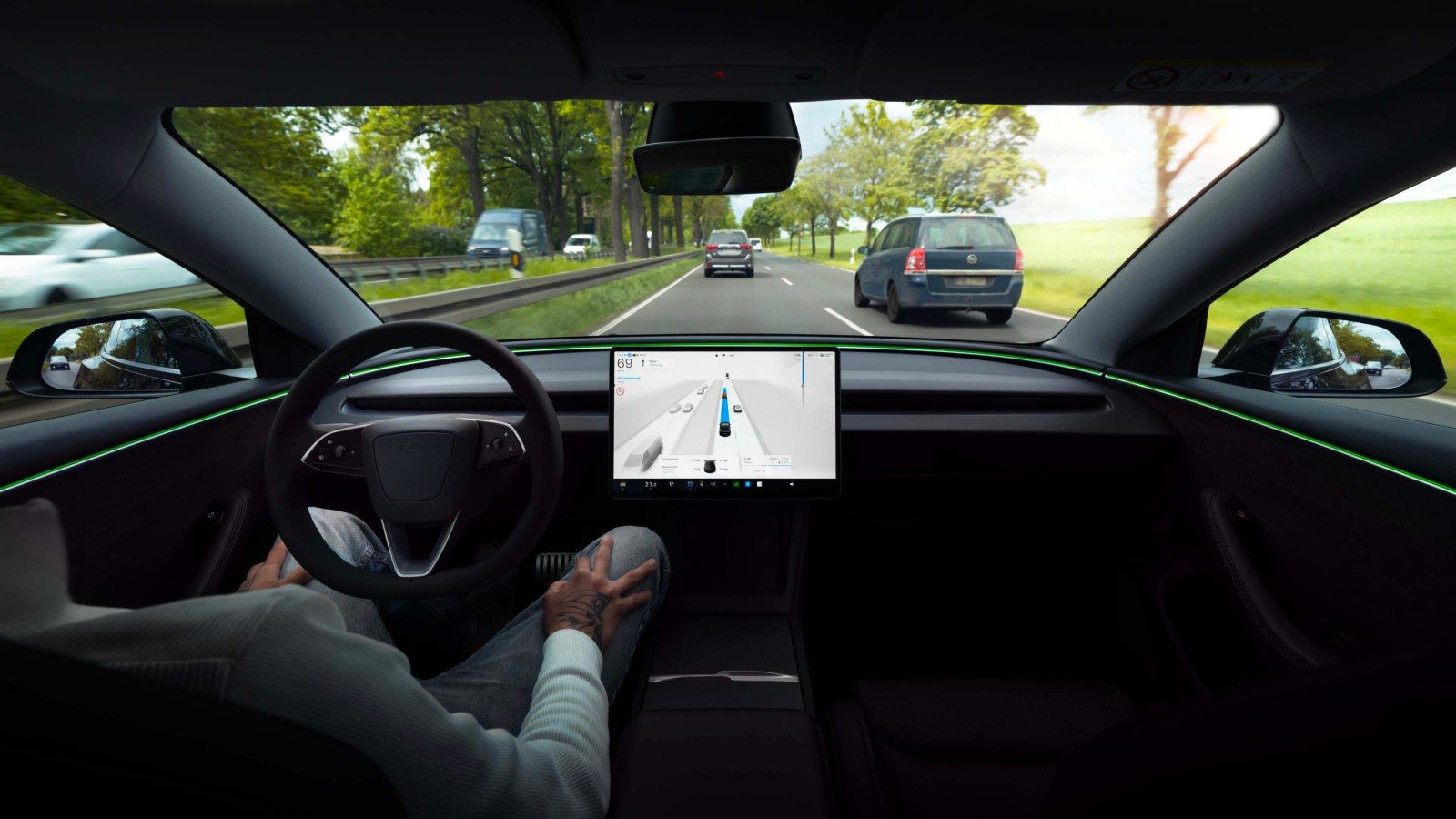

Estonia has officially approved Tesla‘s Full Self-Driving (Supervised) software on Friday, according to both its Transport Administration and the Elon Musk-led company.
Estonia’s Transport Administration announced on Friday that it has recognized the type approval issued by Dutch vehicle authority RDW for Tesla‘s system last month.
It becomes the third country in Europe to permit the driver-assistance software on public roads.
The Estonian agency described FSD as an SAE Level 2 driver-assistance system, noting that the vehicle is capable of independently handling most traffic situations.
“However, the driver remains fully responsible at all times for the safe and traffic-law-compliant operation of the vehicle and must be ready to take over control immediately when necessary,” they flagged.
The administration also cited Estonia’s existing track record with advanced vehicle technology.
“Autonomous and remotely operated vehicles have been driving in Estonia since 2017, and allowing Tesla‘s highly automated FSD onto Estonian roads was a logical continuation of these developments,” they wrote.
Tesla‘s European account also announced the approval on X, writing that “FSD Supervised now approved in Estonia. Rollout will begin soon.”
How the Approval Works
Estonia’s recognition follows the same regulatory pathway used by Lithuania last month.
Under EU Regulation 2018/858, member states may recognise temporary type approvals issued by other national authorities for new technologies without conducting independent testing of their own.
The RDW, the Dutch vehicle authority, approved FSD (Supervised) on April 10 after an 18-month review.
The process included more than 1.6 million kilometres of on-road testing across Europe, over 4,500 closed-track test scenario executions and ride-alongs with approximately 13,000 customers.
Additionally, it required the review of thousands of pages of documentation covering more than 400 compliance requirements under UN Regulation 171.
The RDW also granted an Article 39 exemption under EU Regulation 2018/858, a provision designed for technologies that do not yet fit within existing regulatory frameworks.
The Estonian statement explicitly referenced this process, noting that test drives were conducted on European roads for one and a half years before the Dutch approval was issued, and that driving data was collected from across Europe during that period.
EU Approval
Lithuania approved the software earlier this month, with the country’s Ministry of Transport and Communications and the Lithuanian Transport Safety Administration also choosing to rely on the RDW’s evaluation rather than conducting a separate review.
Transport Minister Juras Taminskas said at the time that while the system represented a step toward safer and more convenient driving, drivers must continuously monitor traffic and remain ready to take control.
Most EU member states, however, are waiting for a formal bloc-wide vote before acting.
The European Commission’s Technical Committee on Motor Vehicles (TCMV) held its 117th meeting on May 5, during which the RDW presented its Article 39 file in a dedicated one-hour session. No vote was held.
The next scheduled TCMV sessions are June 30 and October. A formal qualified-majority vote requires at least 15 of the 27 member states representing 65% of the bloc’s population.
France has said it will not authorise the software until the Commission’s review concludes.
Italy’s Transport Ministry has similarly signalled it will await an EU-level decision.
Sweden’s Transport Agency has flagged that the system may only be permissible in newly manufactured vehicles, raising questions about coverage for existing Tesla owners.
Norway’s Public Roads Administration has said it would evaluate how Nordic winter conditions were accounted for in the Dutch review.
In Belgium, Flanders completed an initial screening and moved to a limited additional testing phase but has not yet granted formal approval.
A System Under Driver Supervision
All three approvals in Europe have been granted under the same classification.
Tesla‘s FSD (Supervised) is a Level 2 system under the SAE scale, which means the vehicle can handle acceleration, braking, and steering in most scenarios, but requires a human driver to remain attentive and in control at all times.
The RDW drew a direct distinction between the European and North American versions of the software when granting its approval, stating that the two are not directly comparable.
The version deployed in Europe is distinct from the release currently available in North America.
In the Netherlands, where the software has been live since April, Dutch owners activating FSD for the first time are required to complete a mandatory safety quiz before the system can be engaged — a step not present in the US rollout.
FSD (Supervised) is currently available in the United States, Canada, Mexico, Puerto Rico, Australia, New Zealand, South Korea, the Netherlands, Lithuania, and now Estonia.