

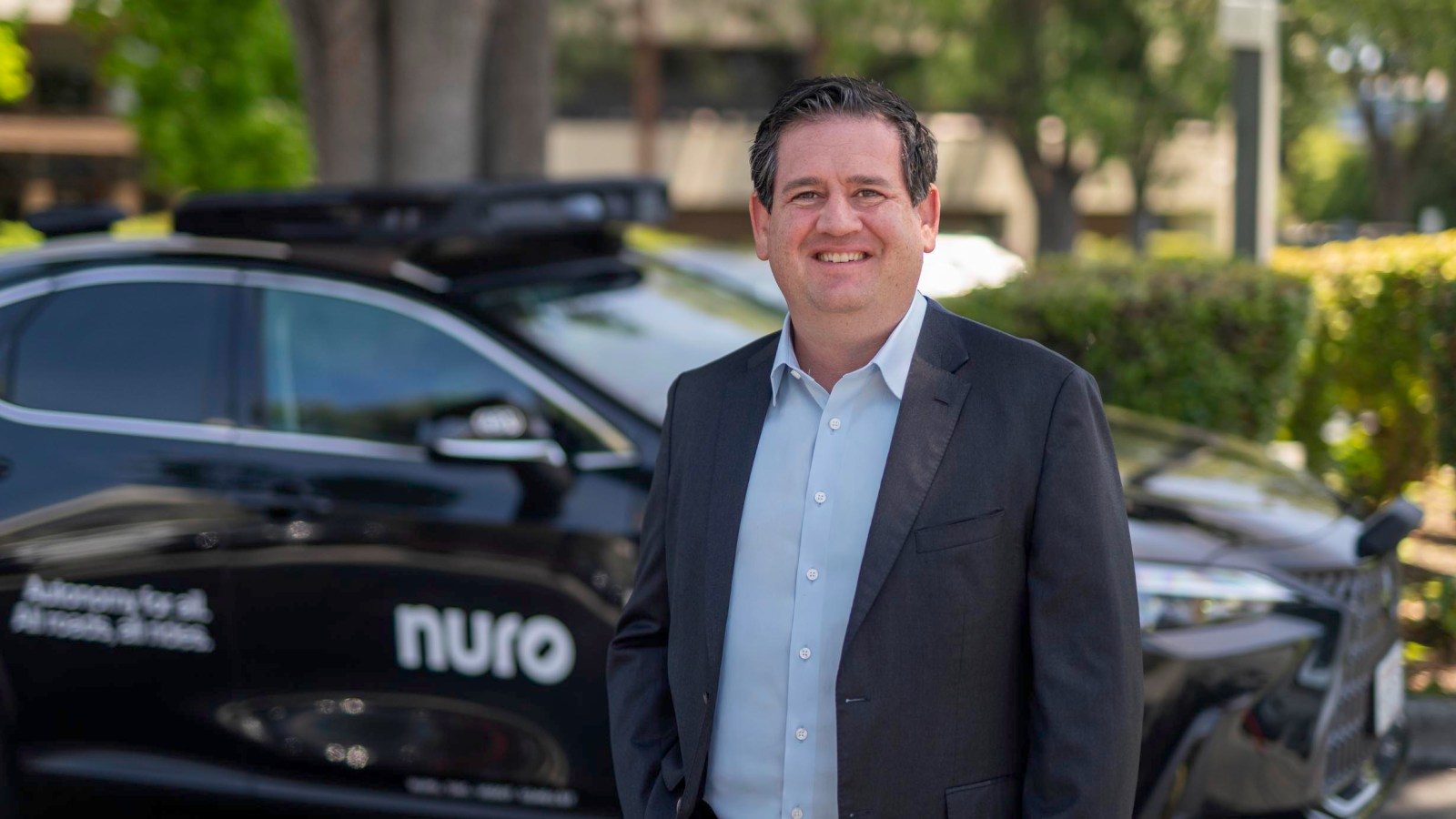

Nuro on Tuesday named Michael Mancini as its new Chief Financial Officer — ending a roughly 32-month vacancy in the senior finance role that has spanned the autonomous driving startup’s most consequential commercial period.
The appointment fills a seat that has been empty since Abi Viswanathan stepped down as Chief Financial Officer in September 2023, after holding the role for one year and nine months.
Viswanathan briefly served as an advisor to Nuro on a part-time basis through December 2023 before leaving the company entirely — according to the executive’s LinkedIn profile.
Mancini joins Nuro as the SoftBank-backed autonomous driving company prepares for the planned commercial launch of its robotaxi service with Lucid Motors and Uber in the San Francisco Bay Area later this year.
The timeline has been maintained by Lucid, Uber, and Nuro management since the partnership was originally announced in July 2025.
The 32-month CFO vacancy included the July 2025 Lucid-Uber partnership signing, last month’s expansion of Uber’s commitment to at least 35,000 vehicles, the announced German expansion, and the preparation for the late-2026 commercial launch.
The New CFO
Mancini joins Nuro with extensive senior finance experience across capital-intensive technology companies and a self-described “hard-tech CFO” profile.
Most recently, Mancini served as Chief Financial Officer at Energy Recovery, Inc. from August 2024 until joining Nuro— a tenure of approximately one year and ten months at the Bay Area energy technology company.
Before Energy Recovery, Mancini served as CFO at Astranis Space Technologies from January 2020 to April 2024 — a four-year, four-month tenure at the San Francisco-based satellite communications company.
His longest tenure was at Aerion Supersonic, where he spent four years and five months across three progressive roles: VP of Finance (September 2015 to December 2016), Senior Vice President of Finance (January 2017 to December 2017), and finally CFO and Executive Vice President of Strategy (January 2018 to January 2020).
The supersonic aviation company was based in Palo Alto, California.
All three companies share structural characteristics with Nuro’s autonomous driving platform: capital-intensive development cycles, complex regulatory frameworks, hardware-plus-software business models, and multi-year paths to commercial validation.
“Mike brings the financial discipline, operating judgment, and strategic perspective we need for this next chapter,” said Nuro Co-Founders and Co-Chief Executive Officers Jiajun Zhu and Dave Ferguson in a joint statement.
“As Nuro enters a new phase of growth and commercialization, his experience scaling ambitious technology companies will be invaluable.”
In his new role, Mancini will lead Nuro’s financial strategy, planning, and operations — helping the company scale its technology, strengthen global commercial partnerships, and support long-term growth — according to the company’s statement.
“Nuro is building one of the most important technologies of our time, and I’m excited to join the company at such a pivotal stage,” Mancini said.
“Nuro has a clear vision, a strong technical foundation, and a thoughtful approach to commercialization. I look forward to working alongside the team as the company scales responsibly and brings autonomous driving to more people and markets.”
The 32-Month CFO Vacancy
The predecessor CFO, Abi Viswanathan, joined Nuro as Head of Finance in November 2018 — three years after the autonomous driving company was founded by Co-CEOs Jiajun Zhu and Dave Ferguson.
Viswanathan was promoted to Chief Financial Officer in January 2022, holding the role through September 2023 — a CFO tenure of one year and nine months.
He continued in a part-time advisory role at Nuro from September 2023 through December 2023 before leaving the company.
Before joining Nuro, Viswanathan spent four years and five months in Strategic Finance at Uber from July 2014 to November 2018 — a connection that becomes editorially distinctive given that Uber is now Nuro’s primary commercial partner on the robotaxi program.
The Operational Momentum
The CFO appointment arrives during a period of accelerating operational momentum for Nuro.
The company now operates a fleet of nearly 100 robotaxi engineering vehicles — Lucid Gravity vehicles integrated with the Nuro Driver autonomous driving platform — across the San Francisco Bay Area.
In April, select Uber employees began testing the autonomous service directly through the Uber app — the first commercial-style end-to-end ride test of the program.
The expansion of internal testing to live Uber employee rides represents the most significant commercial validation milestone for the Lucid-Nuro-Uber program since autonomous on-road testing began in the San Francisco Bay Area in December 2025.
Vehicles in the engineering fleet have also been spotted in Houston, suggesting Nuro is preparing additional market validation testing beyond California.
Lucid-Uber Robotaxi Partnership
Uber’s purchase commitment to the Lucid-Nuro robotaxi program reached at least 35,000 vehicles in April 2026 — up from the original 20,000 Gravity SUVs agreed under the July 2025 deal.
Additionally, Uber invested an additional $200 million in Lucid, bringing its total equity commitment to $500 million.
The German Expansion
Beyond the US robotaxi program, Nuro is also expanding its international footprint, with testing underway in Japan and a new expansion into Germany.
The autonomous driving startup said last week that it is establishing operations in Germany, opening its first European office in the Munich area as it expands its Level 4 AI driving platform.
The Munich office will serve as Nuro’s European hub — supporting engineering, operations, and partner engagement, according to the SoftBank-backed company.
The European hub will allow Nuro to validate and adapt its technology for European driving conditions and regulatory frameworks.
The Universal Autonomy Platform Strategy
Nuro’s approach is intended to reduce integration complexity, accelerate development cycles, and establish a consistent technical foundation across the full range of vehicle applications.
The strategic positioning distinguishes Nuro from autonomous driving competitors that have focused narrowly on a single vehicle category — such as Waymo’s robotaxi-only deployment, or autonomous trucking startups focused exclusively on logistics.
By developing a single Level 4 platform adaptable to multiple vehicle types, Nuro is positioning itself as a horizontal supplier to OEMs and ride-hailing operators rather than a vertically integrated competitor.
The Japan Precedent
Nuro’s Munich expansion builds directly on the company’s Japanese operations, which served as the first validation of its universal platform thesis.
In Tokyo, Nuro demonstrated what it calls “zero-shot autonomy” with the Nuro Driver — showing that its platform could operate in a new driving environment without prior training on local driving data.
Germany introduces a broader range of road infrastructure and regulatory frameworks that will further strengthen the generalisability of the Nuro Driver, the company said in its announcement.
California Permit Progress
Nuro’s German expansion came a week after the company added a second key California permit for its autonomous testing operations.
The autonomous vehicle technology company secured a California Public Utilities Commission (CPUC) Drivered Pilot Permit, allowing it to conduct pilot testing of autonomous passenger service with a safety driver while carrying passengers on public roads.
The CPUC permit builds on a separate milestone — Nuro’s California Department of Motor Vehicles Driverless Testing Permit, which the company has held for six years and has now been extended to also cover Lucid Gravity vehicles.
Nuro’s existing driverless permit previously covered only the low-speed autonomous delivery vehicles the startup operated before pivoting to licensing its technology to ride-hailing partners.
Neither permit currently authorises paid rides, and the CPUC Drivered Pilot Permit does not allow for driverless passenger operations.


