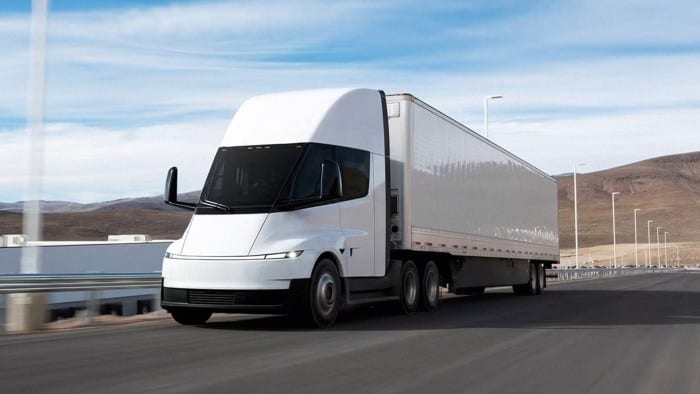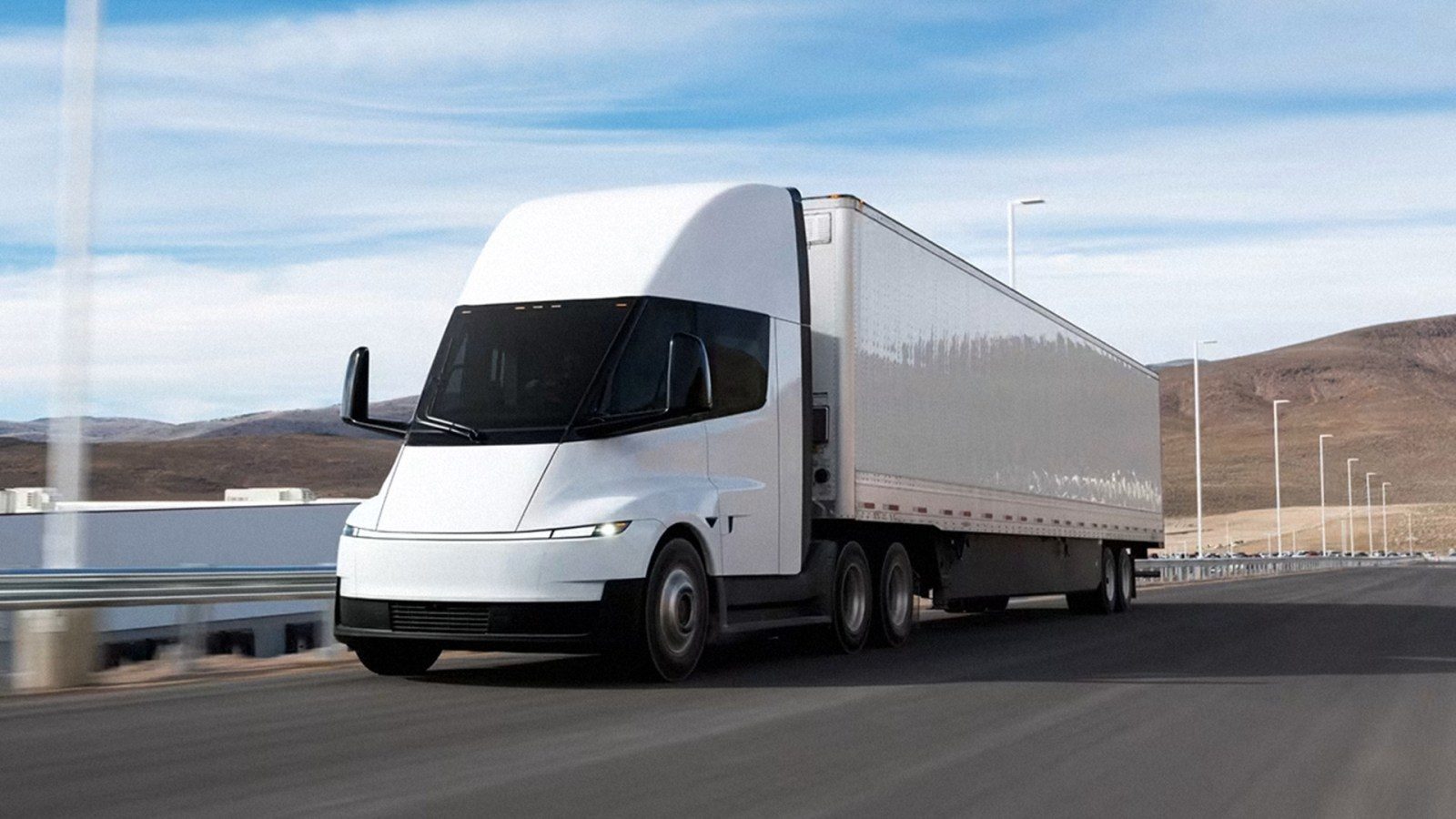

Tesla will supply 50 Semi electric trucks to IMC Logistics, a marine drayage operator that has kept a fleet of Nikola hydrogen fuel-cell trucks running through the truckmaker’s bankruptcy.
IMC, which describes itself as the largest marine drayage provider in the United States, announced the order during the Intermodal EXPO in Long Beach, California, held from September 14 to September 16.
Founded in 1982 as a regional drayage company and based in Collierville, Tennessee, IMC says it has more than 2,500 drivers across North America.
“We are focused on making sustainability attainable in day-to-day drayage operations,” Jim Gillis, IMC’s Pacific Region President, said in a statement.
“That means taking a blended approach rather than relying on a single technology.”
“The addition of 50 Tesla Semis strengthens that strategy as well as allows IMC to establish zero-emission service for long haul lanes,” he added.
The company will use Standard Range Semis for drayage within California and Long Range models for freight moving between Southern California and inland destinations, but has not disclosed how many of each it ordered.
IMC expects to receive the trucks later this quarter, it told Trucking Dive. Gillis said in a social media post that IMC expects to receive 34 of the 50 Semis before the end of 2026.
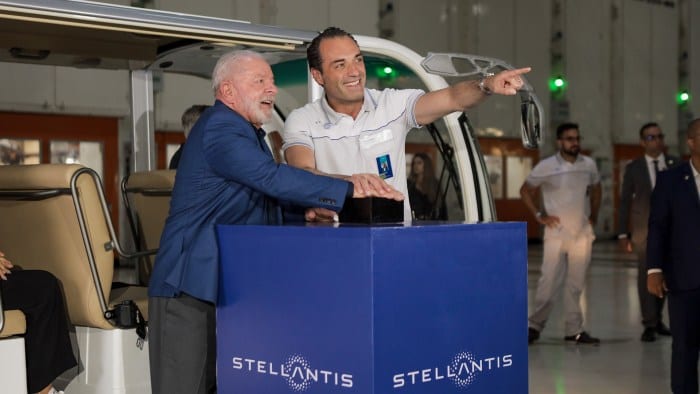
It received the keys at a ceremony with Tesla in September, and VP of Marketing and Public Relations Jennifer Shaffer said on September 29 that IMC was “supposed to take actual delivery later this week or early next week.”
A Semi in IMC’s livery was among 11 customer-branded trucks seen outside Tesla’s Nevada plant the day before the company’s Semi production launch event on September 24.
From Hydrogen Bet to Battery Trucks
The order marks a shift in emphasis for IMC, which turned to hydrogen in 2024 partly because of the limits it saw in battery-electric trucks.
IMC bought six Volvo battery-electric trucks in September 2022, along with chargers able to serve a fleet of 30.
Chief Executive Officer Joel Henry said in early 2024 that battery trucks delivered only four to six hours of productive work in a 12-to-14-hour window under load, compared with 20 to 24 hours for diesel tractors.
Gillis told The Wall Street Journal at the time that 300-mile round trips between ports and warehouses were “just beyond the reach” of battery-electric trucks.
IMC instead ordered 50 Nikola fuel-cell trucks, worth more than $22 million, for operations in California, Arizona and Nevada, and unveiled the fleet at its Compton, California, facility in March 2024.
“Our blended approach to investing in both electric and hydrogen gives us the best of both technologies,” Gillis said then.
Nikola filed for Chapter 11 bankruptcy in February 2025, and its customers have since received no software updates or fixes from the company, Transport Topics reported.
By late June 2025, 40 of IMC’s 50 Nikola trucks were operating and 10 were out of service, Gillis told the trade publication in a report published in July 2025.
He said IMC had found a new hydrogen supplier but that the price had risen to $29 a kilogram from $7.50.
“Our commitment was to keep the trucks running,” Gillis said.
“So, we took it on the chin with the increased fuel cost,” he added.
IMC was then using about 10,000 kilograms of hydrogen a week and keeping the trucks closer to base to limit fuel costs, he said.
IMC said in a September 3 post that 56 of its roughly 200 trucks were zero-emission, without breaking down the figure.
In the same post, Zero-Emission Vehicle Program Manager Khari Burton said drivers who switch to zero-emission trucks “honestly don’t want to go back.”
Chief Commercial Officer Brian Kobza wrote on LinkedIn that diesel will “remain critical for years,” but that “EVs have already earned a place in port and regional operations where the economics and infrastructure make sense.”
Volume Production
The IMC order comes as Tesla begins building the Semi at scale, more than eight years after unveiling it in November 2017.
Tesla launched high-volume production on September 24 at a dedicated plant in Sparks, Nevada, which it says is designed to build 50,000 trucks a year.
The first truck came off the high-volume line on April 29, and Dan Priestley, who leads the Semi program, has put the target rate at 1,000 trucks a week.
Tesla has not disclosed its current weekly output.
IMC was among the fleets due to receive the first production trucks, alongside DHL Supply Chain, US Foods, Einride, ABF Freight and WattEV.
Tesla said its pilot fleet of about 180 trucks had logged 17.5 million miles, according to the trade publication.
“Semi is here. Today, we’re launching high volume production,” the company said.
Tesla rates the Standard Range Semi at up to 325 miles and the Long Range version at up to 500 miles.
In a 2023 demonstration run by the North American Council for Freight Efficiency, PepsiCo’s Semis completed 384 miles on a single charge and 806 miles in one 24-hour day with fast charging, Transport Topics reported at the time.
Tesla has not published official prices.
Tesla advertised $150,000 and $180,000 for the two versions when it unveiled the truck in 2017.
IMC joins a growing list of Semi buyers.
Einride said in August it would add 500 Semis, and Tesla was named primary manufacturer on September 22 for a 2,500-truck electric order pooled by the ZET SCALE alliance, whose founding shippers include PepsiCo and Microsoft.
PepsiCo took the first hand-built Semis in late 2022.
“I’d recommend placing more orders if you haven’t already,” Chief Executive Officer Elon Musk said in a recorded video at the Nevada event.
“The waiting list is already pretty significant,” he said.
Musk also said self-driving would come to the Semi “in the very near future.”
Morgan Stanley estimated in September that autonomous software could bring Tesla $12,000 to $18,000 a month per truck, assuming a per-mile fee and about 18,000 miles of monthly use.
Tesla shares fell the day after the launch, when The Information reported problems with the hands of the company’s Optimus robot.
Charging Network
Tesla opened its first Megacharger on the East Coast on Thursday, an eight-stall site in Conley, Georgia, near Atlanta.
Tesla expects about 30 Megacharger sites to be operating in the United States by the end of 2026. IMC has not said how it will charge its Semis.
In Europe, where Tesla plans to start deliveries of a model rated at 550 kilometers in 2027, the company has opened charger sales in five markets and plans more than 100 Megacharger stalls.