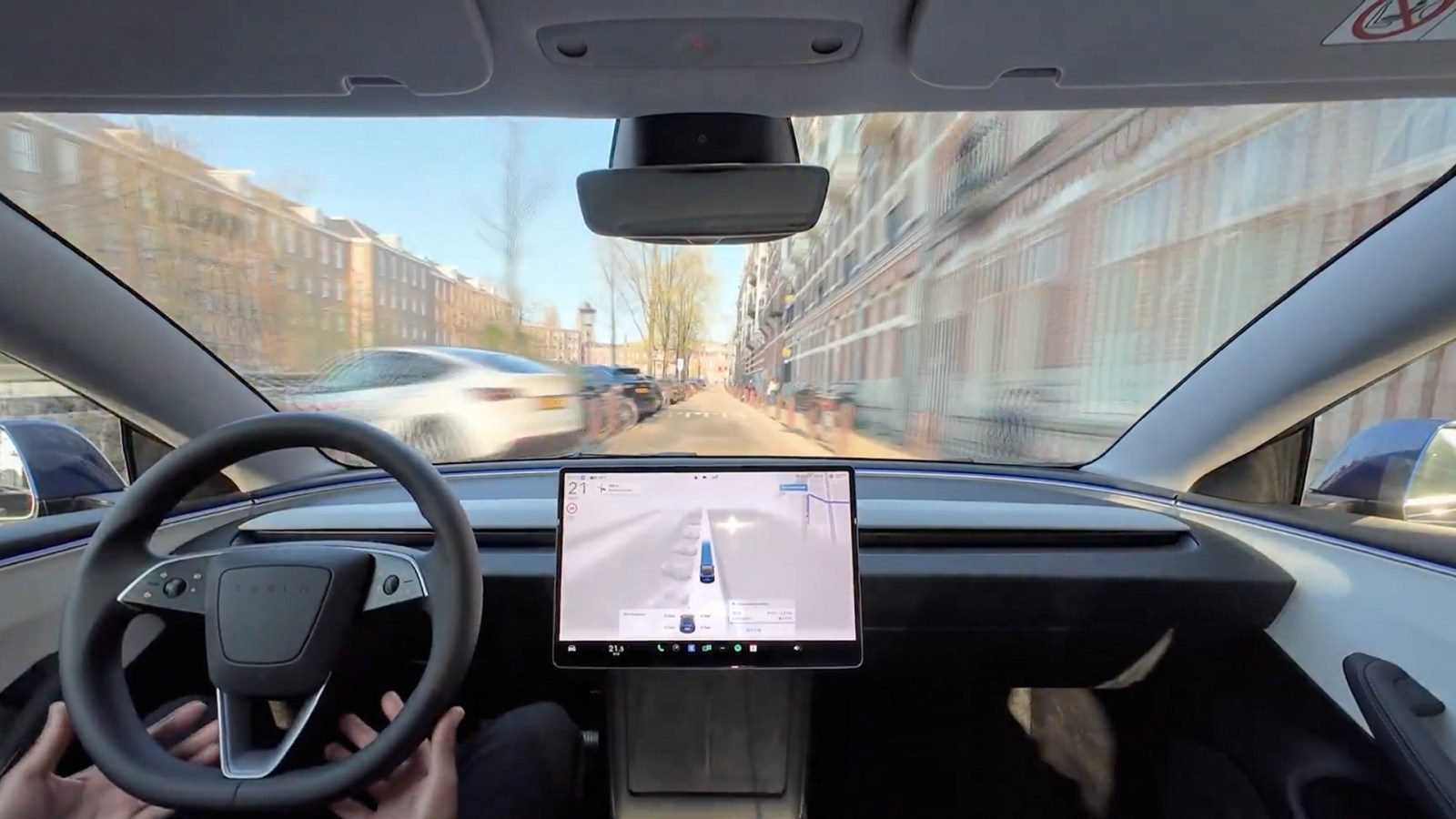

Slovakia will recognize the Dutch approval of Tesla‘s Full Self-Driving (Supervised) system within days, Transport Minister Jozef Ráž said, a move that would make it the ninth European Union country to allow the driver-assistance software.
Ráž said in a video posted on LinkedIn on Wednesday that his ministry would send a recognition letter to the Netherlands, whose vehicle authority RDW approved the system in April.
“Once this letter is delivered, the FSD system will be available for use here as well,” Ráž said in the video. “But remember: you’re still the driver, and you’re responsible for the car.”
Ráž said data showed the cars “reduce the accident rate and that’s exactly what we’re aiming for.”
The ministry had already negotiated directly with Tesla, Slovak site StartStop reported.
Ráž did not give a date for when Slovak owners could use the system, and did not say whether Slovakia had carried out any tests of its own.
A petition from Tesla Owners Slovakia asking the ministry to recognize the Dutch approval had gathered 601 signatures.
Recognition, Not Approval
The RDW granted FSD (Supervised) a provisional approval on April 10 under Article 39 of EU Regulation 2018/858, which allows exemptions for new technology not yet covered by harmonized rules.
The approval is valid only in the Netherlands, and other member states can choose to recognize it for their own roads.
Lithuania followed on May 20 and Estonia on May 29, both without their own testing, while Denmark recognized it on June 9 and Belgium on June 10 after testing in Flanders.
Slovenia followed on Sept. 7, the Czech Republic on Sept. 21 and Croatia on Sept. 29, after both Czech and Croatian authorities had earlier said they would wait for an EU decision.
The first seven countries account for under 12% of the EU’s population, EV calculated last month.
The RDW classifies FSD (Supervised) as an SAE Level 2 system, meaning the driver remains responsible and must be able to take over at any time.
In Europe the software is sold only as a subscription, at €99 ($111) a month, after Tesla removed its one-time purchase option in May.
A Vote Pushed Back
An EU-wide approval requires a qualified majority in the Technical Committee on Motor Vehicles, with at least 15 of 27 member states representing at least 65% of the bloc’s population.
The committee’s October 6 meeting was listed only as a continuation of discussions, the third session on the file without a vote after May 5 and June 30.
Germany’s Transport Ministry has said a vote is planned for December.
Germany, France, Italy and Spain, the EU’s four most populous countries, have not recognized the Dutch approval.
Germany’s Transport Ministry said on October 6 it had reached an understanding with Tesla under which the system may exceed the speed limit “by a maximum of 10%” and the driver “remains 100 percent responsible.”
Transport Minister Steffen Bilger said he would push for EU-wide approval and floated a national solution if that fails, without giving details.
Germany had raised the system’s ability to exceed speed limits with Tesla in September, as its vehicle authority KBA continued to evaluate the Dutch file.
France said in July the system was not acceptable in its current form and has since started road tests, while Sweden has said it would vote against unless Tesla removes its speed-offset function.
In Ireland, Tesla said it was working with authorities on approval, while the Department of Transport has tied any decision to the EU process.
Safety Claims Under Scrutiny
The RDW said in June it had assessed the system over more than 18 months, with more than 1,000 test runs and more than 3,000 hours of testing on tracks and public roads.
Nearly 40,000 Dutch Teslas had driven about 24 million kilometers with the system “without any relevant incidents,” the regulator said.
Tesla says FSD (Supervised) drivers are about 4.1 times less likely to crash than when driving manually, and that the system cut collisions by 40% in its first year in Australia and New Zealand, both based on its own data.
Seven traffic-safety researchers told Reuters in an investigation published on Wednesday that Tesla’s European study did not show the system prevents serious crashes.
The study relied on proxies such as horn use, indicator use and hard braking, and compared professional drivers using FSD with ordinary owners driving manually, according to Reuters.
Tesla also disputed a €365,000 ($410,700) RDW bill and questioned the need for some tests, while an RDW employee offered to reduce the intensity of the review, Reuters reported.
The RDW told Reuters it ran an extensive independent investigation and that engagement with manufacturers is routine.