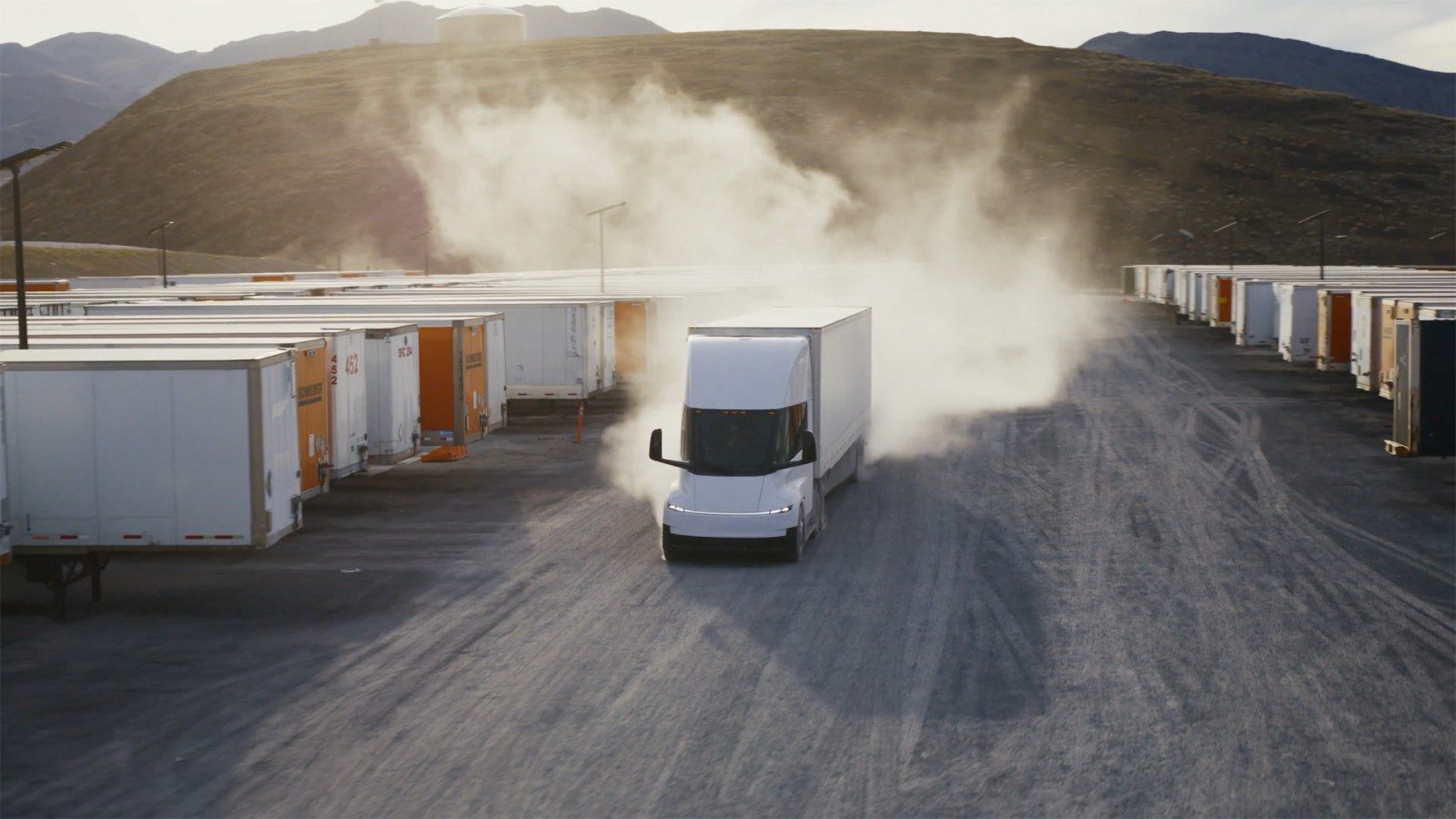

Einride said on Tuesday it will buy and deploy 500 Tesla Semi trucks across North America over the next 24 months, the largest publicly announced order for the Class 8 electric truck and roughly triple the size of the Swedish company’s deployed electric fleet.
The trucks will serve Amazon and other customers across freight corridors in California, Texas, New Jersey, Illinois and Georgia, running on Einride’s Saga AI fleet platform.
Deployment begins in September and is fully financed through third-party arrangements.
Einride already runs 75 electric heavy-duty trucks on Amazon’s middle-mile network, announced in April, together with charging infrastructure at five US locations.
The order is 35% larger than the 370-truck deal WattEV signed in May, which was until Tuesday the largest disclosed.
It remains unknown how many of the 500 arrive in each phase, what the trucks cost, which Einride customers beyond Amazon are involved, and whether the order is firm or contingent on delivery timing.
Neither company disclosed the value of the deal.
What Each Side Said
“This deployment is yet another proof point that we can execute at the scale our customers demand,” said Roozbeh Charli, Einride’s chief executive. “Working closely with Tesla to bring next-generation Semis into active operations quickly and at scale is a testament to the strength of that partnership, and how quickly this technology is maturing from promise to daily operations.”
Dan Priestley, Tesla‘s director of Semi, said the company was “thrilled to deepen our relationship” with Einride.
“EV heavy trucks provide lower costs per mile from fuel savings, reduced maintenance, and better uptime over diesel trucks,” Priestley said. “These savings increase further through operational efficiency when deploying EV trucks at scale, and we are excited that Einride recognizes this and look forward to supporting their deployments.”
The Revenue Behind It
Einride framed the deployment as converting contracts it has already signed into operating capacity.
The company said it is a step toward turning approximately $800 million in potential long-term annual recurring revenue under joint business plans with shippers into “active, revenue-generating freight capacity,” and that the arrangement gives customers earlier access to next-generation, longer-range Semis.
That figure is a target rather than booked revenue, and Einride did not say what share the 500 trucks represent or over what period it would be realised.
Saga AI has powered more than 19 million electric miles and 42,000 optimisation sessions globally, built on seven years of commercial operations, according to the company.
Einride currently runs about 200 heavy-duty electric trucks for customers including Amazon, PepsiCo and Heineken, which is why 500 additional units triple the fleet.
The company also builds cab-less autonomous trucks and operates a dual model combining freight capacity as a service with software.
Where Tesla’s Production Actually Stands
The order lands while Tesla‘s own disclosures are inconsistent about whether Semi production has begun.
The first truck came off the high-volume line at the Nevada factory on April 29, an event the Semi account marked with the words “First Semi off high volume line.”
Tesla had described the programme as being in pilot production in its first-quarter shareholder deck days earlier.
But the second-quarter update, published on July 22, states that “Tesla Semi remains on track for production this year at our new factory in Nevada,” and that the Semi and Megapack 3 “remain on schedule for production starting in 2026.”
A summary of the same materials describes building construction as complete with the commissioning phase beginning and production to start by year end.
On the same day’s earnings call, Elon Musk said: “We have started production with the Tesla Semi truck.”
Tesla has not reconciled the two statements, and has published no Semi production or delivery figures.
The company has pulled back from its commitment to reach volume production this year, and that it told shareholders it is working to increase output of its 4680 cells in order to build the Semi and Cybercab at scale.
The Capacity Question
The Nevada plant covers 1.7 million square feet, sits adjacent to Gigafactory Nevada in Sparks and is designed for an eventual 50,000 units a year.
Priestley described the current phase at the ACT Expo in May: “Right now, we’re focused heavily on ironing out all the processes, balancing the lines and the stations, ensuring factory equipment is running optimally. We’re going to be trying to do all the things to demonstrate rate. And then it’s ramp like hell.”
He has guided to “many thousands” of units this year. Analysts cited by Electrek expect 5,000 to 15,000 deliveries in 2026.
Against that range, 500 trucks phased over 24 months from September is a substantial order but not one that tests the factory. Battery pack output remains the near-term constraint, and Priestley has said most early volume is already committed.
The Order Book
Disclosed commitments have accumulated quickly this year.
WattEV signed for 370 trucks in May, days after a California freight firm ordered 40. DHL has confirmed an order beyond “just a handful” for 2026 delivery after testing in Livermore.
Paper Transport began evaluating the truck on Chicago dedicated runs in July. ArcBest, King Fio Trucking and port drayage operators have also run pilots, and PepsiCo has operated Semis since December 2022.
The clearest demand signal is regulatory. In California’s Clean Truck and Bus Voucher programme, the Tesla Semi accounted for 965 of 1,067 applications between January 2025 and February 2026.
Daimler, PACCAR and Volvo together received fewer than 100.
The Truck and Its Charging
The production Semi is offered in two trims at 82,000 lb gross combination weight: a standard range version at roughly 325 miles on 548 kWh, and a long range version at about 500 miles on 822 kWh, both certified by the California Air Resources Board.
It runs three independent rear motors, 4680 cells and a 48-volt architecture, and is about 1,000 pounds lighter than the prototypes.
Reported pricing is roughly $260,000 and $290,000 before incentives, against the $150,000 and $180,000 Tesla quoted at the 2017 unveiling.
The pre-volume fleet has logged more than 13.5 million miles with uptime above 95%, and EV has recorded consumption of 1.64 kWh per mile across 4,700 miles in a first-generation test, against the 1.7 Tesla lists.
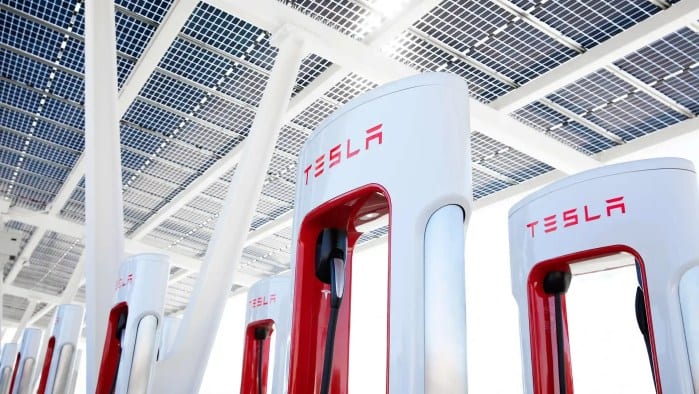
Charging remains the open variable for any operator at this scale. Tesla opened its first public Megacharger station in Bloomington, California in July, describing it as “the beginning of the Megacharger network,” with 46 sites targeted by 2027.
Einride did not say how the 500 trucks will be charged across five states, or whether depot infrastructure is included in the third-party financing.