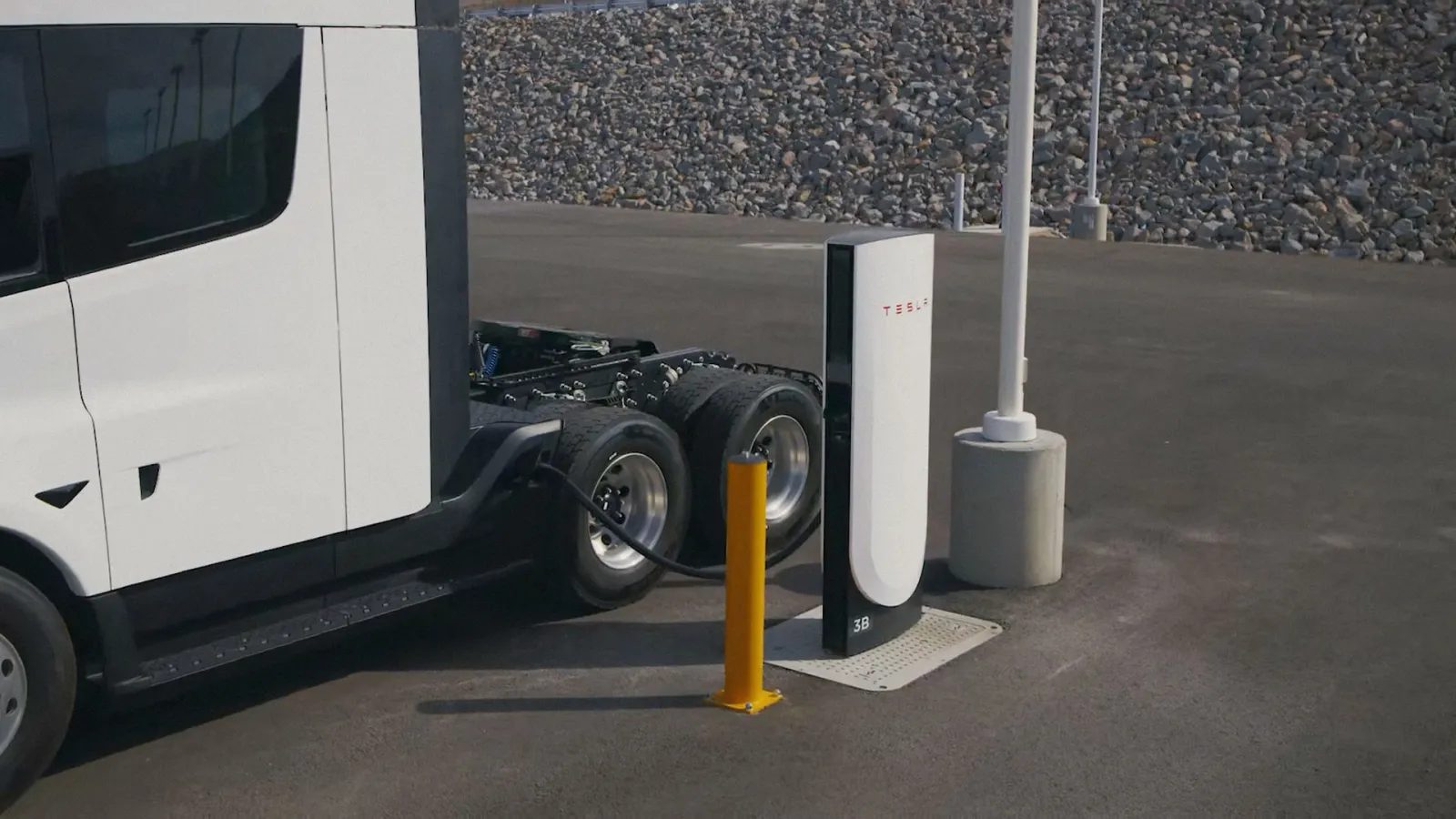

Tesla began selling Semi charging hardware to businesses in five European markets on Monday, the press day of IAA Transportation in Hannover, where it showed a European-specification truck for the first time.
The Semi Charging for Business programme is live in Germany, the Netherlands, Belgium, France and the United Kingdom, the company said on its charging account on X, linking to pages in each market.
Tesla has not yet opened a public Megacharger anywhere in Europe.
Buy the Hardware, Build the Network
The website invites operators to “become part of our Semi charging network” by investing in chargers at their own sites.
Two products are offered. The Megacharger, for short stops, listed at up to 1.2 megawatts and adding up to 60% of range in 30 minutes. The Basecharger, at 120 kilowatts, for depots and overnight charging.
Buyers get the same hardware, software, pricing controls and service as units in Tesla’s own network, the page says, with over-the-air updates for the life of the charger and a maintenance package the company says guarantees uptime of “up to 97%+”.
The minimum order is two chargers. Installation is either by the buyer’s own contractor with a Tesla engineer attending, or by Tesla. Deliveries are expected from the middle of 2027.
Every performance figure on the page is marked as an estimate.
The American Precedent
Tesla opened a comparable scheme in the United States on May 1, the week series production of the Semi began at its Nevada plant.
The two are not identical as European prices are unpublished, the American per-kilowatt-hour fee has not been confirmed for Europe, and the European truck accepts 800 kilowatts where the American long-range model takes 1.2 megawatts.
Its American configurator prices a Megacharger cabinet with two posts at $188,000, made up of $179,000 of hardware, $6,000 of services and $3,000 of shipping, before tax and installation.
Two Basechargers cost about $40,000. Revenue-generating sites pay Tesla an all-inclusive $0.08 per kilowatt-hour, against $0.10 for Superchargers.
No European prices have been published.
Two figures read differently across Tesla’s own material. The Basecharger appears as 125 kilowatts in American coverage and 120 in Germany, which may be the difference between alternating-current input and direct-current output rather than two products.
And the German charging page says the Basecharger adds up to 80% of range in four hours, where the American material and Tesla’s own European Semi page say 60%.
What the Truck Accepts
The European Semi, shown in Hannover on Monday, is a single Standard Range tractor rated at 550 kilometres at 40 tonnes, with energy consumption of 1.0 kilowatt-hour per kilometre and a kerb weight under 9,100 kilograms. Deliveries begin in 2027.
It charges at up to 800 kilowatts, against 1.2 megawatts for the long-range truck sold in the United States.
That leaves European buyers purchasing a cabinet that can outperform the truck arriving first. The gap covers two posts sharing one cabinet and any longer-range model Tesla adds later.
Tesla has not published a European battery size. If the truck carries the 548 kilowatt-hour pack used in the American standard-range model, recovering 60% of it in half an hour would need an average of about 658 kilowatts across the session, which an 800-kilowatt peak allows but does not leave much room for.
European Rules
European rules require drivers to break for 45 minutes after four and a half hours at the wheel. The Semi’s commercial case rests on the charge and the break being the same event.
That only works where a charger exists on the route. Until public sites are built, a 550-kilometre tractor is a regional and national vehicle running on depot charging, which is what the Basecharger is for and what most European electric trucking does today.
Tesla’s European pages describe an expanding public network with conveniently located sites. The company has named no locations, no corridors, no partners and no opening dates.
Charger deliveries begin in the middle of 2027, the same year as the trucks.