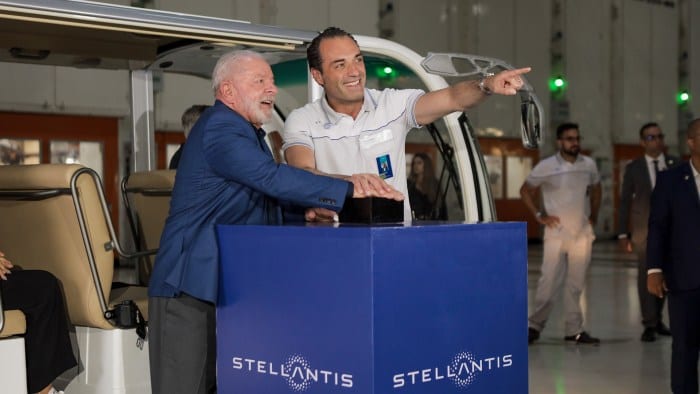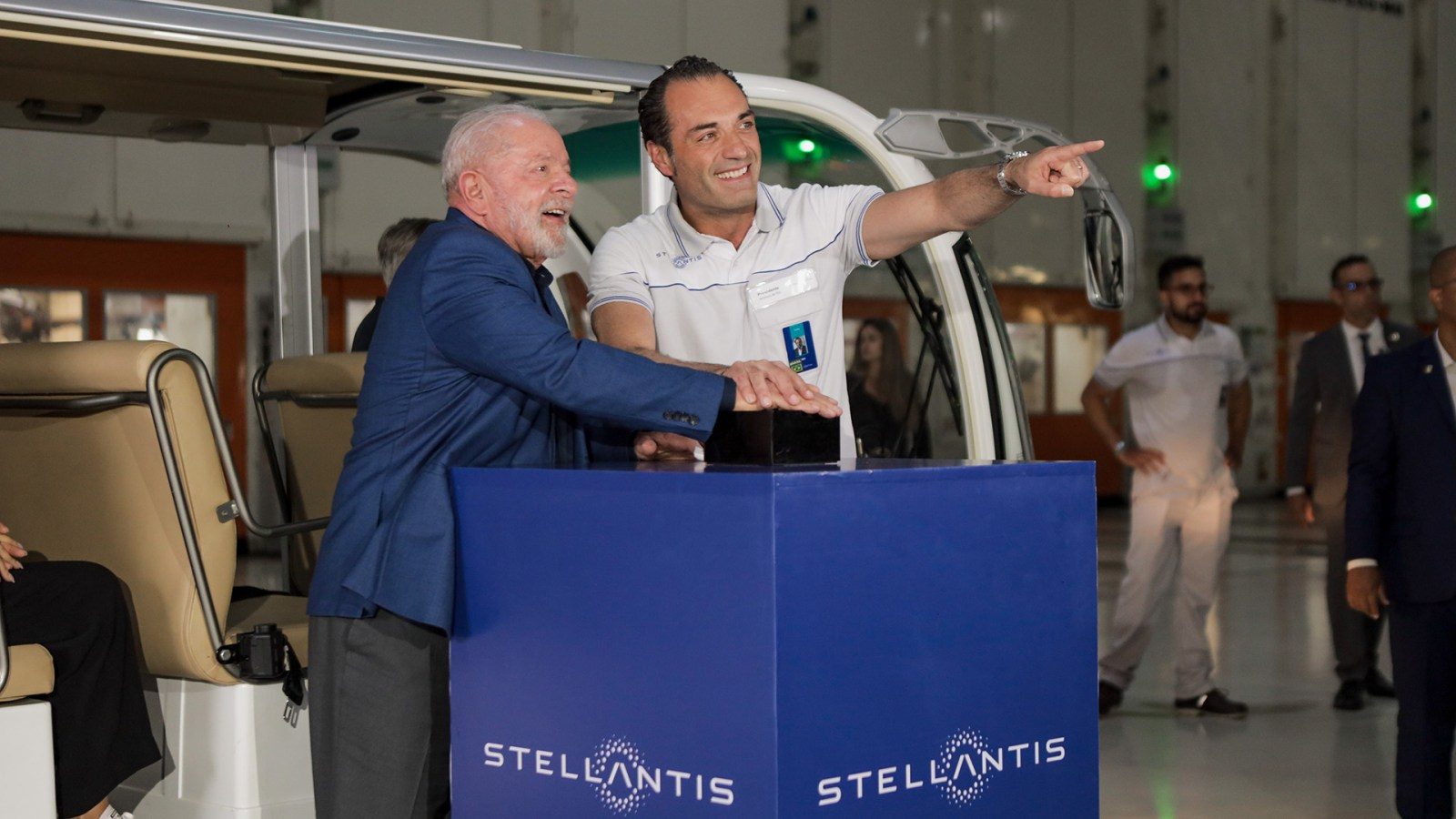

Stellantis said the spread of cars partially assembled in China threatens South America’s auto supply chain, with its regional chief warning that the company would need only about 10% of its roughly 35,000 workers in the region if it adopted the same model.
Herlander Zola, President of Stellantis for South America, made the remarks at a lunch with reporters in São Paulo on Tuesday.
“Today, we at Stellantis employ around 35,000 people in South America,” Zola said. “If this business model changed completely, 10% of this workforce would be enough.”
That implies about 31,500 jobs that a kit-only operation would not need, a figure Zola did not state himself.
“If this model really starts to migrate to CKD and SKD, this is the chain that is at risk in this business,” he said, referring to vehicles shipped as completely knocked-down and semi-knocked-down kits.
He went further on what the current rules reward.
“Given what we have today, if nothing is done, it is better to produce cars in China, take them apart and bring them here,” Zola said.
Chinese carmakers BYD and Great Wall Motor (GWM) have opened plants in Brazil that put together vehicles from kits made in China, and both have gained market share quickly.
Zola said Stellantis itself could import kits if that proves the most competitive option, possibly through its Chinese partners Leapmotor and Dongfeng.
“We have an absolutely open range so we can adapt,” he said.
How the Kit Model Works
In an SKD operation, a vehicle arrives largely built, often with its body already welded and painted, and is finished locally.
A CKD kit arrives as separate components, so the local plant does more of the assembly work.
BYD began production in July 2025 at the former Ford site in Camaçari, Bahia, and inaugurated the plant on October 9 that year, with President Lula da Silva attending.
The plant started with SKD assembly of the Dolphin Mini, the Song Pro and the King, has initial capacity of 150,000 vehicles a year and is planned to reach 300,000 in a second phase, the company said at the inauguration.
BYD has committed more than 5.5 billion reais ($1.1 billion) to the complex.
The company said in October it had about 8,500 employees in Camaçari and expected stamping, welding and painting operations to begin by the end of 2026.
“No car factory on the planet starts fully integrated,” BYD Brazil Senior Vice President Alexandre Baldy said in June, adding that every plant has “a transition period.”
BYD is targeting 50% local content, counting in-house production and Brazilian suppliers, by January 1, 2027, Baldy told Reuters in February, calling SKD assembly “a transitional regime.”
The company has said its Brazilian operations will eventually generate 20,000 jobs.
GWM began operations at Iracemápolis, São Paulo state, in August 2025, building the Haval H6, the Haval H9 and the Poer pickup.
The plant built more than 15,000 vehicles from January to August 2026 and expects to reach 32,000 by December, with capacity of 50,000 a year, the company said in August.
Its workforce has grown to more than 1,800 from about 600 at launch, and the plant welds and paints bodies on site, part of a 10 billion reais ($2 billion) investment plan in Brazil.
GWM describes its process as “part by part” assembly, a form of CKD in which components are taxed individually rather than as a kit.
Average local content is 20%, and GWM is targeting 35% so it can export the Haval H6 to Argentina in 2027.
“We are seeking greater localization to be able to export the Haval H6 to Argentina next year,” Institutional Affairs Director Ricardo Bastos said in June.
GWM has also formalized a second, complete plant in Espírito Santo that will include stamping, though work there has not started.
Geely began building its first car in the Americas in September, the EX5 EM-i plug-in hybrid, at the Renault-led plant in Paraná in which it holds a stake.
Tariffs and Quotas
Brazil reinstated import duties on electrified vehicles in January 2024, with the rate on battery-electric cars rising in steps from 10% to 35%, reached in July 2026.
The fight over kits came to a head in July 2025, when BYD asked for three years of reduced rates of 10% on SKD kits and 5% on CKD kits.
The government’s foreign trade committee, Gecex, rejected that request but granted a six-month zero-tariff quota worth $463 million for kits, and brought forward the full 35% rate on kits to January 2027 from July 2028.
Gecex renewed the $463 million zero-tariff quota on June 23, 2026, for six more months from July.
Outside the quota, SKD kits now pay 35%, while CKD kits pay 14% until the end of the year before rising to 35% in January.
Zola said 35% was “insufficient” to make local production the better option, though he did not call for a higher tariff.
Instead, he argued for incentives for carmakers that buy Brazilian steel, tires and components.
“Today, rules that encourage local production are missing,” Zola said.
“There is no incentive whatsoever for traditional carmakers to buy Brazilian steel, Brazilian tires, Brazilian parts,” he added.
Carmakers’ association Anfavea said in June that the quota renewal was taken “without consultation with the productive sector” and said it was considering legal action.
In a study published in January, Anfavea estimated that replacing full local production with high-volume kit assembly would put 69,000 direct jobs at risk and affect 227,000 jobs in the supply chain.
It put potential losses for parts makers at up to 103 billion reais ($20.7 billion), with about 26 billion reais ($5.2 billion) less in tax revenue and 42 billion reais ($8.4 billion) less in exports in a single year.
“SKD and CKD are not harmful processes in themselves,” Anfavea President Igor Calvet said at the time.
“The problem is keeping incentives for simple high-volume assembly without a requirement for national value added,” he added.
General Motors South America Vice President Fabio Rua said the country should not be shaped by “unilateral measures designed to benefit a single competitor.”
GM itself uses kits for a Chinese-built model, with partner Comexport assembling the Chevrolet Spark EUV from SKD kits in Horizonte, Ceará, since December 2025.
Stellantis, Volkswagen, GM and Toyota had warned President Lula in a July 15, 2025 letter that kit imports “will not be a transition stage” toward a new industrial model.
They said about 180 billion reais ($36.1 billion) in planned investment over five years was at stake.
China’s Share of the Market
Chinese brands took about 9% of Brazil’s car market last year and 17% in the first nine months of 2026, rising to roughly 25% in September, according to Zola.
Registration data compiled by Brazilian newspaper O Tempo show a lower figure for September, with Chinese brands at 21.4% of light-vehicle sales, up from 10.1% a year earlier.
“Nobody could have predicted this acceleration like this,” Zola said, adding that Western carmakers had misread the market.
Rejecting the idea that the industry had merely underestimated its Chinese rivals, he said: “The correct word is error.”
BYD was the fourth-best-selling brand in Brazil through September, with 169,135 units and a 7.8% share, more than double a year earlier, according to dealer association Fenabrave.
It topped monthly retail sales for the first time in April and has set a 2026 target of 250,000 vehicles.
GWM ranked 10th with 63,402 units and a 2.9% share, up 133.5%.
Stellantis’s Fiat remained the market leader with 421,999 units and a 19.6% share.
Stellantis said on October 6 it had sold more than 700,000 vehicles in South America in the first nine months, about one in four sold in the region.
It held 26.8% of Brazil’s market in September and 57% of the pickup segment, its best result in three years, the company said.
Zola estimated that about 700,000 vehicles would enter Brazil this year either fully built or as kits.
“As each vehicle has around 1 ton, that is almost 700,000 tons of steel entering Brazil imported,” he said.
Stellantis’s Own Chinese Partners
Zola’s warning comes as Stellantis prepares its own assembly of Chinese-designed cars in Brazil.
Leapmotor, in which Stellantis invested €1.5 billion ($1.7 billion) in 2023, entered Brazil in November 2025 and will build the B10 and C10 SUVs at Stellantis’s plant in Goiana, Pernambuco.
Production is due to begin in the first quarter of 2027 as SKD assembly, moving progressively to CKD as local content rises, and the cars will use a flex-fuel engine made in Brazil, according to details Stellantis gave in April.
“Local production of Leapmotor at our Goiana factory is a fundamental piece of the strategy,” Zola said at the time.
Leapmotor also entered Argentina in August through Stellantis’s dealer network and is weighing a pickup with Brazil in mind.
Stellantis has also deepened ties with Dongfeng in China this year.
On further Chinese partnerships, Zola said: “I can partner with one more, two more or 10 more.”
Margins and Argentina
Stellantis’s South American adjusted operating income fell 33% to €795 million ($894.5 million) in the first half, on revenue up 2% at €7.96 billion ($9 billion), according to its half-year results.
Its margin in the region fell to 10.0% from 15.3%.
Stellantis attributed the second-quarter decline mainly to a Brazilian tax credit booked a year earlier that did not recur and to lower volumes in Argentina.
Stellantis held a 25.6% share in Brazil in the second quarter, the market leader.
In Argentina, Zola said the company’s two plants, the Peugeot factory at El Palomar near Buenos Aires and the Ferreyra site in Córdoba, were under review.
“We can migrate from one to the other, keep both, close one and keep the other, or close both,” Zola said.
He said labor costs in Argentina were double those in Brazil and that Peugeot’s Argentine market share had fallen to about 5% from close to 9% last year.
He said the Argentine operation had been competitive while the market was closed to imports.
“With the market open, it definitely takes us out of the game,” Zola said.
Days earlier, Stellantis Argentina Chief Executive Officer Martín Zuppi said the company had cut a shift but would keep producing locally, with output planned for 2026 and 2027.
A Decision for the Next Gov.
Zola said Stellantis needed predictability before making industrial decisions across the region, because Brazil accounts for about 65% of the South American market, by his estimate.
Brazil holds a presidential runoff on Oct. 25 between Lula and Senator Flávio Bolsonaro, who led the first round with about 47% of valid votes.
Zola said the next government, whoever leads it, must decide whether Brazil keeps a manufacturing auto industry or becomes a kit assembler.
Stellantis pledged in March 2024 to invest 30 billion reais ($6 billion) in Brazil between 2025 and 2030, its largest commitment in the country.
Its Betim plant in Minas Gerais sources more than 90% of its parts locally from over 1,000 suppliers, the kind of network Zola says is at risk.