Tesla shares reversed early gains on Friday, a day after the company launched high-volume production of its Semi truck, as The Information reported that problems with the Optimus robot’s hands are threatening its production goals.
The stock opened 1.9% higher at $385.00 and rose to $386.83 before falling to $369.78 within minutes, a swing of about $17.
It was down 1.9% at $370.87 at 9:43 a.m. in New York, against Thursday’s close of $377.94.
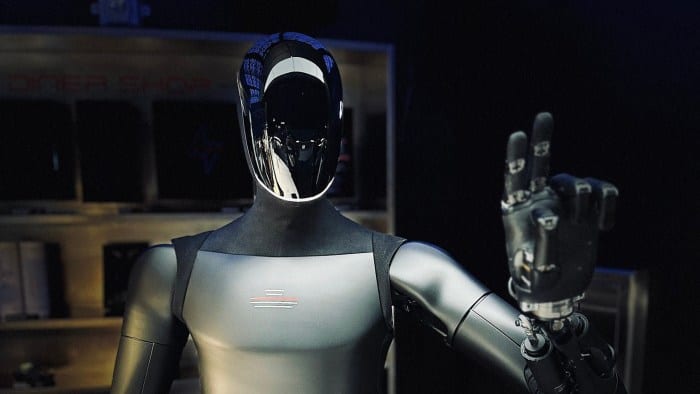
Complex hand assembly, supplier constraints and failures of automated equipment are challenging Tesla’s goal of building 1,000 Optimus humanoid robots per week by year-end, The Information reported.
According to the report by Qianer Liu and Grace Kay, the robot’s intricate hands pose “major manufacturing and durability challenges.”
The report describes the 1,000-unit weekly target as a step toward an eventual goal of 20,000 robots per week**, according to accounts of the article**.
As of the time of writing, Tesla had not publicly commented on the report.
Semi Launch
At an event in Sparks, Nevada, on Thursday, Tesla launched high-volume production of the Semi at a dedicated factory with capacity for 50,000 trucks a year.
The Standard Range version is priced at $250,000 and the Long Range at $290,000, before taxes and fees.
Chief Executive Officer Elon Musk called it “almost like a sports car in truck form” and said self-driving features would come “in the very near future.”
Tesla closed the event with a teaser for its next-generation Roadster, due to be unveiled on October 1.
The Report
Tesla managers told staffers the company wants to set up a production line capable of producing more than 1,000 robots per week by year-end, according to The Information.
A 1,000-unit weekly line would equal 5.0% of the 20,000-unit eventual target.
Musk said in January that Tesla was replacing the Model S and X line in Fremont with a “million unit per year line of Optimus,” which equals about 19,200 robots a week.
Tesla has ramped up Optimus production about tenfold in recent months, the outlet reported.
Weekly output rose from a few dozen robots in the second quarter to several hundred recently, but production has not yet become reliable at scale.
The Information identified three constraints on the ramp at Tesla’s Fremont plant: supplier limits, breakdowns of automated assembly equipment, and the intricate assembly the robot’s hands require.
Accounts of the subscription-only article describe the current Fremont-built model, Optimus V3, as lighter than its predecessors, with more cameras and a more human-like design.
V3 performs tightly programmed tasks under supervision in Palo Alto testing areas and on factory floors, rather than working autonomously as a general-purpose machine.
Early commercial units will be leased rather than sold, according to those accounts, which lets Tesla retrieve robots for hardware upgrades.
The report follows Oppenheimer’s note on Monday, in which analyst Colin Rusch flagged “likely further delays on Optimus ramp.”
A Recurring Bottleneck
Hands have held back the programme for more than a year.
In October 2025, The Information reported that Tesla had accumulated a stockpile of Optimus bodies missing hands and forearms, with no timeline for completing them.
Tesla initially aimed to build at least 5,000 units that year, then cut the goal to 2,000, according to that report.
The Gen 3 design has also kept changing.
In April, Tesla published four patents detailing the robot’s upper limb, consistent with Musk’s earlier disclosure of “25 actuators in each forearm and hand,” or 50 per robot.
Tesla has been auditing suppliers in China for Gen 3 parts, including joint modules and actuators.
Compared with earlier versions, the robot features major upgrades to its dexterous hand mechanism and joint actuators.
The suppliers did not confirm the audits.
Musk on the Hand
Musk has repeatedly named the hand as the hardest engineering and manufacturing problem in the programme.
“Designing dexterous hands for robots is a very hard problem. Then figuring out how to manufacture them at scale is 100 times harder,” he wrote on X on September 10, 2025.
On Tesla’s third-quarter earnings call in October 2025, Musk described the forearm as the location of most of the hand’s actuators, mirroring human anatomy.
“The Optimus hand and forearm is an incredibly difficult engineering challenge,” he said. “The forearm and hand are more difficult than the entire rest of the robot.”
Weeks later, his mother Maye Musk wrote on X that he had told her the hand was the most difficult part of the robot.
Musk replied on November 7: “This is just the V2 Optimus hand. The V3 hand is another level beyond this. Exquisite engineering.”
On the fourth-quarter call on January 28, Musk said Optimus was “still in the R&D phase.”
“Building an incredible hand that has the same degrees of freedom and dexterity as a human hand is an incredibly difficult engineering challenge,” he said.
After Gen 3 hand work became public in February, he posted on February 14: “This bot got hands.”
Two months later, responding to coverage of the published hand patents and their rolling-contact joint, Musk wrote on April 19: “We already changed the design. This one didn’t actually work.”
On the first-quarter call that month, he said 2026 volume was “impossible to predict,” citing more than 10,000 unique items on the robot. “It will move as fast as the least lucky, slowest, dumbest part in the entire 10,000,” he said.
On July 2, after posting photos of the Fremont line, Musk rejected claims that volume production was already running.
“No, Optimus production will be extremely slow at first, as everything is new. This is not like making a car,” he wrote.
On the second-quarter call later that month, he returned to the hand. “It will have human and then superhuman dexterity,” Musk said.
“The more you study the human hand, the more you realize how amazing hands are,” the Chief Executive Officer added.
He also called Optimus “the hardest product to scale manufacturing that we’ve ever made at Tesla because everything on the robot is new.”
Commercial Timeline
Tesla removed references to Optimus mass production from its second-quarter shareholder presentation, after using that language as recently as the first quarter.
The first-quarter deck described Tesla as “installing lines toward mass production,” while the second-quarter deck said “installing lines with 2026 production anticipated.”
Musk said at the World Economic Forum in Davos on January 22 that he expects Tesla to begin selling humanoid robots to the public by the end of 2027.
Tesla has never published an Optimus unit count and has reported no Optimus output in any production release.