
Tesla has applied for a patent on a flexible touch-sensing skin that can be shaped to fit curved surfaces such as a robot’s thumb, palm and fingers, according to a filing published by the US Patent and Trademark Office on Thursday.
The application, titled “Three-Dimensional Soft Compliant Array Tactile Sensor with Multi-Modal Sensing and Scalable Manufacturing Methods,” covers sensors that measure surface force, touch and pressure, and several ways to mass-produce them.
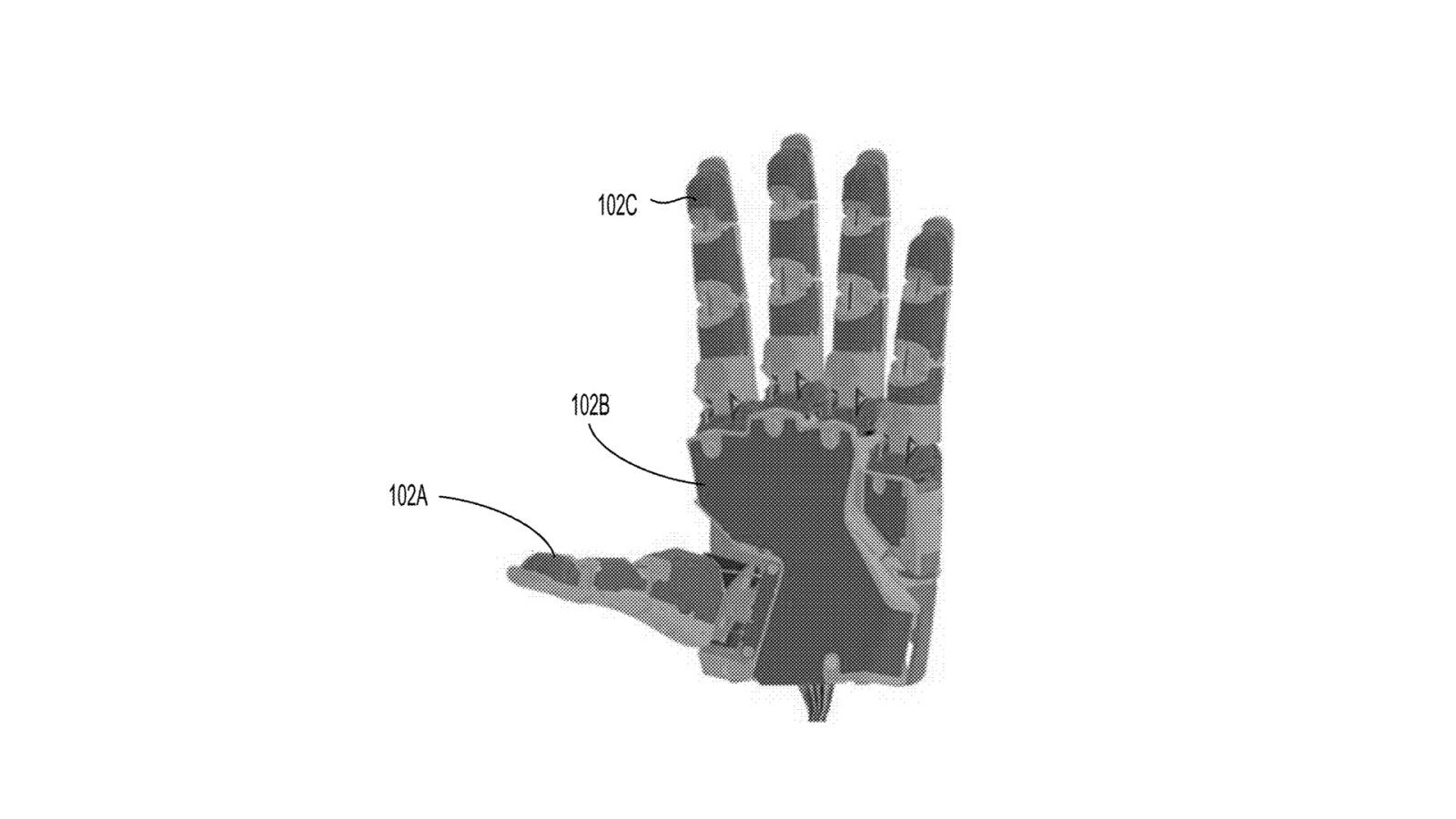
Its first drawing shows a robotic hand with one sensor along the thumb, a second covering much of the palm and a third on the index finger, with separate pads on each finger segment and a cable leaving at the wrist.
The filing does not mention Optimus, Tesla’s humanoid robot, whose hand CEO Elon Musk has repeatedly described as its most difficult part to engineer.
Tesla filed the application on September 11, 2025, claiming priority from a provisional application filed on April 4, 2025.
The filing was first reported on X by user ‘seti_park’.
Two Layers and a Separator
The sensor is a stack of two flexible plastic layers carrying printed conductive tracks, with a separator material between them.
Where the tracks on the two layers overlap, they form sensing points that the filing calls “pixels,” each able to detect contact independently.
Cross-section drawings show the tracks on the two layers running at right angles to each other, so each sensing point sits where two tracks cross.
With an insulating separator, pressing on the stack squeezes the gap between the tracks and changes the capacitance, while a separator made of carbon-loaded silicone, conductive elastomer or conductive foam changes its electrical resistance under force.
The filing names thermoplastic polyurethane, polyethylene terephthalate and polyimide as the base materials, and silver, carbon, copper and gallium-indium as conductive inks and pastes.
It describes two manufacturing routes.
In the first, the tracks are screen-printed or laid into laser-cut channels on flat sheets, the layers are stacked, and the stack is then heated and pressed into a mould shaped like the target surface.
One drawing shows a formed stack bent into a tight U-shape, with the tracks on both layers still facing each other across the separator.
In the second, the plastic is shaped first, and the tracks are added directly to the curved part by 3D dispensing, laser-direct structuring followed by metal plating, or pad printing.
The drawings for this route show a grid of tracks written onto a dome, with the separator dispensed as small dots on the grid before the second layer is laid over it.
The finished sensor can be mounted on a hard backing of plastic or metal, or on a soft one of foam, thermoplastic elastomer or silicone, and covered with a protective layer.
Besides fingertips, palms and robot end-effectors, the filing says the sensors could form a tactile “skin” for a humanoid robot, or cover “a robot, an autonomous vehicle, or any other type of system.”
The application has 20 claims, covering both manufacturing routes and the thermoformed sensor stack.
It contains no performance figures, such as the number of sensing points, their spacing, the force range or durability.
Despite the “multi-modal” in its title, the text describes sensors that can work in either capacitive or resistive mode and register force, touch and pressure, without separate sensing of shear, slip or temperature.
‘Incredibly Difficult’
Musk has singled out the hand as the hardest part of the robot. “Designing dexterous hands for robots is a very hard problem,” he wrote on X in September 2025.
“The Optimus hand and forearm is an incredibly difficult engineering challenge,” he said on Tesla’s earnings call the following month.
He has said the robot will have 50 actuators, 25 in each forearm and hand, and told investors in July that Optimus would have “a hand that has the same level of dexterity, if not higher, than a human hand.”
Tesla published four patent applications on Optimus’ upper limb in April, covering a tendon-driven hand, its joints, the wrist and the forearm.
Three days later, Musk wrote on X of the hand design: “We already changed the design. This one didn’t actually work.”
The Information reported in September that hand assembly, supplier constraints and equipment failures were threatening Tesla’s goal of building 1,000 Optimus robots a week by the end of the year, describing the hands as major manufacturing and durability challenges.
V3 Reveal Pushed Back
Tesla has also delayed the public debut of Optimus V3, the version it plans to mass-produce.
In October 2025, Musk said Tesla would show a production-intent V3 prototype in the first quarter of 2026.
“Optimus 3 is walking around, but needs some finishing touches before it’s ready to be shown,” he wrote on X on March 31.
On April 22, he said V3 would probably be shown in the middle of the year, and that Tesla was wary of revealing it early.
“We’re also a little hesitant to show V3 off because we find our competitors do a frame-by-frame analysis whenever we release something and copy everything they possibly can,” Musk said on the first-quarter earnings call.
“I think there’s some value to not showing new technology until it’s close to production,” he said.
Musk did not name the competitors, but told investors in January that China was “by far” Tesla’s biggest competition in humanoid robots.
Chinese rival XPeng began producing its IRON humanoid on a new line in September.
Tesla had not shown V3 publicly by the end of September, and it plans to display the older Optimus Gen 2 at the Paris Auto Show, according to the show’s organiser.
Production on Tesla’s converted Model S and X line in Fremont was due to start in late July or August, but the company’s July shareholder letter moved the start to “later this year”.
“No, Optimus production will be extremely slow at first, as everything is new,” Musk wrote on X in July. “This is not like making a car.”
On the second-quarter call, he described a goal of 1 million Optimus V3 units a year, and “sort of aspirationally” 10 million a year of a fourth version to be built in Austin.
Musk wrote on X last week that Tesla had cut the memory on its AI5 and AI6 chips because it was “the only way to get enough volume for Optimus production.”