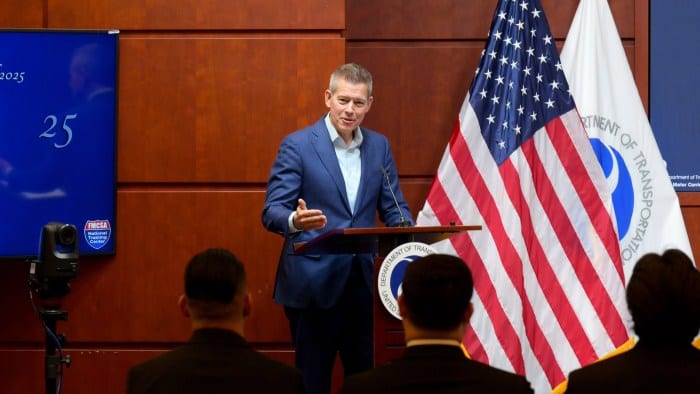
Germany’s Transport Ministry said it reached an agreement with Tesla in September on the carmaker’s FSD Supervised driver-assistance system, and that Transport Minister Steffen Bilger will now push for the software to be approved across the European Union.
Germany is Europe’s largest car market and the site of Tesla’s only European vehicle plant, at Grünheide near Berlin.
Tesla’s registrations in the country more than tripled in September to 12,552 units, its highest monthly total since December 2022.
The two sides agreed that the system may exceed the speed limit by a maximum of 10%, the ministry said in a statement published on Tuesday.
Tesla has also offered to rename the system “Tesla Assisted Driving”, according to the ministry, which called the current name “somewhat misleading”.
“We quickly found a common understanding and reached a constructive agreement,” Bilger said in the statement, referring to talks with Tesla in September. “On this basis I will now work to ensure that the system is approved across Europe soon.”
The statement does not say that the system has been approved in Germany, and it sets no date.
It was published hours after Bilger told a conference in Berlin that he wanted the system available across Europe soon and raised the prospect of a national solution if an EU agreement failed.
The written statement makes no mention of a national route and commits Germany to supporting the EU procedure.
What Was Agreed
The ministry described two points of agreement, on speed and on liability.
On speed, it said the ministry and Tesla “agreed that the driver-assistance system may exceed the permitted maximum speed slightly, by a maximum of 10%”.
Germany has “signalled its willingness to constructively support this approach in the European procedure”, the statement said.
Slight speeding “can, depending on the situation, contribute to a more even and smoother flow of traffic”, the ministry added.
On liability, it said responsibility stays with the person at the wheel because the software is an assistance system.
The driver “remains 100 percent responsible for safe driving”, according to the statement.
The Name
The ministry said the name FSD, short for Full Self-Driving, gives the wrong impression.
“This is not a system that takes over the complete driving task,” it said, describing software that can support acceleration, braking and steering while the driver stays attentive at all times.
Tesla already uses the name Tesla Assisted Driving for the system in China, where it made the change in May.
The company has not announced a change of name in Europe.
Germany’s Earlier Position
Speed was among the issues German officials had raised.
Christian Hirte, Parliamentary State Secretary at the ministry, wrote in September that Germany’s vehicle authority was in contact with the Dutch regulator over the software’s ability to exceed speed limits.
Sweden has indicated it would vote against EU-wide approval unless Tesla removes a function that lets drivers set the car to travel above the limit.
The statement now accepts a tolerance of up to 10% and says Germany will support it in the EU process.
Germany is following the approval process “in close exchange” with its Federal Motor Transport Authority, the Dutch type-approval authority and Tesla, the ministry said.
On current findings the system shows “a high level of performance, particularly in urban traffic”, it added, while questions about individual functions and liability had been “examined intensively”.
What Still Has to Happen
FSD Supervised is on European roads on the basis of a provisional approval granted by the Dutch vehicle authority RDW on April 10.
That approval applies at first only in the Netherlands, and seven other member states have since chosen to accept it, most recently Croatia.
Germany is not among them, and the statement does not say it will take that step.
Validity across the whole bloc requires a qualified majority in the EU’s Technical Committee on Motor Vehicles, meaning at least 15 of the 27 member states representing 65% of the population.
The committee was due to meet on Tuesday with a draft agenda that listed discussion of the Dutch request and no vote.
Germany accounts for 18.6% of the EU’s population, which makes its position significant in that arithmetic.
“My goal is that Tesla drivers can use the advantages of Assisted Driving throughout the EU as quickly as possible,” Bilger said.