
Lucid Motors sold 905 vehicles in the United States in May, down 7% from the 975 units recorded in the same month a year earlier, according to sales estimates published by Motor Intelligence on Tuesday.
Over the first five months of 2026, the Saudi-backed EV maker sold 5,838 vehicles in the US, up 38.8% from 4,207 over the same five-month period in 2025.
Cumulative growth reflects a sharp start to the year despite being compared to a slow base as Lucid faced issues in producing Gravity SUVs in the first half of 2025 — as first reported by EV in February 2025 and later confirmed by the management.
Recent monthly volumes have since cooled, mainly due to delivery disruptions in the first quarter.
Lucid registered 1,700 vehicles in January and 1,500 in February, up 156% and 86% year over year as the SUV reached customers in volume for the first time.
Monthly figures have since settled below 1,000, with 893 registrations in March, down 5%; 840 in April, up 2%; and 905 in May, down 7%.
Compared with other US EV manufacturers, Lucid has had a relatively strong start to the year.
In the first quarter, both Tesla and Rivian reported year-over-year declines in US sales.
Tesla‘s US registrations in May were lower than a year earlier for the eighth consecutive month.
Rivian, after posting year-over-year growth in April, returned to a decline in May.
Model Breakdown
The agency reports registrations split between “cars” and “trucks,” rather than by model name.
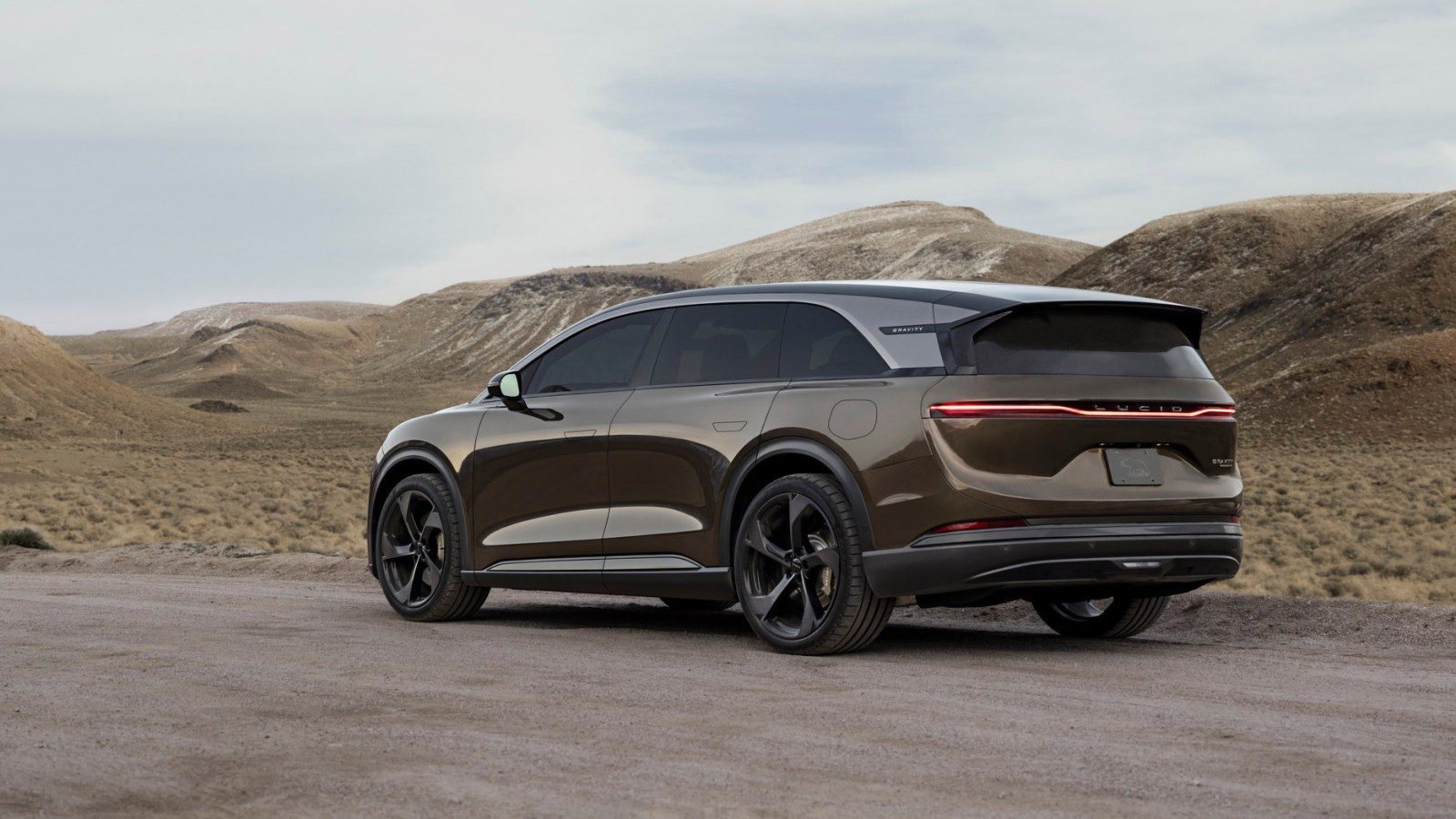
Lucid‘s US lineup currently consists of only the Air, classified as a car, and the Gravity, classified as a light truck.
A two-nameplate lineup allows the agency’s car-versus-truck breakdown to map directly onto each model, giving a per-model read that the company does not disclose.
Registrations of the Air sedan totaled 310 units, while the Gravity SUV accounted for 595 — making the SUV responsible for roughly two-thirds of Lucid‘s US volume for the month.
Air registrations of 310 mark the sedan’s continued slide as the model ages against newer competition in the premium segment.
Lucid has launched the 2027 model year for the Gravity — but not for the Air sedan.
A Quarter of Disruption
May’s registration count follows a first quarter shaped by a supplier problem that halted Gravity deliveries.
Lucid temporarily halted Gravity deliveries in February after a defective second-row seat-belt anchor was traced to the seat supplier, Camaco Automotive.
A physical recall affected more than 4,000 Gravity SUVs built before February 14.
The company produced 5,500 vehicles in the quarter but delivered 3,093 — flat against the first quarter of 2025, opening a 2,407-vehicle gap between production and delivery.
Pomerantz LLP has since filed a federal securities class action against Lucid, former interim CEO Mar Winterhoff and CFO Taoufiq Boussaid — alleging the company concealed the supplier defect that halted Gravity deliveries for 29 days while publicly promoting improved manufacturing and delivery capabilities.
Quality issues have extended beyond the seat-belt recall.
Lucid is pushing a software update to 2,039 Air sedans to address an inverter defect.
VP of Comms Nick Twork has said a mobile key feature is expected in the third quarter as key-fob reliability complaints persist.
Q1 Earnings and Outlook
Disruption pushed first-quarter gross margin to negative 110.4%, against negative 80.7% in the prior quarter and negative 97.2% a year earlier.
Wall Street responded to the quarter with four price-target reductions, with Morgan Stanley halving its target.
Citi separately trimmed its target to $14.00 while retaining the only Buy rating on the stock.
Silvio Napoli, who was appointed by Lucid as its CEO in mid-April after a 14-month search, formally took the chief executive role on Tuesday after a wait tied to US work authorization.
He declined to comment on the first-quarter outlook on his maiden earnings call, citing his recent arrival, and pointed to a strategic update in the second quarter.
On the product front, the midsize Cosmos has appeared in two sets of spy shots ahead of its debut.
Management has positioned the midsize platform, which will start below $50,000, as the route out of structural unprofitability, with production scheduled to ramp in 2027.
Robotaxi Program
Lucid‘s partnership with Uber and autonomous driving startup Nuro remains a central plank of its medium-term revenue plans.
Uber has committed to purchase at least 35,000 robotaxi vehicles built on the Gravity and the upcoming midsize platform, up from an initial 20,000-unit agreement struck in 2025.
Nuro has ended a 32-month chief financial officer vacancy and reaffirmed the launch timeline for the commercial robotaxi service.
The startup also secured a second key robotaxi permit within a week, advancing the regulatory groundwork for driverless operation of the Lucid Gravity.
Commercial launch of the robotaxi service remains scheduled for late 2026, with production validation builds of the robotaxi-specification Gravity targeted to begin in the second quarter and regular production for commercial sale set for early in the fourth quarter.