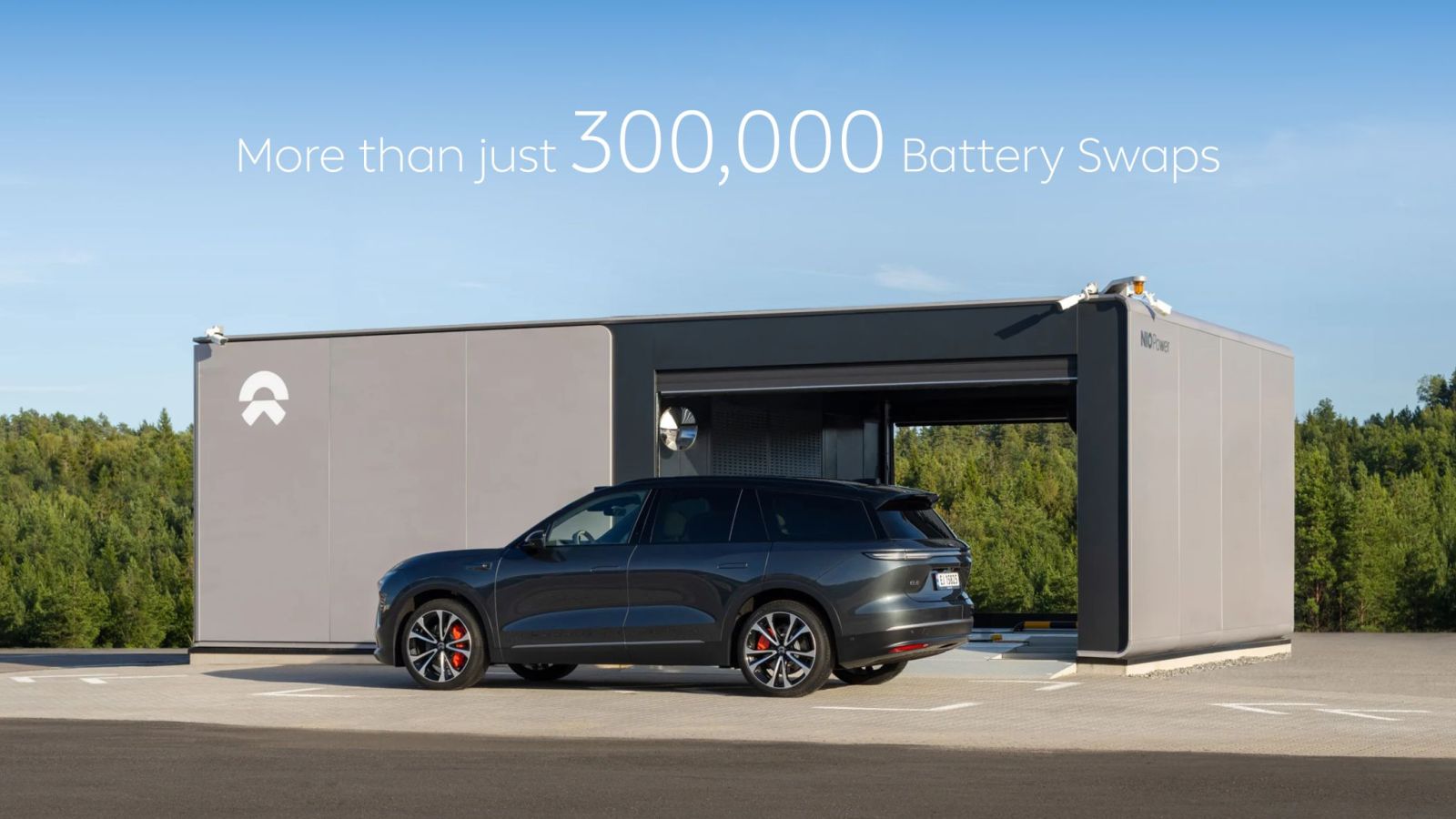

Nio completed its 300,000th battery swap in Europe on June 21, the company said on Wednesday, even as the rollout of new stations on the continent remains nearly frozen.
The figure caps a marked slowdown in how quickly the latest swaps piled up, even as more Nio vehicles reached European roads.
The Shanghai-headquartered company has pushed Europe down its priorities until 2028, with founder and chief executive William Li viewing competition there as fierce as in China.
Nio completed its first 100,000 European swaps in November 2024, almost three years after its first swap, performed in Lier, Norway, in January 2022.
Few stations existed in those early days; when Nio marked its first 10,000 European swaps, in early 2023, it ran just 11 on the continent.
The second 100,000 came far faster, in 269 days, reached in August 2025.
Reaching the third 100,000 took longer — 307 days, from August 2025 to June 21.
That is 38 days more than the previous 100,000 required, despite a larger base of cars and drivers.
Each swap takes about three minutes, Nio said.
On its busiest day, June 6, drivers completed 481 swaps in 24 hours. Two owners in Germany have between them used 40 different stations.
About two-thirds of European Nio customers now choose swapping over charging, the company said.
Nio said it has delivered more than 17.6 million kWh through European swaps, which it compared to the annual electricity use of about 4,638 households. The busiest site is in Bryn, Oslo.
Across the network, Nio said it performed one swap every 2.39 minutes during opening hours this year, quicker than the 2.84-minute rate it reported for 2025.
A Network on Hold
Behind the rising swap count, the physical network has barely moved.
Nio runs about 60 swap stations across six European countries, most of them in Norway and Germany, according to its power map and its latest annual report.
The build-out was once quick. Nio reached 30 European stations by November 2023 and added 20 more within eight months, hitting 50 by July 2024.
Growth has since fallen to barely one station a month, and management has said no new swap stations will be added in Europe in 2026, leaving this year’s openings to China.
The most recent additions had already slowed to a trickle, with the 59th station opening in December 2024 and the 60th in late April 2025.
For the first time, the network has also contracted.
As reported by EV, the brand closed its only Danish station, in Slagelse, in November — the first swap facility it had shut anywhere in Europe since arriving on the continent in 2021.
The site, once the 12th Nio station in Europe, had supplied grid-balancing services to the Danish power system since 2024. Its removal left the European total at 60, down from 61, and accompanied a relaunch of the brand in Denmark under a local distributor and without battery rental.
Nio‘s stations in Sweden have, by contrast, won approval to provide grid frequency regulation, a small but recurring source of revenue per site.
Cuts Behind the Slowdown
The stall traces to spending cuts at Nio Power, the group’s energy arm.
As EV reported in April 2025, the European unit had been cut to five active employees, two of them on long-term sick leave and shielded from dismissal. Only three new station projects were still advancing, each tied to a binding contract.
Nio had signed contracts for 170 sites across Europe, but people familiar with the plans described many as “barely usable,” because the urban-focused Firefly brand needs city-centre locations while the existing stations were built for long-distance highway travel.
Weak Sales and New Rivals
Nio‘s registrations in Europe have fallen to their lowest levels since it entered the region.
In May, the group registered just three vehicles in Germany, once one of its two strongest European markets, down from 22 a year earlier.
Its German total for the year stands at 12, an 89% drop.
Norway remains the strongest, helped by sitting outside the European Union’s tariffs, which reach 30.7% on Nio vehicles. Firefly, the group’s cheapest brand, starts at €29,900 in Europe, close to double its Chinese price.
In Norway, the group registered 43 vehicles in May, 28 of them Firefly models, though Nio has said its official European figures understate its presence because of an early subscription model.
Nio broke up its European management structure in February, splitting the operation into six departments and moving sales to a dealer-and-distributor model.
The company aims to sell “several thousand” vehicles outside China this year.
Nio returned to a non-GAAP operating profit in the first quarter, its second straight, giving management room to prioritise China over a loss-making European build-out.
New competition is arriving even as Nio pauses.
CATL has told the Financial Times it plans to bring its own modular swapping to Europe, starting with commercial fleets in markets such as Germany, France and the Netherlands.
The battery maker is also building a separate swap system for electric trucks, though its push for drivers centres on cars.
CATL, which already runs more than 1,000 swap stations in China, is pursuing the European rollout partly through a venture with Britain’s Octopus Energy.
A pioneer batch is due in mid-2026, with a Firefly swap on the new stations taking about three and a half minutes.
Swapping remains Nio‘s signature feature. The company passed 100 million swaps globally in February with nearly all of them being achieved within its home market.