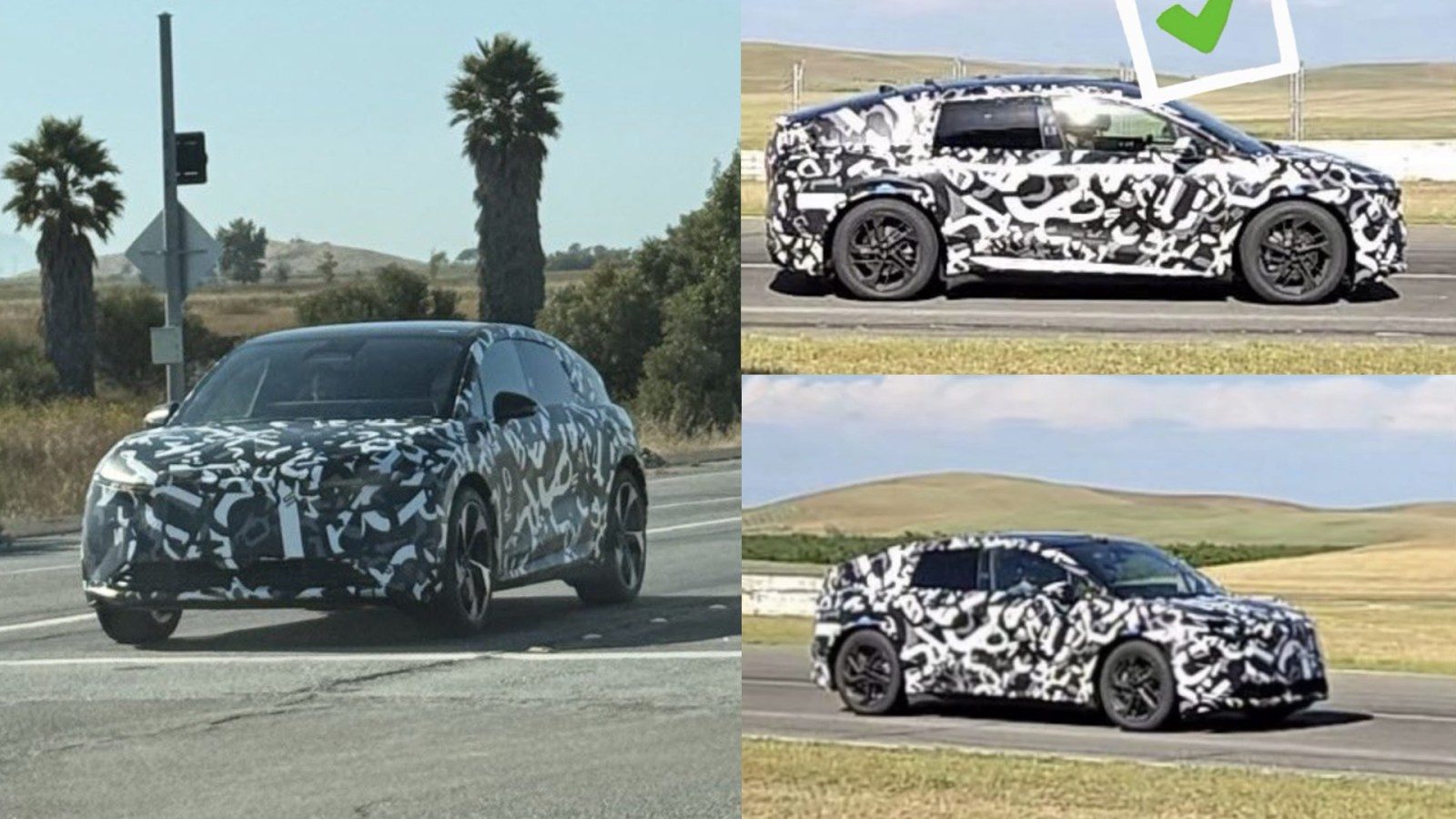

A camouflaged Lucid Cosmos has been spotted testing on public roads twice in recent days, with one sighting near the company’s factory in Casa Grande, Arizona.
One of the images was shared on X by ‘john61640 and shows the Cosmos wrapped in black-and-white camouflage and stopped at an intersection beside a previous-generation Tesla Model Y.
The sighting drew a telling response from inside Lucid.
Cory Steuben, the company’s Director of Cost Engineering, quote-reposted the photo the next day with an “👀” eyes emoji — an apparent nod from a senior executive that the camouflaged vehicle is indeed one of the automaker’s midsize prototypes.
The sighting comes as Lucid prepares for the full public unveil of the Cosmos this summer. An official date for the event has not yet been announced as of Sunday morning.
Production is slated for late 2026 at Lucid‘s AMP-2 plant in Saudi Arabia’s King Abdullah Economic City, a sequencing decision that lets the company bypass tariffs that would apply to a start of production in the US.
Output at the Arizona plant is expected to follow in 2027.
A Make-or-Break Model
The Cosmos is the most consequential product in Lucid‘s pipeline allowing
Priced below $50,000, it is the company’s first midsize model and its entry into the high-volume segment where the Tesla Model Y and the newly launched Rivian R2 compete.
Lucid has positioned the midsize program as the line that determines whether the Saudi-backed EV maker reaches profitability after years of cash burn and modest volumes on its luxury Air sedan and Gravity SUV.
The Cosmos will not contribute meaningfully to 2026 volumes, as the interim CEO Marc Winterhoff recently announced.
The company has guided for 25,000 to 27,000 vehicles produced this year, with the Gravity accounting for the vast majority.
However, Lucid has recently suspended its 2026 production guidance — when reporting its first quarter financial results.
A Platform Built for Cost
The Cosmos is built on an entirely new platform powered by the Atlas drive unit, a ground-up redesign with 30% fewer parts, 37% lower manufacturing cost, and 23% less weight than the Zeus powertrain used in the Air and Gravity.
Chief engineer Zach Walker said Atlas is 40% more power-dense than its closest competitor.
The electrical architecture moves to a centralized layout. The midsize platform uses just three pieces of electrical hardware, compared to twelve in the Gravity.
As EV reported last month, Steuben — the former president of teardown benchmarking firm Munro & Associates — said the Cosmos uses about half the wire count of a comparably equipped Chinese model and hit a wire harness cost target set at 40% of the Air and Gravity.
Steuben said the program is landing “at or near should-cost predictions across the board.”
The platform targets an 80% reduction in battery assembly components, 50% lower labour and overhead costs, and up to 70% lower unit costs relative to Lucid‘s current models.
On March 12, then-interim CEO Marc Winterhoff claimed, citing A2MAC1 benchmarking data, that the Cosmos bill of materials undercuts both a leading US midsize EV and a comparable Chinese-built model.
The company deliberately avoided full-underbody gigacasting — the technique used by Tesla, Rivian, and others — in favour of four corner-node mega castings with bolt-on replaceable crash structures.
Steuben said the decision was driven by insurance repairability and total cost of ownership.
Efficiency, Range, and Charging
The platform uses an 800-volt architecture with a 69 kWh battery delivering approximately 300 miles of range at an efficiency target of 4.5 miles per kWh.
The Cosmos can regain over 200 miles of range in 14 minutes of DC fast charging and reaches 60 mph in 3.5 seconds in all-wheel-drive configuration.
Design chief Derek Jenkins told reporters the drag coefficient will come in below 0.22, a figure that would be remarkable for any utility vehicle and would beat the Gravity’s already-low 0.24.
What Reporters Saw in March
Lucid has been guarded about the Cosmos’ exterior.
At its Investor Day in New York on March 12, attendees were given hands-on access to a finished design mockup and a body-in-white production-validation vehicle, but phones were confiscated before entry and no exterior photographs were published.
Car and Driver described the Cosmos as a smaller, sleeker echo of the Gravity — shorter, lower, with five seats instead of seven and a drooping roofline.
Kyle Conner of Out of Spec Reviews, the first person outside Lucid to sit in the vehicle, called it a “younger, more modern” Gravity with a “totally unique” rear end and a “striking” interior.
The cabin replaces the dual-screen layout of the Air and Gravity with a single 36-inch-wide display, with an AI voice assistant called “Lucid Intelligence” as the primary interface.
The front light bar hides camera, radar, and LiDAR sensors — the first confirmation that the Cosmos will carry LiDAR.
Conner described the frunk as “insanely large” and said total cargo volume exceeds that of a Toyota RAV4.
The Midsize Lineup
The Cosmos is the first of three midsize models.
The second, called Earth, targets a more adventurous buyer and follows about one year after the Cosmos. A third unnamed model aimed at “active explorers” will come later with an off-road focus.
All three share approximately 95% of their components. The platform also underpins the Lunar, Lucid‘s two-seat robotaxi concept revealed at the same event.
Uber has expanded its purchase commitment from 20,000 to at least 35,000 Lucid vehicles, now including the midsize platform alongside the Gravity.
The ride-hailing giant’s CEO Dara Khosrowshahi said the midsize platform “creates an even clearer path to stronger unit economics.”