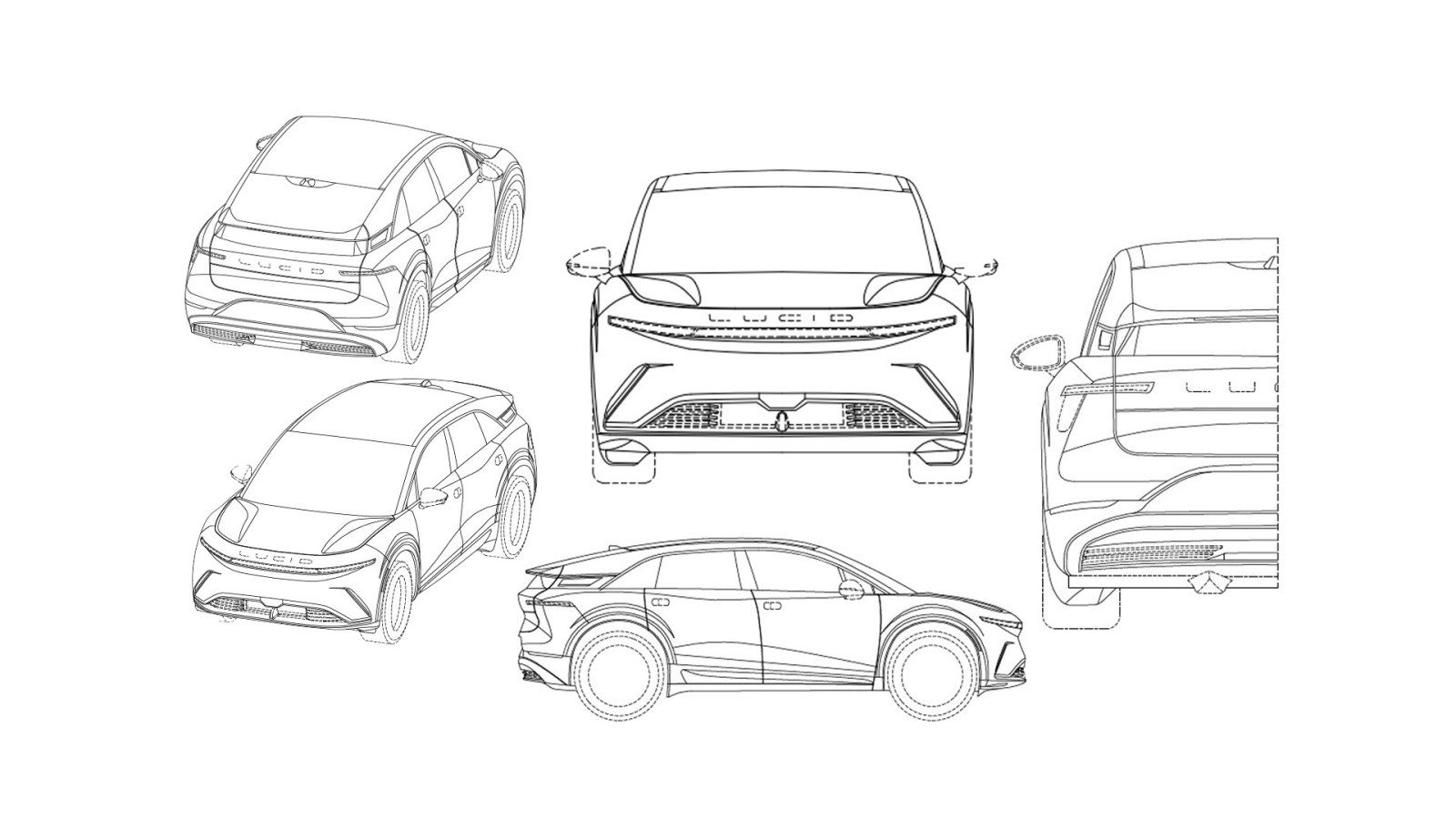

Lucid Motors has registered the design of its upcoming Cosmos midsize SUV with the European Union Intellectual Property Office, giving the clearest look yet at a vehicle the Saudi-backed EV maker has kept under wraps since March.
The design was applied for and registered on May 22, 2026, and only published — and so made publicly visible — on June 15, which is why it has surfaced now.
The registration was made under Atieva Inc., Lucid‘s former corporate name.
No model designation appears in the documents. However, the design closely matches the vehicle Lucid showed to media and Wall Street analysts at its Investor Day in New York on March 12 — an event where phones were confiscated and no exterior photographs were published.
A camouflaged prototype was spotted testing near the company’s Casa Grande, Arizona factory in late May, but the patent drawings mark the first time the Cosmos has appeared without camouflage or concealment.
Side-profile images show a compact crossover utility vehicle visibly smaller than the Lucid Gravity.
A roofline slopes sharply from the B-pillar into a rear spoiler that partially obscures the rear window.
A slim full-width light bar spans the front bumper, flanked by angular air intakes at the corners.
Some drawings feature a more pronounced lower front grille that extends forward with a larger opening, while others show a cleaner, more restrained front end.
Lucid previously disclosed that the Cosmos performance variant targets a 0-60 mph time of 3.5 seconds.
Dutch outlet Auto Week first reported the filing on Tuesday.
Platform and Cost Architecture
Cosmos is the first vehicle built on Lucid‘s all-new Atlas midsize platform, an 800-volt architecture that also underpins the Earth, a third unnamed off-road-oriented variant, and the Lunar two-seat robotaxi concept developed in partnership with Uber.
Chief engineer Zach Walker said at Investor Day that Atlas has 30% fewer parts, 23% less weight, and 37% lower bill of materials than the Zeus platform used by the Air and Gravity.
Walker added that the Atlas drive unit is 40% more power-dense than its closest competitor. A 69 kWh battery pack targets 300 miles of range at an efficiency of 4.5 miles per kWh.
Cost competitiveness has been central to Lucid‘s pitch for the midsize programme.
Then-interim CEO Marc Winterhoff claimed at Investor Day, citing benchmarking data from A2MAC1, that the Cosmos bill of materials undercuts both a leading US midsize EV and a comparable Chinese-built CUV.
Neither competitor was named.
Director of cost engineering Cory Steuben — the former president of teardown firm Munro & Associates — said in a subsequent interview that the Cosmos uses approximately half the wire count of a comparably equipped Chinese model and hit a wire harness cost target set at 40% of the Air and Gravity.
Lucid‘s midsize platform uses just three pieces of electrical hardware, compared to twelve in the Gravity.
Broader targets for the platform include an 80% reduction in battery assembly components, 50% lower labour and overhead costs, and up to 70% lower unit costs relative to the company’s current models.
Steuben also confirmed that the EV maker deliberately chose not to use gigacasting for the Cosmos underbody, citing total cost of ownership and insurance repairability — a notable divergence from Tesla, Rivian, and several other manufacturers that have invested billions in the technique.
Pricing and Production
Lucid has confirmed a US starting price below $50,000.
Production is scheduled to begin at Lucid‘s AMP-2 plant in Saudi Arabia’s King Abdullah Economic City by the end of this year.
CFO Taoufiq Boussaid said the Saudi sequencing allows the company to source certain components from China without incurring the tariffs that would apply to US-based assembly.
Output at the Arizona plant is expected to follow six to 12 months later.
Boussaid cautioned that the Cosmos will see a slow production ramp through 2027, with full capacity targeted for 2028. The Saudi facility has capacity for 150,000 midsize units per year.
A public debut is planned for this summer. An official date for the unveil event has not been announced.
European Expansion
The design filing comes as Lucid works to scale a European operation that remains in its earliest stages.
The company registered 35 vehicles across Europe in May, a 12.9% year-over-year increase from 31 units and a six-unit gain over April, according to official data compiled by EV.
Germany accounted for 60% of the total with 21 registrations.
Year-to-date, Lucid has registered 118 vehicles across the continent.
Lucid confirmed to EV that the first European customer handover took place in the Netherlands in late December 2025, though the company did not publicly disclose the delivery until May.
The first sale through a retail partner came in May via the Wackenhut Group in Baden-Baden, Germany — the family-owned Mercedes-Benz dealer that became Lucid‘s first European distributor.
Lucid‘s leadership has been explicit that the current lineup is too large and too expensive to drive meaningful European volume.
Winterhoff attributed the growth of Chinese OEMs in Europe to low-cost vehicles and noted that brands selling higher-priced EVs have not performed well on the continent.
Boussaid also acknowledged that the Air and Gravity are oversized for European buyers.
Both executives framed the midsize platform as the inflection point — Winterhoff said the company is not projecting significant European growth from the current range, adding that the dynamic will shift with the Cosmos.
Lucid currently sells in four European markets — Germany, the Netherlands, Switzerland, and Norway — and plans to expand to as many as 12 by year end.
Belgium opened on June 2.
As EV exclusively reported last week, Lucid has delayed its entry in both Spain and Austria to 2027.
The United Kingdom entry has been pushed to 2028, when the EV maker plans to enter with the Cosmos rather than either of its current models.
European President Lawrence Hamilton framed the Air and Gravity as brand-building vehicles and called the midsize platform the company’s real volume play.