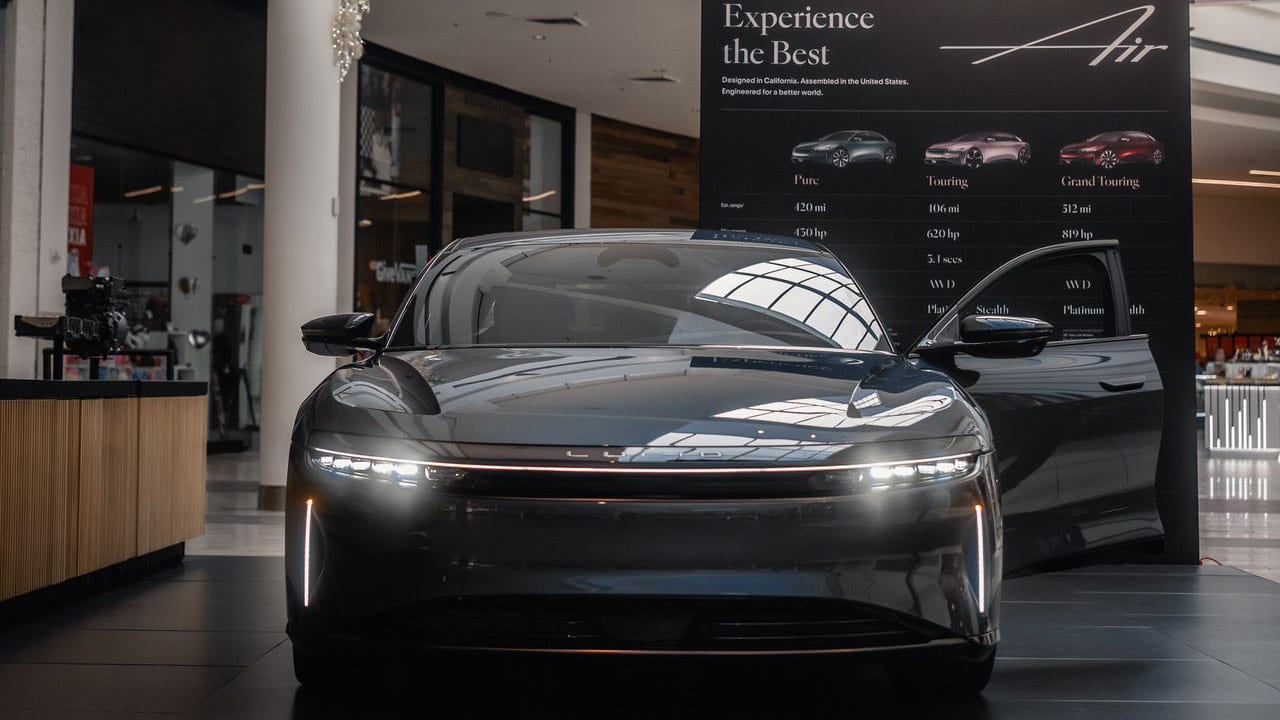

EV maker Lucid Motors will be rolling out an over-the-air (OTA) software update to 2,039 of its Air electric sedans in the US over an inverter defect that can cut drive power without warning, raising the risk of a crash.
The issue covers 2024 and 2025 model-year Air Pure Rear-Wheel Drive vehicles built with a Gen 4 inverter.
Lucid filed the action with the National Highway Traffic Safety Administration (NHTSA) on May 27, and the agency acknowledged it the following day.
As of press time, shares of the Saudi-backed EV maker were trading slightly lower at $6.43.
The Defect
The fault lies in the Gen 4 inverter, the part that converts the battery’s DC power into the AC current that runs the motor.
Vibration from the motor travels into the inverter and acts on its internal components.
Over time, that movement wears the pads and contacts on the gate driver circuit board, a process known as fretting. The friction damage can interrupt internal signals and trigger a switching module failure, according to the NHTSA report.
When the module fails, the inverter can no longer convert power, and the car suffers what the filing calls an “unwarned loss of drive power.”
Lucid estimates that about 1.6% of the recalled population, or roughly 33 vehicles, actually carries the defect.
Only the Air Pure RWD
The issue is limited to the single-motor Air Pure as the variant runs on one drive unit, the rear drive unit, so a single inverter failure leaves no backup.
Dual-motor Air models, including Touring and Grand Touring, are excluded.
Their second motor can keep the car moving if one unit fails, which removes the risk of a complete, unwarned power loss.
Lucid further narrowed the population to cars built with the Gen 4 inverter specifically.
Every failure tied to this issue occurred on a Gen 4 unit, and no other inverter generation showed the fault.
The OTA Remedy
Lucid will push an over-the-air update, targeted for around the end of June, that adds more sensitive monitoring logic to each car.
The software watches for signs of an impending Gen 4 inverter failure, sets a diagnostic trouble code, and triggers an in-vehicle alert.
The warning reads “Drive System Fault, Schedule Service Immediately,” and it remains latched until cleared by LucidService.
Lucid expects drivers to receive the alert at least 100 miles before any actual loss of power.
Only cars that trigger the warning go in for hardware work.
At the service center, Lucid will inspect the vehicle and, if necessary, replace the Gen 4 inverter with a later-generation unit at no cost.
The EV maker will mail remedy notification letters on July 10.
How Lucid Traced the Problem
Lucid first saw the failures in March 2025, on Air Pure RWD cars run by a fleet operator that accumulated miles faster than typical owners.
Non-fleet cars began showing the same fault months later.
Between March 2025 and March 2026, Lucid logged 55 inverter failures attributable to the defect, one of which reached NHTSA as a formal complaint.
Engineers ruled out heat as a primary cause after a software-based cooling adjustment produced no measurable benefit.
They settled on fretting inside the Gen 4 inverter as the root cause.
Lucid had already deployed a Fleet Health Monitoring alert to flag at-risk cars and tightened that logic in November 2025.
Some failures still slipped past the system before it could warn the driver, prompting Lucid to raise the data sampling rate for sharper detection.
The matter moved up to Lucid‘s Product Safety Executive Council, which declared a safety defect on May 6 and approved the recall.
The council concluded that an adequate driver warning, delivered over the air, would mitigate the risk.
Production and Recall History
Lucid builds the Air at its AMP-1 plant in Casa Grande, Arizona.
The recalled cars left the line between September 13, 2023, and December 12, 2024.
Lucid has since stopped fitting Gen 4 inverters to new vehicles. The inverter campaign adds to a string of safety actions in 2026.
Earlier this year, Lucid recalled 3,627 Air sedans over half-shaft bolts that could disengage and cut drive power, and pulled 4,476 Gravity SUVs over insufficient seat belt anchor welds, an action that triggered a stop-sale.
The company also issued a software fix for a rearview camera fault on more than 10,000 Air vehicles.