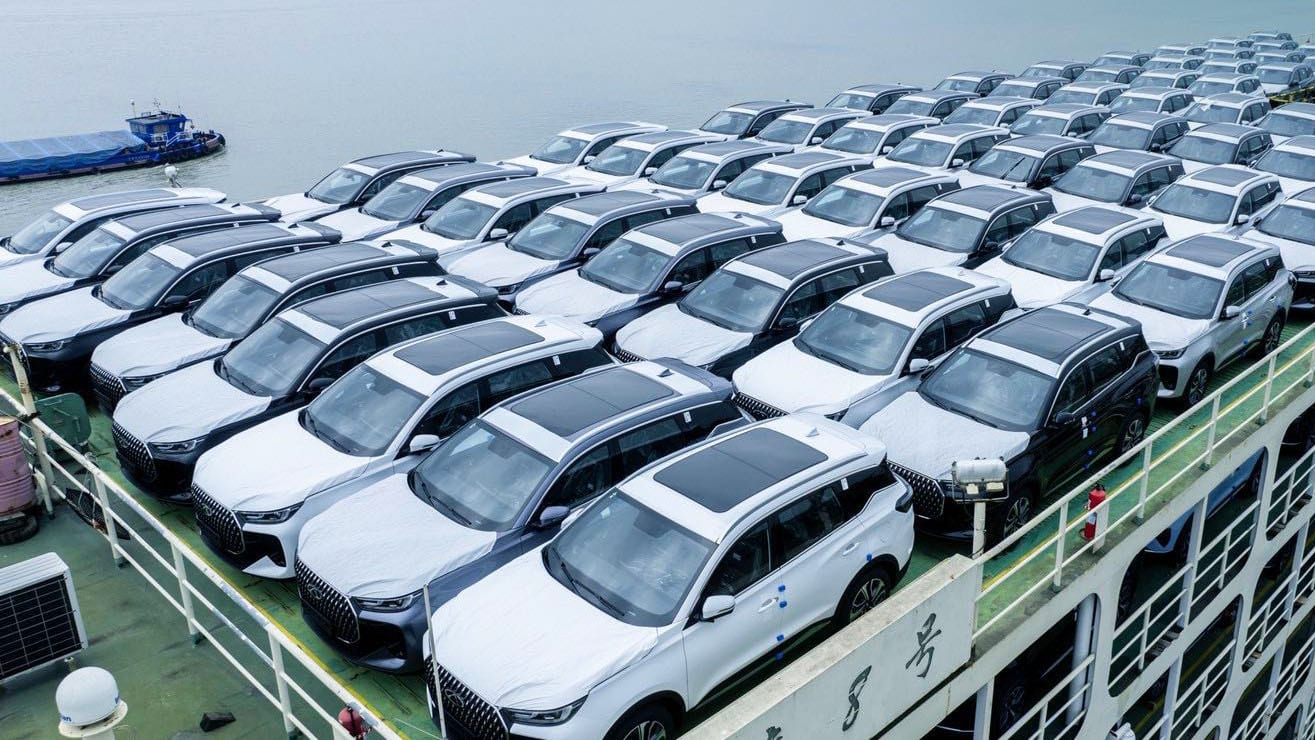

Mike Rogers, the Republican US Senate candidate in Michigan, says Washington should pressure Ottawa to keep Chinese EVs out of Canada as a condition of opening the newly built Gordie Howe International Bridge.
“I would use that leverage,” Rogers told The Detroit News on Monday.
The former congressman wants the long-delayed span over the Detroit River folded into a broader fight over Chinese cars in the North American market.
Rogers’ target is the trade framework Canada struck with Beijing in January, when Prime Minister Mark Carney cut the country’s 100% tariff on Chinese EVs to 6.1% on an annual quota of 49,000 vehicles.
A Bridge Caught in a Trade Fight
The Gordie Howe crossing is a 1.5-mile, $4.7 billion span linking Michigan and Ontario, financed by Canada.
A ribbon-cutting was abruptly canceled earlier this month after objections from Trump administration officials, leaving the opening in limbo.
President Donald Trump had threatened in February to block the bridge unless Canada offered concessions in trade talks or a share of future toll revenue.
The dispute sits inside a tense review of North American trade, with Ottawa pressing for relief from Trump-era tariffs even as Washington treats the Chinese EV quota as a fresh point of friction.
Rogers wants to attach the Chinese EV question to that standoff.
He called the moment a chance to “push back on this Chinese car production issue” and to bring Ottawa, in his words, “to a better place” on Chinese-made cars entering the northern market.
What Canada Agreed To
Under the January framework, Canada replaced the 100% surtax it imposed on Chinese-built EVs in 2024 with a 6.1% most-favoured-nation tariff on up to 49,000 vehicles a year, a figure set to rise to 70,000 by 2030.
In exchange, Beijing eased the retaliatory duties that had shut Canadian canola out of the Chinese market, cutting the roughly 85% tariff on canola seed toward 15%.
The quota took effect on March 1 and covers less than 3% of Canada’s new vehicle market.
Carney has defended the structure to Trump directly, describing it at the G7 as a “hard cap” rather than an open door.
Washington has stayed wary throughout, with US officials warning that Canada could become a backdoor for Chinese vehicles and components into the wider North American market.
The Production Question
Rogers framed his concern around manufacturing, not just imports — the issue that has animated EV‘s recent coverage.
Buried in the January deal is a clause requiring Chinese automakers to set up joint ventures or local manufacturing in Canada within three years of entry.
Ottawa has treated the quota as bait for exactly that outcome.
Industry Minister Mélanie Joly has courted four Chinese automakers to build EVs on Canadian soil, and Carney has doubled down on demands for Chinese investment as the price of market access.
No Chinese carmaker has committed to a Canadian plant so far.
Joly rejected a plan by Stellantis to assemble Leapmotor cars from Chinese kits at its idled Brampton, Ontario factory — an arrangement that would have made Leapmotor the first Chinese brand built in Canada.
The first Chinese EVs reached Canadian soil in May, the CBC reported, with Lotus the first brand to ship cars across under the framework — as imports, not locally assembled vehicles.
‘Existential Threat’
Rogers cast Chinese cars as the central danger to American manufacturing.
He called them “the biggest existential threat” to the US auto business, arguing that Beijing subsidizes the vehicles to undercut competitors.
His framing echoes Ford Chief Executive Officer Jim Farley, who has previously likened Chinese EVs to an “existential threat” for the North American industry, a warning Detroit’s legacy automakers have repeated as they brace for the cars’ arrival.
The goal, he said, was to “stop Canada from hurting American automobile workers.”
Canada is the largest export market for US-made vehicles, even as China looks to exploit regional trade strife and a broader retreat from EV targets across North America.
BYD, Geely and XPeng are among the automakers that have met Canadian officials while weighing North American expansion.
Tesla, already delivering Shanghai-built cars to Canada, is positioned to capture the largest share of the quota in its first year — a reminder that the framework benefits Western brands manufacturing in China as much as Chinese ones.
Contested on Both Sides of the Border
Opposition leader Pierre Poilievre’s Conservatives want the quota scrapped entirely and Canada’s China tariffs realigned with Washington’s.
Ontario Premier Doug Ford has branded Chinese-built cars “subsidized spy cars,” while Ottawa has weighed capping how much of the quota any single automaker can claim.
Polling has nonetheless shown Canadians far more receptive to Chinese cars than Americans, a divide EV documented in the weeks after the January deal.
A Republican Breaking With Trump
Rogers’ stance puts him at odds with Trump, who has signaled openness to letting Chinese automakers manufacture inside the United States.
“That’s where he and I disagree,” Rogers said.
He argued that he, unlike Michigan’s two Democratic senators, could press the case with the president in person.
“All they do is poke him in the eye,” Rogers said of Gary Peters and Elissa Slotkin, the latter of whom defeated him in the 2024 Senate race.
A seven-term former congressman from White Lake Township, Rogers also praised a Senate bill from Slotkin and Bernie Moreno that would ban the import, manufacture and sale of internet-connected vehicles tied to China and other adversaries.
On the bridge’s eventual use, he said truckers should keep the choice between the new span and the privately owned Ambassador Bridge, which has held a monopoly on commercial crossings at the Detroit River.