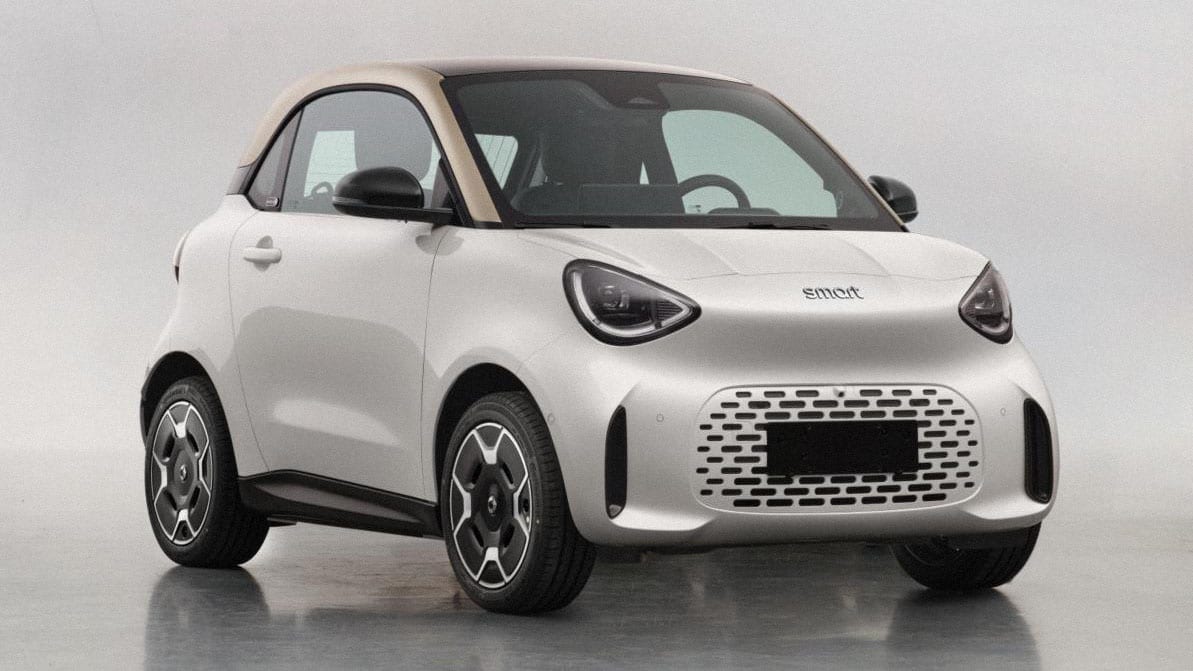

Smart‘s long-awaited successor to the Fortwo has surfaced in China’s regulatory filings, confirming the production form of the two-seat electric city car ahead of its global debut at the Paris Motor Show in October.
The new Smart #2 appeared in the latest catalog published by China’s Ministry of Industry and Information Technology, the certification step that precedes production and sale in the country.
The model will premiere at the Paris Auto Show, which opens on October 12.
The filing marks the return of the layout that built the brand: two doors, two seats and a footprint small enough to park nose-to-curb, a formula Smart abandoned when the original Fortwo went out of production in 2024 after a 26-year run.
Slightly Shorter Than the Concept
Per the filing, the production #2 measures 2,751 mm (108.3 inches) long — 2,764 mm in one configuration — 1,669 mm wide and 1,555 mm tall, on a wheelbase of just 1,875 mm.
The production version comes in marginally shorter than the Concept #2 shown in April, which stretched 2,792 mm, and only slightly longer than the final third-generation Fortwo’s 2,695 mm.
Those dimensions would make the #2 the shortest electric passenger car on sale, undercutting the Fiat 500e by close to a meter, with anything smaller — such as the Citroën Ami — falling into the quadricycle category.
The filing lists a turning diameter of 6.95 meters, matching the figure Smart has quoted for the model’s city maneuverability.
Power comes from a single 60 kW rear-mounted drive motor, supplied by Xingqu Technology (Jiaxing) Co., a Geely e-drive affiliate, paired with a lithium iron phosphate battery pack — preserving the rear-drive character of the original Fortwo.
Smart has separately confirmed a range of roughly 300 km (186 miles), charging from 10% to 80% in under 20 minutes, and vehicle-to-load capability allowing the battery to power external devices.
Design Stays True to the April Concept
The filing images show a production car closely aligned with the Concept #2, which was unveiled during the Beijing auto show week in April.
The front end adopts a closed EV face with a split lighting arrangement, rounded triangular headlamps housing three-segment LED daytime running lights, and a large cooling aperture in the lower bumper.
In profile, the #2 keeps the brand’s signature wheels-at-the-corners stance with minimal overhangs, a floating roof and subtly widened arches, while the rear pairs circular taillamps echoing the front graphics with a roof spoiler and a centered license plate recess.
A two-door hardtop will launch first, according to the local reports, with a convertible version possible later, mirroring the body-style progression of the first Fortwo generations.
Mercedes-Designed, Geely-Engineered
The #2 rides on a bespoke Electric Compact Architecture developed by Geely specifically for the model — a platform whose cost former Smart Europe chief executive Dirk Adelmann has said would need additional models to justify.
Mercedes-Benz, which co-owns the Smart joint venture 50:50 with Geely, took the lead on the design, continuing the division of labor set when the two groups relaunched the brand as an all-electric marque headquartered in Ningbo.
The production #2 was announced last September, with the concept following in April and disguised prototypes testing since; European sales are planned for next year, positioning the car as a Europe-focused product despite its Chinese certification.
Pricing has not been announced in any market.
A Return to Roots
The #2 lands as a deliberate counterpoint to the direction Smart has taken since its relaunch.
The joint venture’s lineup has moved steadily upmarket and upsize, from the #1 and #3 compact crossovers to the #5 flagship SUV — offered in a 475 kW Brabus version — and, in December, the brand’s first sedan, the #6 EHD, a plug-in hybrid liftback stretching 4.9 meters.
The strategy has courted volume, but the Chinese reports frame the growth as having strained the brand’s original identity, with the #2 restoring what one described as the soul of the marque.
Commercial pressure frames the launch: Smart delivered nearly 130,000 vehicles globally in 2024, up 7%, yet its China sales of 33,427 that year fell 19.4% and missed the company’s 50,000-unit target.
The refreshed #1, which went on sale in China days ago at 152,900 to 172,900 yuan ($22,600 to $25,600) — with limited-time pricing from 149,900 yuan ($22,200) — added LiDAR and an 800-volt platform in a bid to revive demand for the brand’s original crossover.