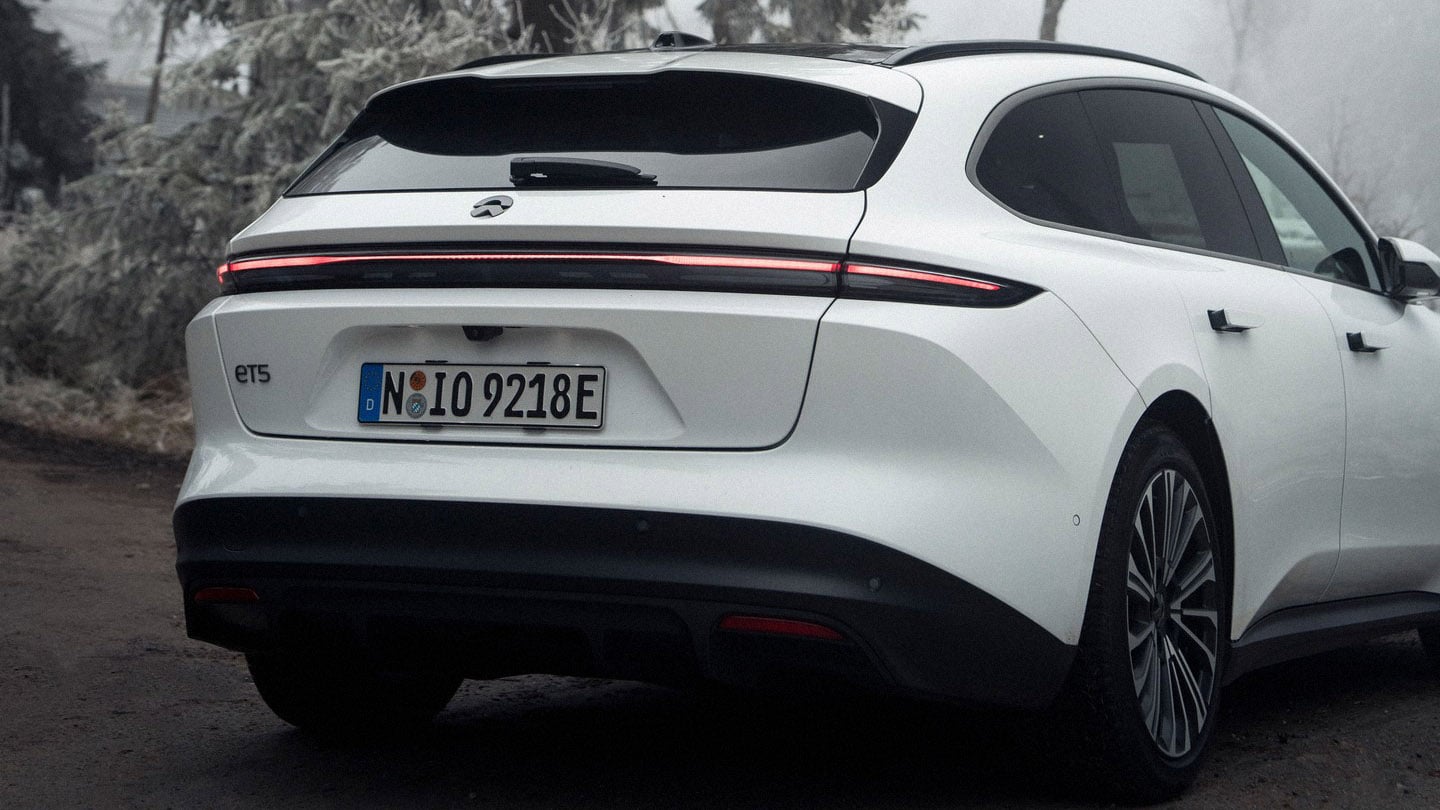

Nio registered three vehicles in Germany in July, a 93.6% decline from a year earlier, according to data released on Thursday by the Federal Motor Transport Authority (KBA).
The Chinese premium EV maker has now registered 18 cars in the country through the first seven months of 2026, down 89.3% from the same period last year.
Over the last five months, the company founded and led by William Li registered three or fewer vehicles. February was the only month in which Nio recorded a higher number — with five units.
July figures land in a German market that grew 1.2% overall in July and whose battery-electric segment expanded 61.7% to 78,609 units — and in a month when nearly every other Chinese brand advanced, led by BYD at 5,240 registrations and XPeng at 1,253.
A Network Built for Volume
Germany was designed as Nio‘s largest European market, and the company built accordingly.
Four large-format Nio Houses combined car displays with cafés, member lounges and co-working areas, supported by smaller Nio Hubs pairing compact showrooms with in-house workshops, roughly 20 battery-swap stations and a Berlin lobbying office.
That structure assumed volume growth the market never delivered, and 2026 has become the year of its dismantling.
In February, Nio split its European operation into six departments and moved sales toward a dealer-and-distributor model in Germany, Norway, the Netherlands and Sweden, as EV first reported.
By April, the company was seeking subtenants for its Berlin, Frankfurt, Düsseldorf and Hamburg flagships, attempting to exit long-term leases — including 1,300 square meters in Berlin — as the high-cost direct-sales model collided with the company’s pursuit of its first full year of profitability.
The physical closures followed in July.
The Hamburg Nio House, opened near Jungfernstieg in June 2024, shut on July 20 — the first closure of a flagship European showroom on record.
Days earlier, the company had quietly closed its Weiterstadt hub, the fuller-service location opened in November 2024 as the third German site after Munich and Cologne, cutting into the operational network rather than only brand presence.
Leadership Drains Away
The human side of the retreat has moved just as quickly.
Nio‘s deputy general manager and Marketing lead for Germany, Christian Wiegand, left at the end of July with no replacement planned — for him or for any other country chief in Europe.
Wiegand, who arrived before the German operation existed in any structured form, described his four years as among the most unpredictable of his career.
XPeng hired Wiegand as its marketing head, a departure decided in March as part of the restructuring that dismantled Nio‘s European organization.
Kurt Kranz oversaw the opening of the first Nio Houses but exited in early 2024 after registrations failed to scale — the company recorded 1,263 German vehicles in 2023, his only full year — and Marius Hayler, who had led the Norway entry, moved to Germany in October 2023 to replace him.
An Aging Lineup
The product explanation for the sales collapse is structural.
Every Nio available in Germany is a 2023 or 2024 build on the older NT 2.0 platform, with no model updates due until late 2027, as EV first reported.
The three launch models remain the only ones on sale, while the brand’s newer China lineup — including the refreshed ES8 and the Onvo and Firefly sub-brand ranges — has not reached German customers in volume.
The swap network tells a similar story of paused ambition.
European stations passed 300,000 cumulative swaps on June 21, though the pace has slowed even as more vehicles reached the road, and no new stations will be built during 2026.
The Rest of the Chinese Cohort Pulls Away
Chinese brands combined for 13,870 German registrations in July, a 5.2% share of the market — above their 4.0% share across the first seven months, a sign the cohort is still accelerating.
BYD led at 5,240 units, up 365.4%, and is running ahead of its 50,000-unit German target for 2026 behind a dealer network expanding toward 350 locations.
MG followed at 3,698 registrations, up 86.2%, while Leapmotor — selling through the Stellantis dealer ecosystem and operating its own Munich innovation center since March — grew 328.8% to 2,736.
Behind the leaders, Geely reached 479 units four months after its German launch, Zeekr added 133 in its first year of deliveries, and Lynk & Co posted the cohort’s steepest percentage gain at 547.1%, albeit to 110 units.
Chery registered a single vehicle under its parent badge while channel brands Omoda and Jaecoo carried 83 between them, and only Great Wall Motor shared Nio‘s direction, falling 49.1% to 110 units ahead of its planned mid-2026 European relaunch.
Against that field, Nio‘s three registrations place the one-time standard bearer of China’s premium EV push at the very bottom of its own national cohort.
German R&D Bet
The company’s global design centre has operated in Munich since before the first car was delivered, predating even the German retail expansion that followed, and remains responsible for design across the entire product line and brand.
The centre is led by Kris Tomasson, the company’s Senior VP of Design, who leads Nio, Firefly — and more recently, Onvo — brands.
A Berlin innovation center opened in 2023.
The contrast with the winners sharpens the picture.
Nio‘s difficulties in Germany stand in isolation among Chinese automakers, whose collective July share now exceeds the individual shares of Ford, Toyota or Hyundai.