
Volvo Cars delivered 14,003 fully electric vehicles in July, up 33.2% from a year earlier — the strongest year-over-year growth of 2026 and the tenth consecutive month of rising EV deliveries, according to EV‘s analysis of the company’s sales disclosures.
The acceleration is the headline inside an otherwise soft report.
Volvo said on Tuesday that total sales for the May-to-July period fell 4% year over year, with the Gothenburg-based automaker citing the continued downturn in China.
Fully electric deliveries rose 21.0% across the three months to 44,243 units and reached 27% of everything Volvo sold, while electrified vehicles — fully electric plus plug-in hybrid — grew 14.9% to 87,464, or 53% of total sales.
Volvo started earlier this year to report rolling three-month windows rather than single months.
Monthly figures are derived from the company’s successive disclosures: July’s 24,219 electrified deliveries were up 10.2% from a year earlier, and the fully electric share of that figure accelerated from June’s 24.9% growth to July’s 33.2% — the fastest month since the streak began last autumn.
Hybrids Decline Beneath the Total
Stripping the fully electric figure out of July’s electrified total leaves 10,216 plug-in hybrids — down 10.9% from 11,461 a year earlier.
Across May-to-July the plug-in line grew just 9.3% against the BEV line’s 21.0%.
Volvo‘s new energy vehicle (NEV) sales are now entirely a battery-electric story: the EX30 and EX40 carried the second quarter, per the company, with the new EX60 “exceeding expectations” ahead of broader showroom availability and production set to increase in the second half.
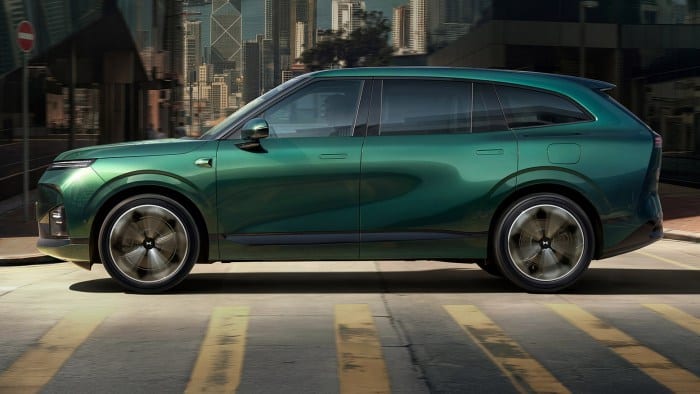
The EX60 — the first model on the SPA3 platform, unveiled in Stockholm in January with up to 400 miles of range and a native NACS charging port — has run ahead of Volvo‘s own forecasts since launch.
The company said in March that European retail orders were considerably above internal projections, with more than 3,000 taken in Sweden alone inside a month and the order pace running above what the cheaper EX30 managed at its debut, prompting a capacity increase at the Torslanda plant.
Through seven months, Volvo‘s fully electric deliveries total 93,505, up 15.8% year over year, against 185,190 electrified units, up 4.6%.
The quarterly arc shows the trend building: BEV growth of 12.0% in the first quarter, 14.3% in the second, and July’s 33.2% opening the third.
The geography remains lopsided. Second-quarter EV growth of 25% in Europe and the rest of the world carried a global figure dragged by Greater China, where deliveries fell 35%.
However, NEV sales in the US fell 17.1% in the second quarter even as total sales in the country rose 9%, with electrified vehicles just 24.1% of the American mix.
Volvo pulled the EX30 — the very model powering its European growth — from the US market in March, citing no single factor, which left the $56,545 EX40 as the brand’s cheapest American EV and no Volvo electric under $50,000.
A Cheaper EV and a Busier Factory
Volvo‘s next US moves target that gap, according to two Automotive News reports this week.
The brand is preparing the EX50, a new compact electric crossover due in US showrooms in fall 2027, positioned to replace the EX40 as the brand’s entry EV in America, people with knowledge of the plan told the publication.
The model is expected to be priced in the high $40,000s — against the EX40’s $56,545 with shipping — while being taller and longer than the model it replaces.
Volvo is targeting first-year US sales of up to 10,000 vehicles, per one of the people, with the caveat that the estimate could fall if European production takes priority.
Separately, Volvo will begin building the XC60 at its Ridgeville, South Carolina plant in January, attacking both slow US electrified demand and the factory’s chronic underuse.
“It’s going to be at least a full shift,” Volvo Cars Americas president Luis Rezende told Automotive News, saying the crossover will add “at least another 20,000 to start with” on top of roughly 30,000 vehicles of current output — and that “Charleston will be very, very busy.”
The $1.3 billion plant, opened in 2018 with capacity around 150,000 vehicles, has run at an estimated 15% of capacity since S60 sedan production ended in 2024, per GlobalData, building only the low-volume EX90 and Polestar 3.