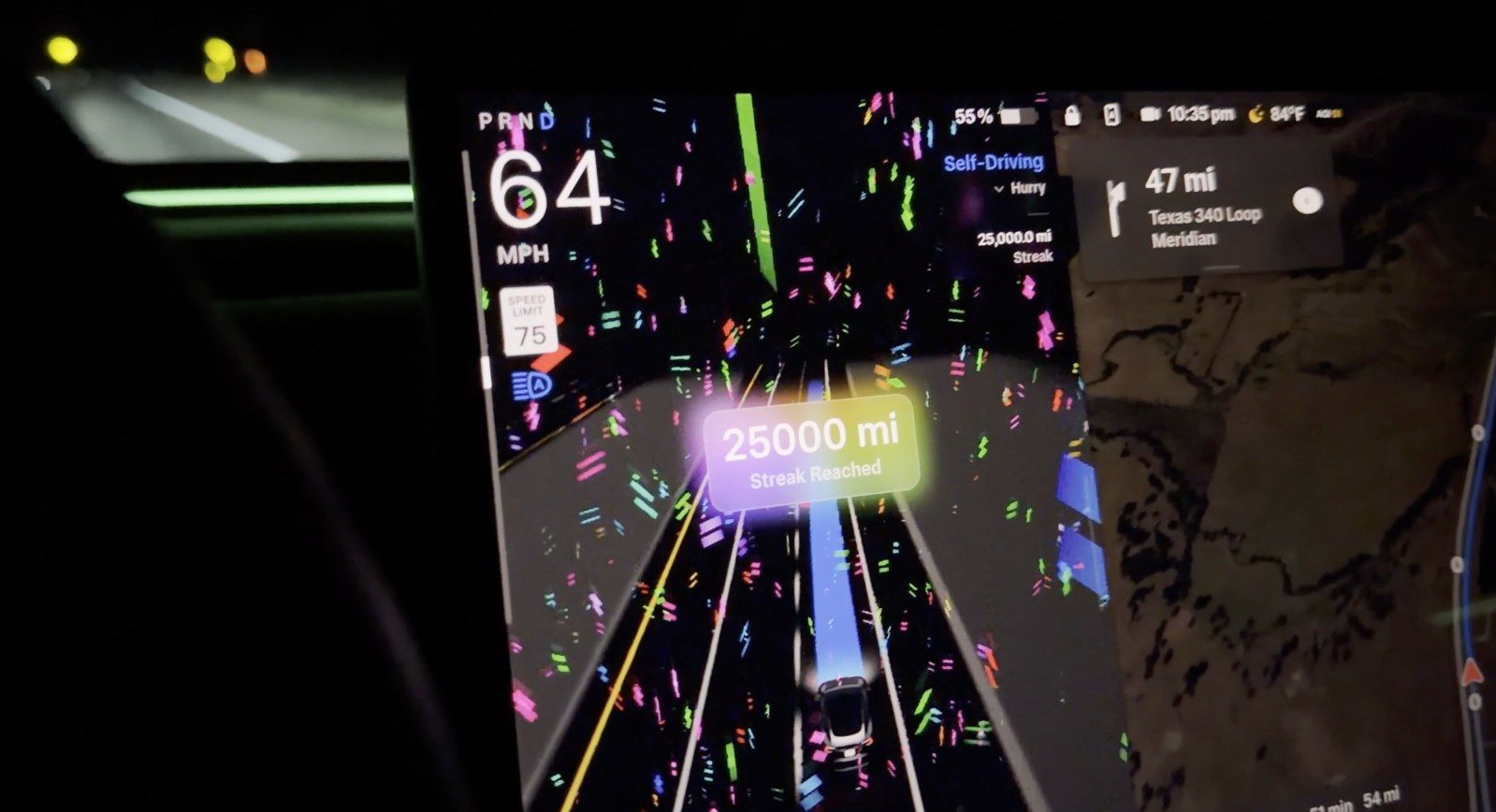

A Tesla Model 3 owner has become the first person to cross 25,000 miles on the company’s Full Self-Driving streak counter without a single human intervention.
David Moss, the Tacoma, Washington driver behind a string of zero-intervention distance records, passed the mark late Saturday, according to in-car footage published early Sunday by Tesla shareholder and content creator Sawyer Merritt.
The video shows the counter rolling over to 25,000.0 miles at night on a road toward the Texas 340 Loop near Meridian, Texas.
Merritt wrote that the distance is “equivalent to one full lap around Earth, or two years of driving” for the average American.
The Streak
Tesla introduced the live streak counter in the FSD v14.3 series this spring, displaying consecutive miles driven on the system without a manual takeover.
The counter resets the moment a driver brakes, adjusts the wheel or cancels navigation, and the figure covers city streets, highways, construction zones and parking, including at Superchargers.
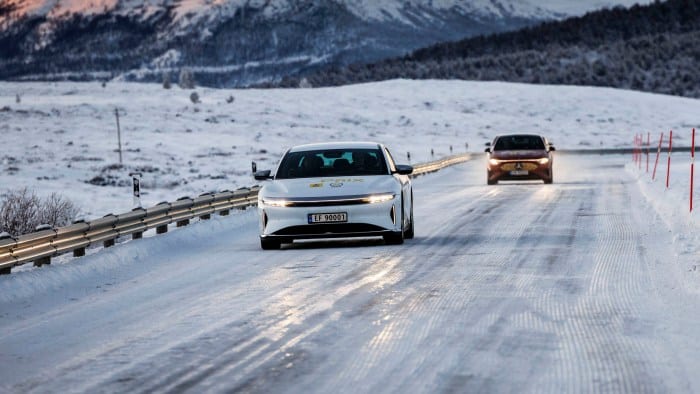
Moss’s current run began after his first documented streak ended at 12,961 miles in January, when snow-covered roads and temperatures in the teens in rural Wisconsin forced a takeover.
The active streak crossed 10,000 miles in June during a north-to-south traverse linking the Canadian and Mexican borders, and passed 20,000 miles in late July.
The run survived an incident in which an inattentive driver rear-ended Moss’s Model 3 at a red light, which did not reset the counter.
The milestone footage places Moss in central Texas, where he has spent recent days publishing first-drive tests of the newest FSD builds, including v14.3.7, around Waco with fellow tester Spencer Scott.
The Records Behind the Number
Moss became a fixture in the Tesla community on the last day of 2025, when he claimed “the world’s first USA coast to coast fully autonomous drive” — 2,732.4 miles from the Tesla Diner in Los Angeles to Myrtle Beach, South Carolina, in two days and 20 hours on FSD v14.2, reporting zero disengagements.
Ashok Elluswamy, Tesla‘s VP of AI software, called that run the “World’s first fully autonomous coast-to-coast drive, done with Tesla self-driving v14”, and the company later featured the trip as an official customer story.
Chief Executive Elon Musk amplified the announcement while former Tesla AI director Andrej Karpathy described it as the first fully autonomous coast-to-coast drive on the V14.2 software.
In late May, Moss, Devin Olsen and Spencer Scott drove 3,760 miles across Canada, from Horseshoe Bay in Vancouver to a Tesla store in metropolitan Halifax, in four days and 21 hours on v14.3.3 with no reported interventions.
In late July, Moss, Scott and Owen Sparks set the fastest autonomous Cannonball Run on record, covering the route from Manhattan’s Red Ball Garage to the Portofino Hotel in Redondo Beach, California in 47 hours, 15 minutes and 39 seconds on v14.3.6.
That run cut about 2 hours and 40 minutes from the previous autonomous record, set in May by a separate team on v14.3.2.
All three records were set in the same Model 3, a 2025 car on Tesla‘s AI4 hardware, whose streak has continued through each trip.
The Verification
Moss’s mileage claims are logged by the FSD Database, a community telemetry tracker built by Tesla investor and content creator Omar Qazi, who posts as ‘Whole Mars Catalog’, alongside dashcam footage and live public trackers for the long-distance runs.
The system remains FSD (Supervised), a Level 2 driver-assistance package that requires an attentive driver, and the streak’s zero-intervention framing reflects Moss’s monitoring choices as much as the software’s performance.
The figure also describes one car and one deliberate driver rather than fleet-wide statistics, and the first streak’s end in Wisconsin marked the boundary the software has not yet cleared: sustained winter conditions.
Moss sells LiDAR scanning equipment professionally while advocating for Tesla‘s camera-only approach, and has built a full-time content operation around the testing.
The European Absence
Every record in the sequence has been set in North America, where Tesla‘s FSD (Supervised) is commercially available and its Robotaxi service has expanded across Austin and other cities.
European drivers cannot yet replicate any of it.
FSD remains unapproved for general use in most countries, where Tesla is courting regulators and last week offered two-month FSD trials to owners in select EU markets.