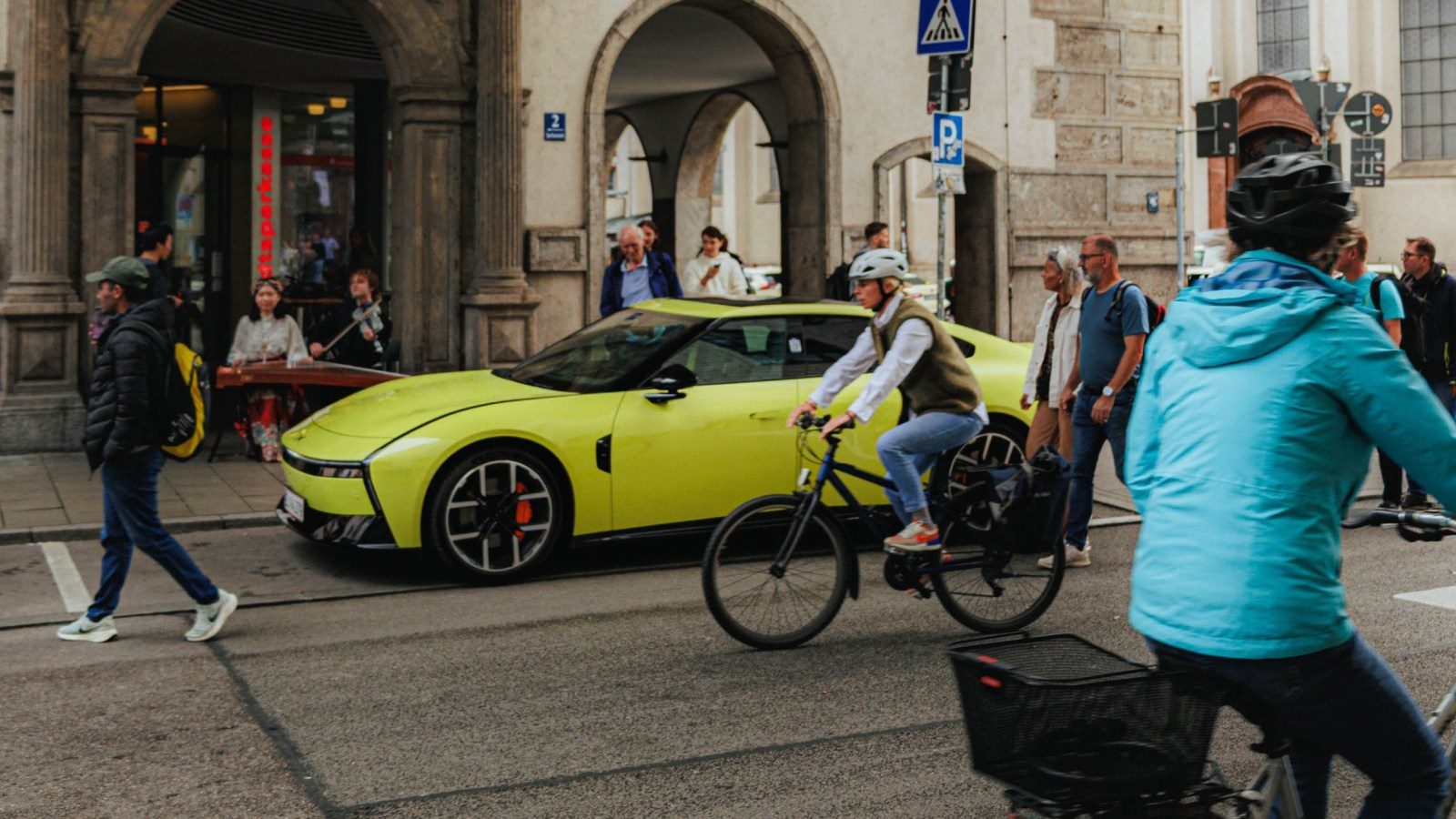

XPeng registered 1,253 vehicles in Germany in July, a 371.1% increase from a year earlier and a fifth consecutive all-time monthly record, according to data released on Thursday by the Federal Motor Transport Authority (KBA).
The result gave the Guangzhou-based automaker a 0.5% share of Europe’s largest automotive market and lifted its seven-month total to 4,610 units, up 246.4% from the same period of 2025.
July’s figure extends the run that produced a fourth straight record in June, and makes XPeng the highest-volume dedicated EV brand in the German market — ahead of Smart at 851 units, and Polestar at 641.
Tesla saw its registrations collapse 66.9% to 367 as the company prioritized other European markets such as France.
A Record Run
The monthly trajectory shows how steep the 2026 curve has become.
Registrations climbed from 327 units in January and 331 in February to 549 in March — the first of the five records — followed by 595 in April, 633 in May and 922 in June, before July’s 1,253 added a 35.9% jump over the prior month.
Every month of 2026 has at least doubled its year-earlier figure, with year-over-year gains running from 104% in February to July’s 371.1%.
XPeng registered 2,991 vehicles in Germany across all of 2025, a total the first seven months of 2026 have already exceeded by 54.1%.
July’s single month, at 1,253 units, nearly matches the 1,331 vehicles the brand registered across the entire January-to-July stretch of last year.
Notably, the record run was built on the existing G6, G9, P7 and X9 lineup — the L03’s Munich launch came only in mid-July, meaning its German registration volume has yet to land in the KBA tables.
Munich Became XPeng’s Second Home
The July number caps the most consequential month in the company’s European history, and nearly all of it happened in one Bavarian city.
In mid-July, XPeng staged the global launch of the L03 coupe SUV in Munich, the first model in its history to go on sale simultaneously in China and Europe.
Founder and chief executive He Xiaopeng said the company chose Munich for its first formal global launch because Germany is where the auto industry was born, with the L03 set for a July 2 China debut ahead of the European rollout and targeted at 64 countries and regions this year.
Chinese buyers placed more than 46,000 non-refundable orders within the first hour of the domestic launch.
German pricing starts at €35,600, undercutting the Tesla Model Y Standard by roughly €3,370 — a positioning choice that lands in a market whose fully electric segment grew 61.7% in July to a 29.3% share, supported by federal purchase incentives of €3,000 to €6,000 for private buyers.
Assisted Driving Tested on German Streets
The launch was only half of the Munich story.
Three days before the event, EV exclusively published video of a camouflaged L03 driving through the city center carrying “NGP powered by VLA 2.0” decals — the first sighting tied to public-road validation of the assisted-driving stack itself.
A day after the launch, XPeng invited EV to be among the first outside testers to ride in a vehicle running the second-generation Vision-Language-Action system on Munich’s streets, navigating trams, cyclists and 30 km/h zones with a Product Development team member behind the wheel.
He Xiaopeng said the company had “been testing on European roads for quite some time and results are pretty positive,” confirming plans to bring the software to European customers in early 2027.
The base of those operations is the research and development center XPeng established in Munich earlier this year — the hub for adapting the software to European roads and driving styles.
The center’s role extends beyond the L03.
EV saw the unreleased G9L SUV road-testing near the Munich facility on the day of the first VLA rides, weeks before the model entered its official teaser phase in China — evidence the company is now validating vehicles on German roads before Chinese customers have seen them.
Building an Organization to Match
The commercial infrastructure is growing into the engineering footprint.
XPeng already sells in 28 European countries, and last week hired Christian Wiegand, the departing deputy chief of Nio’s German business, as its marketing head — a pointed transfer between the two Chinese premium brands now heading in opposite directions in the market.
Nio registered three German vehicles in July against XPeng‘s 1,253, a gap of more than 400 to one between two brands that entered Europe within a year of each other.
The company has also been investing in sport sponsorships to build European brand awareness, part of a push to convert engineering presence into consumer recognition.
Volume growth elsewhere reinforces the trajectory: XPeng delivered 38,027 vehicles globally in July, passing 1.2 million lifetime, and is targeting 550,000 to 600,000 deliveries for the full year.
A Lineup Widening Behind the Launch
The L03 is the spearhead of a broader product offensive aimed at the region.
In recent months the company has announced the X9 minivan, the L03 and the P7 for Europe, stacking new nameplates onto the G6 and G9 SUVs that built the early German volume.
The pipeline behind them keeps filling: six days after the Munich event, a heavily camouflaged XPeng station wagon was photographed road-testing in China for the second time, a body style aimed squarely at European tastes, while the G9L completes its validation runs between Munich and Bangkok.
The German segment data gives the strategy its opening.
Small cars and compact SUVs — the territory the €35,600 L03 enters — sit at the heart of the subsidy-driven demand wave, and the KBA’s July tables show SUVs holding a 35.7% segment share while minis posted the market’s fastest growth at 25.0%.
Fourth in a Surging Chinese Field
The July result places XPeng fourth among Chinese brands in Germany, inside a cohort that combined for 13,870 registrations and a 5.2% market share — up from a 4.0% share across the first seven months.
BYD topped the group at 5,240 units, up 365.4%, tracking ahead of its 50,000-unit German target for the year as its dealer network expands toward 350 locations, followed by MG at 3,698 and Leapmotor — distributed through Stellantis dealers — at 2,736, up 328.8%.
XPeng‘s 371.1% increase was nonetheless the fastest of the four leaders.
The rest of the field trails at a distance, with Geely at 479 units four months after launch, Zeekr at 133 in its first delivery year, Lynk & Co up 547.1% to 110, Great Wall Motor down 49.1% to the same figure, and Nio at three registrations.
Racing Tesla
The German numbers set up a direct contest with Tesla that extends beyond the sales chart.
XPeng has made the US giant its explicit benchmark and has claimed VLA already beats Full Self-Driving on China’s narrow roads.
The two companies are now converging on the same regulatory territory: Tesla is pushing FSD (Supervised) through EU approval while XPeng targets its early-2027 European rollout, with the L03 confirmed as the first model to carry the system in the region.
The technology has also found its first Western buyer.
Volkswagen agreed to adopt VLA 2.0 and the Turing chip, the first time a major Western carmaker has taken Chinese-developed autonomous-driving software.