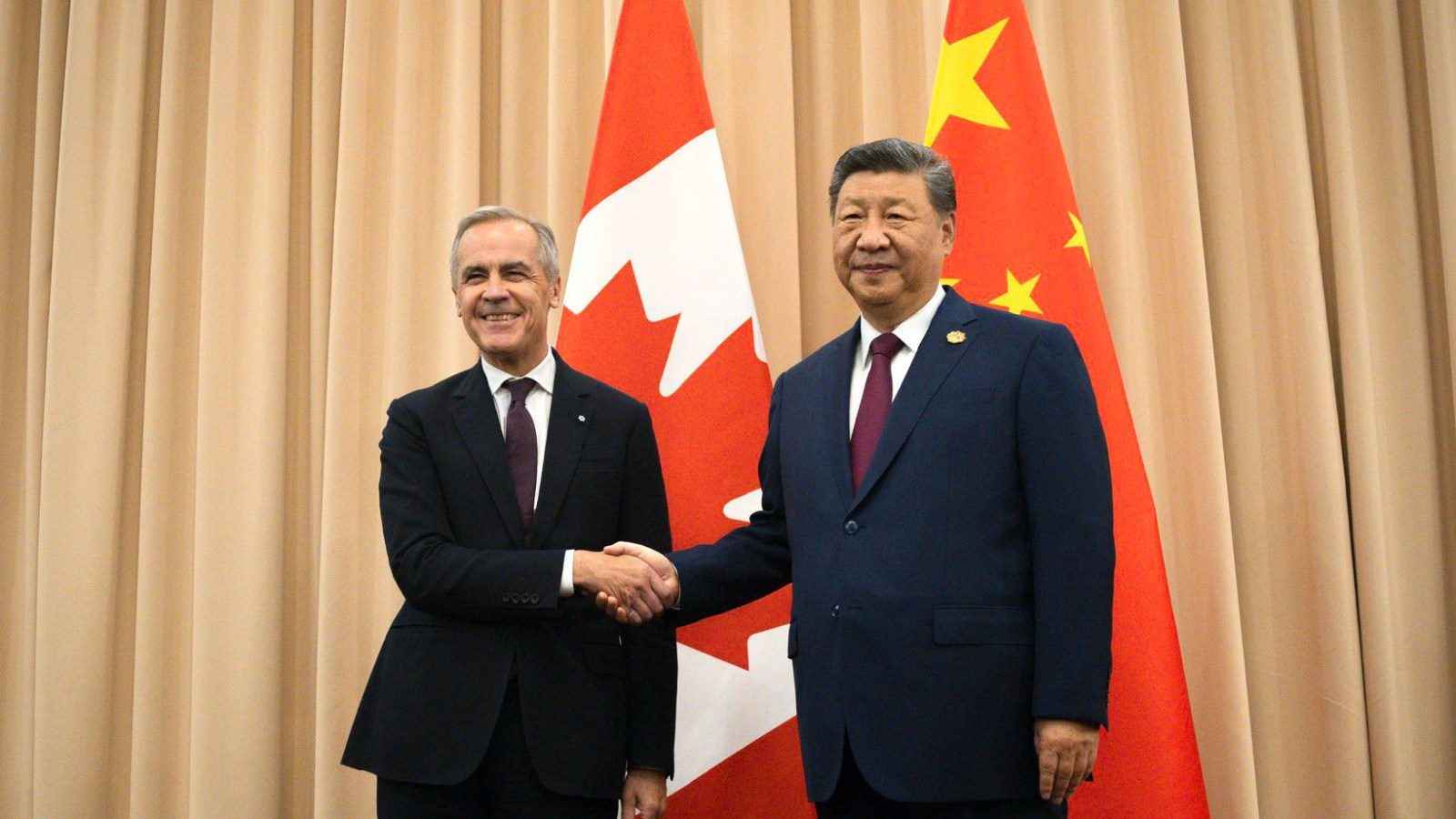

Mark Carney used the G7 summit in France to sharpen Canada’s conditions for Chinese electric vehicle investment, telling reporters that Ottawa will welcome capital from China only when it delivers Canadian manufacturing rather than token assembly.
“We are only interested in Chinese investment in Canada when it’s material Canadian production,” the prime minister said.
Carney drew a hard line against low-value assembly, adding that Canada is “not interested in kits being put together in Canada.”
The conditions he set out are demanding: joint-venture partnerships, Canadian control, substantial value-add, Canadian labour standards and substantial jobs.
Those terms, Carney said, are the only basis on which the commercial relationship opened by his January deal with Beijing would be allowed to deepen.
A Quota Built as Leverage
Carney’s framework dates to a state visit to Beijing in January, when he became the first Canadian leader to travel to China since 2017.
Canada agreed to replace the 100% surtax it had imposed on Chinese-built EVs in 2024 with a 6.1% most-favoured-nation tariff on an annual quota of 49,000 vehicles, in return for Beijing easing the retaliatory duties that had shut Canadian canola out of the Chinese market.
Beijing, for its part, agreed to cut the roughly 85% tariff it had imposed on Canadian canola seed toward 15%, relief for a farm sector caught in the crossfire.
Speaking at the G7, Carney described the arrangement as a “hard cap”: imports up to 49,000 face the low MFN (most-favoured-nation) tariff rate, while any imports above that threshold are subject to a much higher, punitive tariff.
He stressed the quota’s modest scale, calling it “less than 3% of the Canadian car market.”
Half of the 49,000 allocation, built up over several years, is reserved for vehicles priced at C$35,000 or less, a provision the prime minister framed as widening consumer choice.
Ottawa began processing import permits on March 1, releasing the first 24,500 slots on a first-come basis through August 31, with a second tranche running into early 2027.
The cap is set to climb toward roughly 70,000 units a year by 2030.
Joly’s Mission in Beijing
Industry Minister Mélanie Joly is in China from June 14 to 23, courting Chinese automakers to build EVs on Canadian soil and furthering the commitments Carney made in January.
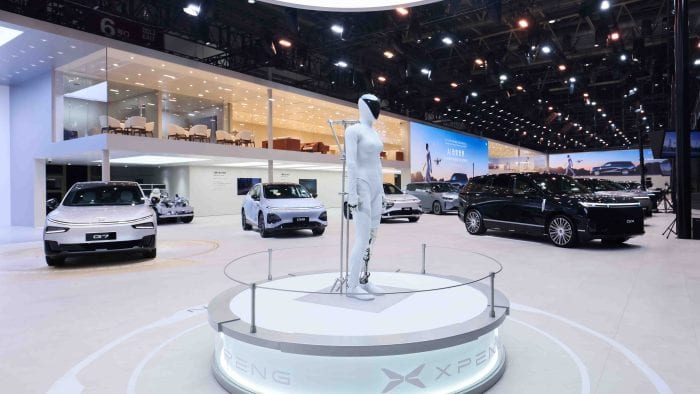
Trade Minister Maninder Sidhu has separately met executives from BYD, XPeng and GAC in Guangzhou.
Joly disclosed in late January that she had met Chery executives during Carney’s Beijing visit, signalling early how central the investment courtship would become.
Carney pointed to precedents abroad, noting that Chinese production is taking root in Europe and, he believed, in Brazil — “a natural evolution of their business model,” he said.
Brazil’s Messy Precedent
BYD started producing vehicles in Brazil last year.
The plant started by assembling vehicles from semi-knockdown and complete knockdown kits shipped from China.
Full local manufacturing — with stamping, welding, and painting done on-site — is not expected until July 2026.
Brazil’s preferential import tariffs for SKD kits expired at the end of January 2026, forcing BYD to accelerate localization.
The CKD-to-full-production trajectory is precisely the path Carney said Canada would not follow.
On Tuesday, the Shenzhen-based company announced plans to expand battery assembly at its Camaçari complex in Bahia — adding a line to assemble cells shipped from China into modules and packs.
The move is part of BYD‘s push to reach 50% local content in its Brazilian-built vehicles by early 2027.
“We are localizing, so that we can truly become a Brazilian manufacturer. The battery is one more item, an important component,” BYD‘s SVP in Brazil Alexandre Baldy stated.
Cell production itself will remain in China.
The facility targets an annual capacity of 150,000 vehicles in its first phase, rising to 300,000 in the second.
BYD operates independently in Brazil with no local joint venture partner and no local control requirement. The labour record undercuts Carney’s comparison further.
Brazil’s Public Labour Prosecutor’s Office prosecuted BYD and two contractors over conditions at the Camaçari construction site described as analogous to slavery, involving over 200 Chinese workers.
BYD was subsequently added to Brazil’s slave-like labour registry.
Construction was temporarily halted during the investigation.
Canadian labour groups have already cited those events directly — Unifor called the reports from Brazil and Hungary “deeply concerning” earlier this year.
Europe’s Two Models
Carney’s comparison to Europe holds broadly, but the details are more complex than his framing suggested.
Two distinct Chinese production models are now operating on the continent, and neither fully matches the conditions Canada is setting.
Stellantis confirmed in March that the Leapmotor B10 compact electric SUV will enter production at its Figueruelas plant near Zaragoza, Spain, in the second half of 2026, with an initial annual volume of 40,000 units.
Three more Leapmotor models are expected to follow. The Stellantis–Leapmotor structure — a 51/49 joint venture controlled by the Western partner — is the closest existing parallel to what Carney described as Canada’s goal.
An earlier attempt to assemble the smaller Leapmotor T03 at Stellantis‘s plant in Tychy, Poland, was discontinued after a short run.
Separately, XPeng has been assembling vehicles in Europe since September 2025 through a contract manufacturing deal with Magna Steyr at its plant in Graz, Austria.
The facility currently assembles three XPeng models — the G6, G9 and P7+ — from semi-knockdown kits shipped from China, with a fourth model expected before year-end.
The arrangement allows XPeng to avoid the European Commission’s additional 20.7% countervailing duties on Chinese-built EVs.
The XPeng-Magna partnership adds a pointed layer to Carney’s pitch.
Magna International is a Canadian company, headquartered in Ontario, and was explicitly named by Canadian officials earlier this year as a potential joint venture partner for Chinese EV production in Canada.
Magna declined then, saying it was still evaluating its strategy while remaining prepared to support Chinese customers in markets where it already operates.
Its CEO Swamy Kotagiri later urged Canada to choose between saving auto jobs and cutting car prices — the core tension in Ottawa’s approach.
Carney’s Opposition
The opposition Conservatives, led by Pierre Poilievre, want the quota scrapped entirely and Canada’s China tariffs aligned with Washington’s.
A proposal pairing a Chinese-EV ban with a tariff-free US deal was voted down in the House of Commons earlier this year.
Earlier on Wednesday, Carney said he walked US President Donald Trump through the structure on the sidelines of the summit, after Trump raised the China question.
“He likes the structure, actually,” Carney told reporters, adding that the two had a follow-up conversation about it.
The exchange marks a notable softening from Washington’s earlier posture.
Trump had threatened 100% retaliatory tariffs on Canadian goods after the China deal and dismissed the continental trade pact as “irrelevant” in January.
Pressed on whether he and Trump discussed renewing the agreement directly, Carney deflected, saying only that “our trade people” had held those talks.
Carney has cast the framework as protection for the roughly 500,000 workers in Canada’s auto sector, arguing that the quota’s real worth lies in the leverage it creates.
Ottawa expects Chinese joint-venture investment within three years, though the prime minister was careful to call that a possibility, “not the certainty in any ways.”
His message in France was that Canada intends to set the price of entry, acting only “in the interest of Canadian consumers, Canadian workers.”
Deliveries of the first Chinese-built models under the quota are expected to build through the second half of 2026.
Tesla has already started deliveries of the China-made Model 3 sedans.