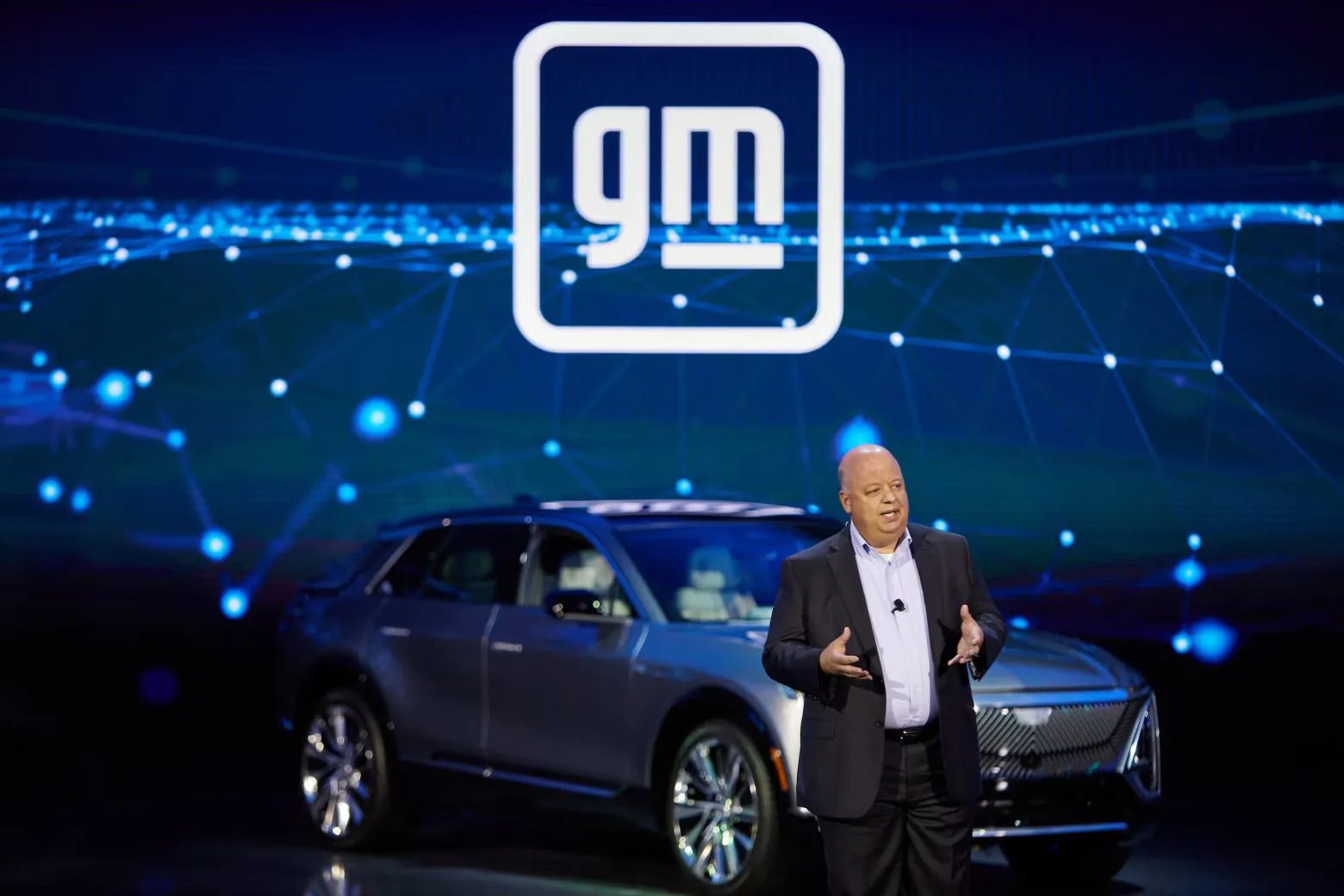

General Motors expects competition in the US to intensify as carmakers losing ground to Chinese rivals in other markets turn to America, Chief Financial Officer Paul Jacobson told the Financial Times, while declining to say whether Chinese carmakers themselves should be let in.
America is “becoming an outlet for global automakers who are facing the pressure of China in their international markets,” Jacobson said in an interview conducted ahead of Chinese President Xi Jinping’s state visit to Washington.
Those automakers are “finding a safe haven in the US,” he said. “It will become more competitive.”
Jacobson declined to comment on the possible entry of Chinese carmakers into the US.
Instead, he said GM must “make sure that the business is as competitive as possible with high-quality products and trim our structural costs wherever we can.”
“We have a lot of deeply embedded loyalty in our customer base… but the minute that we take that for granted, our business becomes jeopardised,” he said.
Detroit’s Share Near a Record Low
The pressure Jacobson described is already visible in US sales, and it is coming mostly from Japanese and Korean brands.
The Detroit Three are expected to hold “just over 36%” of US sales in the third quarter, “the lowest level on record,” Cox Automotive said in its September 24 forecast.
Asian brands are expected to account for more than half of US sales for a second straight quarter.
Cox expects GM to sell 2.01 million vehicles in the US in the first nine months of the year, down 6.2%, and Toyota 1.89 million, up 1.1%, according to the table in its release.
Hyundai Motor Group is forecast to outsell Ford in the third quarter, with 511,421 vehicles against 504,172, and Honda to grow 12.2%.
GM reports its third-quarter US sales on Thursday.
Hyundai plans about 100 new and refreshed models with a focus on US hybrids, Bloomberg reported in August, and has confirmed a mid-size pickup for the US.
The Chinese Question
Jacobson’s comments come as Washington debates whether Chinese carmakers should be allowed to build cars in the US.
“Now, if China wanted to come in, and open a plant to build their cars here, I’d be OK with it – Japan does it – but they hire our people,” President Donald Trump told Fox News on September 11.
In the same interview, Trump said “we don’t allow his cars into the United States,” referring to Chinese President Xi Jinping, and ruled out Chinese cars built cheaply in Mexico and shipped across the border.
A week later, six industry groups whose members include GM, Toyota, Volkswagen, Ford, Hyundai, Stellantis and Tesla asked Trump to “keep the door firmly shut to Chinese automakers seeking to sell, import or manufacture” in the US.
The letter argued that US-built Chinese vehicles would still depend on Chinese suppliers, and that “localized Chinese production will not advance the administration’s manufacturing jobs and national security agendas.”
Xi’s state visit, with a state dinner on September 24, produced no public announcement on cars.
A White House fact sheet said the two countries had set up a Board of Investment, but it named no members, meeting date or agenda and did not mention cars.
GM Chief Executive Officer Mary Barra attended the dinner.
Senior executives from BYD and Xiaomi travelled to Washington but stayed outside the summit, Nikkei Asia reported.
The Barriers
Chinese-built electric vehicles face a 100% US tariff under Section 301.
A Commerce Department rule bars manufacturers with a sufficient link to China or Russia from selling new connected vehicles in the US even if they are built there, with software restrictions taking effect from model year 2027 and hardware from model year 2030.
Senators Bernie Moreno and Elissa Slotkin are trying to make that ban permanent through the Connected Vehicle Security Act, but a Senate vote was delayed last week.
Sponsors were negotiating with Senator Rand Paul, the only senator opposed, and the bill’s 15% Chinese-ownership threshold could catch Mercedes-Benz, in which Chinese investors hold a combined 19.7%.
Europe as the Warning
Industry executives and US politicians have pointed to BYD and Chery’s growth in Europe as evidence of how fast Chinese brands could expand in the US if barriers fell.
BYD registered 177,752 cars in the European Union in the first eight months of 2026, up 163.0%, lifting its share to 2.4% from 0.9%, according to the European Automobile Manufacturers’ Association.
Chery’s registrations rose 250.9% to 116,318, for a 1.5% share.
Including Britain, Norway, Switzerland and Iceland, BYD’s registrations reached 234,099 and Chery’s 207,871.
GM’s Own China Reset
GM’s China business has returned to profit after a sweeping restructuring, the FT reported.
GM’s equity income from China was $83 million in the second quarter.
The company booked a $1.1 billion charge tied to restructuring SAIC General Motors, its China joint venture, in the fourth quarter of 2025, of which about $500 million would have a cash impact.
SAIC-GM sold 300,935 vehicles in the first eight months of 2026, down 9.14%, with August sales down 20.25%, according to SAIC’s data.
GM and SAIC extended their joint venture to 2047 in August. GM said Chevrolet production in China will continue, with vehicles shipping to the Middle East, Africa, South America, Mexico and the Asia-Pacific region.
Under Barra, GM has also retreated from Europe, Vietnam and Australia, prioritising profit over sales volume.
EV Bet
Jacobson said GM will keep working to make its electric vehicles more affordable and profitable, and warned that US climate policy could remain volatile for the next five years.
“If you are completely walking away from EVs,” he said, “that’s a dangerous position to take.”
GM announced $6 billion of EV-related charges in January, about $1.8 billion of them non-cash and $4.2 billion tied to supplier settlements and contract cancellations, according to GM.
With a $1.6 billion charge in the third quarter of 2025, that took its EV charges to $7.6 billion, Bloombergreported.
GM recorded a further $2.28 billion of EV “strategic realignment” adjustments in the second quarter of 2026, according to its results.
It has switched its Orion, Michigan, plant from EVs to gasoline full-size pickups and SUVs.
GM’s EVs made up 3.8% of its US sales in the second quarter, nearly half the share a year earlier. The company is developing lithium manganese-rich battery cells with LG Energy Solution for trucks and large SUVs from 2028, which it says will cut costs.