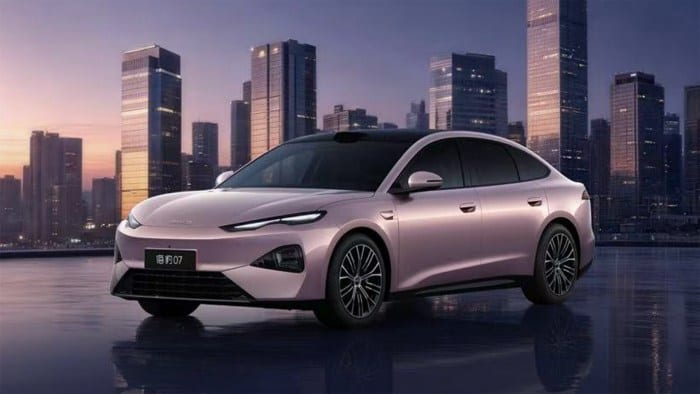
BYD released official images of its second-generation Seal 07 sedan on Monday, repositioning the model as a larger C-segment car that borrows its design from the flagship Seal 08.
The company is showing the replacement less than seven months after the current Seal 07 EV went on sale.
China’s carmakers are refreshing models at a faster pace as competition intensifies and domestic demand weakens.
Passenger vehicle retail sales in China fell 20.8% year on year to 11.72 million units in the first eight months of 2026, according to the China Passenger Car Association.
Zhang Zhuo, General Manager of BYD’s Ocean Network Sales Division, unveiled the exterior and described the model as a C-segment family sedan.
BYD gave no launch date, prices or interior images.
Each carries the disclaimer that the final production model may differ and that the car as sold should be taken as definitive.
A Smaller Seal 08
The new car adopts BYD’s “Ocean Aesthetics 2.0” design language and matches the Seal 08, headlining its story “a smaller Seal 08.”
The front has a closed grille and split headlights with a wave-shaped upper light signature.
The side shows a fastback roofline and semi-hidden door handles.
The rear carries a full-width light bar with BYD lettering, and a panoramic glass roof is standard.
A sensor housing is visible above the windshield, which IT Home and Autohome identify as a roof-mounted LiDAR.
The plug-in hybrid version was filed without LiDAR, IT Home reported, and Sohu said a non-LiDAR hybrid would use BYD’s God’s Eye C driver-assistance system to lower the entry price.
Bigger Than the Current One
The second-generation Seal 07 measures 5,080 mm long, 1,960 mm wide and 1,495 mm tall on a 2,960 mm wheelbase, according to its filing with the Ministry of Industry and Information Technology in batch 410 on August 7.
The current Seal 07 EV, launched on March 5 at 169,900 to 189,900 yuan ($25,300 to $28,300), measures 4,995 mm by 1,910 mm by 1,495 mm on a 2,900 mm wheelbase.
The new car is therefore 85 mm longer, 50 mm wider and 60 mm longer in wheelbase than the current EV, at the same height.
Wheels are 18-inch with 245/50 tyres or 19-inch with 245/45 tyres.
Powertrains From the Filing
The fully electric version uses a single permanent-magnet motor from Xi’an BYD Auto Parts in two outputs, 245 kW peak with 115 kW rated, and 300 kW peak with 150 kW rated.
It uses lithium iron phosphate batteries from BYD’s FinDreams, has a 240 km/h top speed and weighs 1,975 kg or 2,060 kg.
Battery capacity and range were not disclosed.
The current Seal 07 EV has a 240 kW rear motor and a 69 kWh second-generation Blade battery rated at 705 km on the CLTC cycle.
The plug-in hybrid pairs a 1.5-litre turbocharged engine, filed at 110 kW net power and at 115 kW maximum, with a 160 kW drive motor.
It uses a 38.03 kWh battery for 245 km of WLTC electric range, with a 190 km/h top speed and a 1,960 kg kerb weight, according to the filing.
Below the Seal 08
The Seal 08, which launched on July 2 at 196,900 to 239,900 yuan ($29,300 to $35,700), comes standard with BYD’s God’s Eye B LiDAR-based driver-assistance system.
It sold 10,170 units in its first full month on sale.
The electric Seal 08 is rated at 905 km on the CLTC cycle. The second-generation Seal 07 fills the gap below it in BYD’s Ocean Network sedan range, which also includes the Seal 05, Seal 06 and the original Seal.