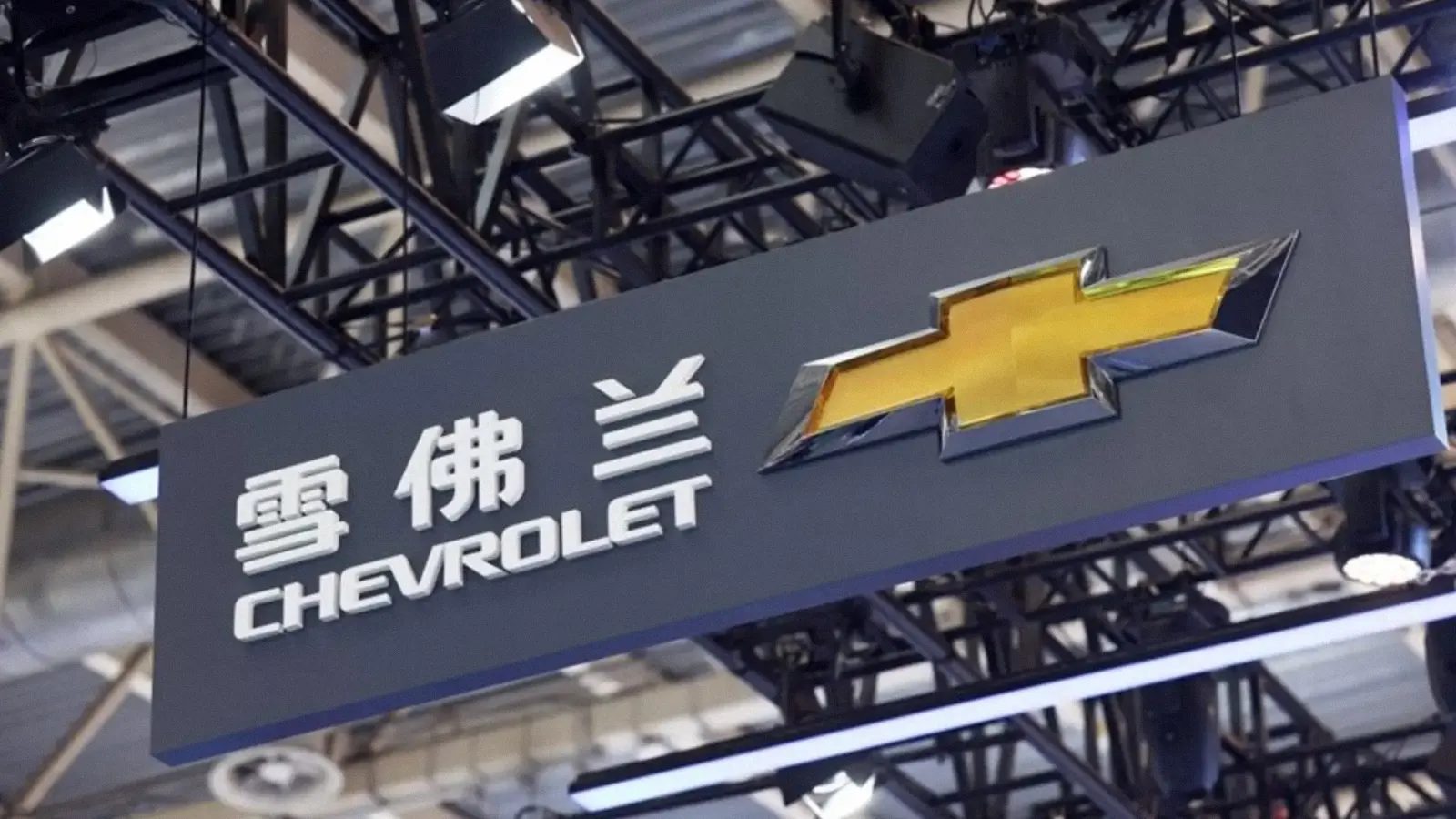

General Motors has confirmed Chevrolet will stop selling new vehicles in mainland China, ending a 21-year retail presence that once made the brand one of the country’s top-selling foreign nameplates.
Rather than shutting down assembly of the brand’s vehicles in China, the Detroit automaker plans to convert the Chevrolet production footprint into an export-only operation serving emerging markets.
Chevrolet exported 6,930 units from China in the first half of this year, up 6.9% year-on-year.
The company’s strategic pivot reflects the collapse of Western brand appeal in China and the tariff walls separating the world’s two largest economies.
GM confirmed that aftersales support for existing Chevrolet owners in China — more than 7.5 million over the brand’s 21-year run — will continue through the joint venture’s service and parts network.
From 767,000 Units to Near Zero
Chevrolet entered China in January 2005 through GM‘s joint venture with state-owned SAIC Motor, a 50-50 partnership that has operated since 1997.
Annual sales peaked at more than 767,000 units in 2014, according to Carscoops, placing the brand among the country’s top performers during a period of rapid market expansion.
However, the decline since then has been stark.
Volume fell to fewer than 9,000 units in 2025, a drop of approximately 98.8%.
According to Motor1, Chevrolet sold just one Equinox in China in June 2026, with only 36 vehicles moving in the entire first half of the year.
Many dealers had already disappeared from major cities including Beijing and Chongqing well before the formal withdrawal.
Chevrolet‘s failure mirrors the broader retreat of foreign combustion-focused brands.
Domestic automakers — led by giants BYD, Geely, Changan and Chery — have captured the majority of the market through aggressive new energy vehicle (NEV) pricing and rapid product cycles.
Chevrolet relied heavily on gasoline models such as the Blazer, Equinox and Malibu XL, and never managed a meaningful pivot to electrification in the country.
NEVs now account for the majority of new passenger car sales in China, a structural shift that has squeezed foreign joint ventures across the board.
SAIC‘s joint venture sales with GM had already plunged 56.5% in 2024.
Last year, SAIC-GM recorded 562,185 in total sales (including exports), representing a 16% fall year-on-year.
Total SAIC–GM sales in the first seven months of 2026 stood at 265,927 vehicles, down 7.5% year-on-year.
Production Slump
By mid-2010s, Chevrolet production in China was concentrated primarily within SAIC–GM‘s manufacturing network, particularly at its Shanghai and Shenyang facilities, while the newly established Wuhan plant was entering trial production.
From the late 2010s onward, however, Chevrolet faced growing competition in the Chinese market, particularly from rapidly expanding domestic automakers.
Falling sales and the impact of the Covid-19 pandemic resulted in lower utilization of SAIC–GM‘s manufacturing capacity.
As Chevrolet‘s sales continued to decline, the JV was left with excess manufacturing capacity across its network, which contributed to a major restructuring in late 2024 and the closing of the Shenyang plant.
Factories Stay Open for Export
GM stressed that Chevrolet production in China will continue.
Vehicles will ship to the Middle East, Africa, South America, Mexico and the Asia-Pacific region through both the SAIC–GM joint venture and the separate SAIC–GM-Wuling venture, which also builds Chevrolet-branded models for export.
According to Reuters, exports will explicitly exclude the United States, due to tariffs and national security policies targeting China-developed technology.
The Chevrolet models still built in China include the Monza sedan, Aveo, Captiva, Groove, S10 Max, and Menlo EV.
Chinese-manufactured EVs currently face a 100% tariff under Section 301 trade measures in the US, on top of the standard 2.5% automotive duty and additional levies.
ICE vehicles face a 25% Section 301 rate
GM’s Wider Production Footprint
The majority of GM‘s vehicle production remains in the United States, where the company has invested more than $6 billion in domestic manufacturing over the past 12 months.
Assembly plants span Michigan, Ohio, Tennessee, Kansas, Texas, Kentucky, Missouri and Indiana, producing the company’s highest-margin trucks and SUVs for the North American market.
GM also operates a significant production base in South Korea through its subsidiary GM Korea, which runs two plants in Incheon and Changwon, and where it is targeting production of 500,000 units in 2026.
Over 95% of that output goes to exports, with more than 85% shipped to the United States.
The South Korean plants produce the Chevrolet Trax, Trailblazer, Buick Envista and Encore GX.
GM committed a combined $600 million to its South Korean operations in late 2025 and early 2026, to modernize production lines and extend manufacturing beyond 2028.
China now becomes a third pillar of GM‘s offshore production, but with a fundamentally different role.
Unlike South Korea — which feeds the US market — China-built Chevrolets will serve price-sensitive markets in the Global South where lower production costs offer a competitive advantage, and where neither US nor Chinese tariff barriers apply.
SAIC-GM Renewed Through 2047
The Chevrolet exit came days after GM and SAIC signed a strategic renewal of their joint venture on August 5, extending the partnership by 20 years to 2047, according to Reuters.
The original deal was established in 1997 for 30 years and had been set to expire in 2027.
Under the renewed agreement, more vehicle-development work will shift to China to better match local consumer preferences.
SAIC–GM plans to launch at least 30 electric or hybrid models by 2030, built on locally developed technology including the Buick Electra series introduced last year.
The Electra lineup features advanced powertrain and intelligent-driving features not found in US-designed GM vehicles.
The Electra E7 SUV sold more than 10,000 units in its first month on sale and will become the first premium NEV exported by the joint venture when overseas shipments begin in October.
According to SAIC, the renewed partnership would allow China’s “local innovation to be shared globally.”
The renewal follows a broader trend of automakers extending Chinese partnerships despite market-share and profit declines — Honda and Volkswagen have both recently done the same.