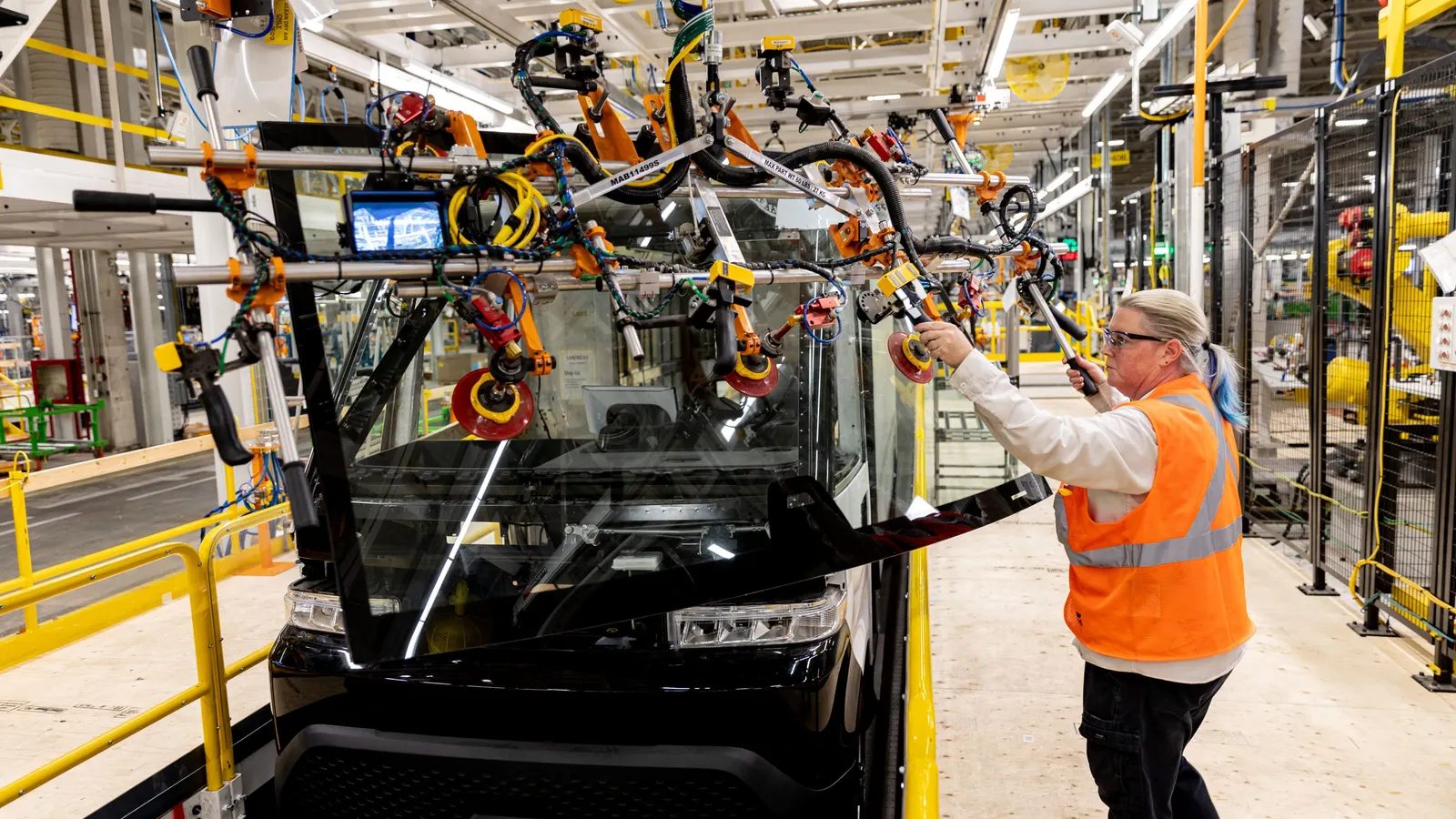

General Motors committed more than C$1 billion (US$719.6 million) in investment across its Ontario facilities as part of a three-year contract ratified overwhelmingly by Unifor members, the union announced.
Negotiations took place with the CAMI Assembly Plant in Ingersoll — a factory that’s been idled with the majority of its workforce on indefinite layoff for nearly a year now.
CAMI has been shut since GM halted BrightDrop electric van production in late 2025, affecting over 1,000 jobs.
The Detroit automaker also laid off 750 workers at Oshawa earlier this year, moving from three shifts to two, with Unifor attributing the reduction directly to US tariffs.
New spending under the agreement includes C$144 million to add the next-generation Heavy-Duty GMC Sierra truck to Oshawa Assembly and C$215 million to assemble a next-generation transmission at the St. Catharines Propulsion Plant.
Work on the transmission is anticipated to begin in late 2029.
Unifor described the transmission programme as a single-source allocation, meaning St. Catharines would be the sole facility producing the component.
Prior commitments of C$691 million to support a sixth-generation V8 engine in St. Catharines and C$63 million toward stamping and CCA upgrades in Oshawa are now enshrined in the collective agreement.
Oshawa Assembly has received more than C$1.5 billion in investment since 2020, according to GM Canada.
CAMI and Defense
Unifor said it will continue to push for production to return at CAMI Assembly.
GM committed to seek opportunities for the facility and designated it as the plant of first consideration for the allocation of Canadian Armed Forces defense work if that work is awarded to General Motors.
The defense provision adds a potential new role for the Ingersoll plant.
GM Defense already runs a substantial military business in the United States, with CEO Mary Barra telling analysts earlier this year the unit expects to win more than $1 billion in contracts, on 2026 revenue of about $700 million.
The automaker has not disclosed whether it has bid on any Canadian Armed Forces contract.
The agreement also extends the Income Maintenance Plan for eligible CAMI members on layoff until May 2028.
GM Master Bargaining Chairperson Trevor Longpre said the union “made significant progress in securing good, stable auto jobs and a stronger Canadian footprint, but the work to bring production back to CAMI is not over.”
“This agreement gives our Ingersoll members a bridge until we get CAMI workers back on the job,” Longpre added.
Wages and Benefits
Wages mirror the Detroit Three pattern agreement Unifor set with Ford Motor Company earlier this year, delivering 3% annual increases across the three-year term.
The agreement also includes a plan to mitigate layoffs at Oshawa Assembly.
The contracts cover more than 4,600 Unifor members across GM’s Ontario facilities in Oshawa, St. Catharines and Woodstock under the GMCC agreement, and at the CAMI Assembly Plant in Ingersoll.
GMCC members voted 80.5% in favour. CAMI members voted 96.5% in support.
Trade Backdrop
Unifor National President Lana Payne said these agreements represent “vital investments to Canadian GM facilities.”
According to Payne, GM “is making these investments in both its highly skilled Canadian workforce and facilities at a crucial time, as our domestic auto industry is under siege by the Trump Administration.”
GM builds 30% of its vehicles sold in the United States in Canada and Mexico.
Canada-US trade talks collapsed in late August with auto tariffs at the centre of the breakdown.
Washington offered to cut the Section 232 rate on Canadian-made vehicles to 15% from 25%. Automakers could have reduced the effective duty further by incorporating more US content, bringing the actual rate collected as low as 7.5%.
Ottawa rejected the terms and pushed to widen relief to include heavy-duty trucks, a category that covers vehicles assembled at Oshawa.
Data published by the non-profit group Center for Automotive Research (CAR) showed that during the first half of 2026, Canada accounted for 79% of US heavy duty truck manufacturing exports.
President Donald Trump responded by threatening to raise auto tariffs to 50% from January 1, 2027. Ottawa retaliated with counter-tariffs of up to 50% on $27.6 billion of American goods.
On Sunday, the US President wrote on Truth Social that he has “revived, and indeed saved, the Automobile Business in our America,” which he has attributed to the tariffs.
In the same post, Donald Trump criticized Canada as “One of the Worst Abusers,” stating that “I don’t want Canadian cars, I don’t want Canadian parts, I don’t want Canadian anything.”
“They’ve been ripping us off for decades, and it’s going to stop,” he wrote, adding that “This should have happened long ago with other Presidents, just as stopping Iran should have happened long ago.”
According to the President, “They want to be treated like a State, but they aren’t one. I deal with the Leadership of many Countries, but I find Canada to be the worst. They are entitled no longer!”