US President Donald Trump posted on Truth Social on Sunday that he had “revived, and indeed saved, the Automobile Business in our America,” crediting tariffs and singling out Canada as “One of the Worst Abusers.”
“[…] I don’t want Canadian cars, I don’t want Canadian parts, I don’t want Canadian anything,” Trump wrote.
The post came on the sixth day of an open trade war.
Open Trade War
Negotiations between Washington and Ottawa collapsed late August 21, after US negotiators introduced demands that Prime Minister Mark Carney said would have limited Canada’s ability to strike trade agreements with other countries.
“They asked too much and offered too little,” Carney told reporters the next day, calling the tariffs a miscalculation.
Tariffs of 50% on about $20 billion of Canadian goods took effect that Saturday, covering hundreds of products including wine, cement and hockey sticks, under proclamations signed in July invoking Section 338 of the Tariff Act of 1930 — a provision allowing the president to impose duties of up to 50% on countries found to discriminate against US commerce.
Trump announced the January auto tariff on the Monday that followed, then told Ontario Premier Doug Ford and other Canadian leaders to “fall in line” or face consequences far worse.
Canada answered on the following Tuesday with counter-tariffs of 15%, 25% and 50% on C$27.6 billion of US goods across more than 700 products, matching Washington rate for rate from September 8, alongside a C$7.5 billion support package for affected workers and businesses.
Auto Tariffs
Trump’s post came also a few days after he announced that tariffs on all cars, trucks and auto parts and steel from Canada would rise to 50% on January 1, 2027 — prompting retaliatory measures taking place as soon as September 8.
Since April 2025, Trump has imposed a 25% tariff on cars and auto parts coming from Canada despite the USMCA free trade deal signed by both North American States — and Mexico — in 2020, which has been matched by its neighbor.
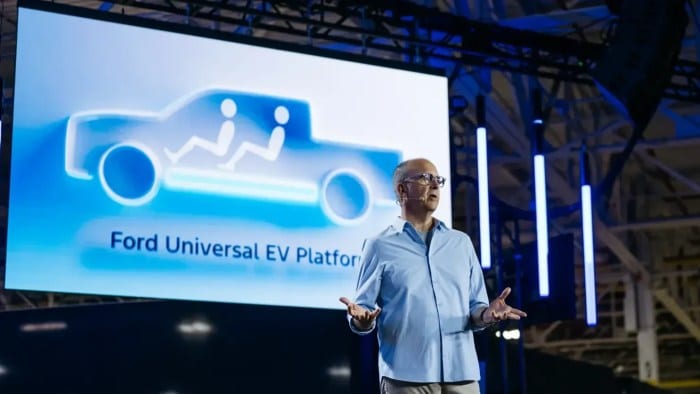
The duties have led Detroit automakers, such as Ford and General Motors, to scale back Canadian EV operations over the past year — while continuing to invest in truck assembly north of the border.
Trump’s Posts
A week prior, the United States’ President announced on Truth Social that all cars, trucks, auto parts and steel coming from Canada would be imposed a tariff of 50% when entering the country.
He added, “build in the US and there are ZERO TARIFFS. Canada will be treated like a State no longer!”
Trump expanded on the idea on Sunday afternoon.
“When I announced that I was running in the 2024 Presidential Election, right at the beginning, Ford was getting ready to close their Big Factory, in Detroit,” Trump wrote. “Then, because I was leading in the Polls, they figured they would leave it open a little longer to see what happened. Now it’s running 24/7, and it’s one of the most profitable Car Plants in the World!”
According to the President, he’s “revived, and indeed saved, the Automobile Business in our America. That’s because of what I’ve done with TARIFFS.”
Dearborn Factory
In his post, Trump is referring to Ford’s Dearborn Truck Plant at the River Rouge Complex in Michigan.
There, the Detroit automaker builds the F-150, which remains America’s best-selling vehicle.
No public reports from late 2022, when Trump announced his presidential bid, indicate Ford planned to close the facility.
Earlier this year, Ford added a third shift at the plant, as confirmed by executives during a presidential visit to the plant.
Production was ramped up to recover from a shortage caused by consecutive fires at their aluminum supplier Novelis plant in late 2025.
During the same visit, Trump called the 25% tariff on vehicles and auto parts “one of the biggest reasons” for economic growth in Michigan.
US-Canada Dependence
Trump also noted in his Sunday post that “One of the Worst Abusers is Canada.”
“I don’t want Canadian cars, I don’t want Canadian parts, I don’t want Canadian anything,” he said, stating that “They’ve been ripping us off for decades, and it’s going to stop.”
About 90 to 95% of vehicles assembled in Canada are exported to the United States, with Canadian auto plants functioning overwhelmingly as a manufacturing base for the US market.
The Canadian Vehicle Manufacturers’ Association (CVMA) put the share at 92% in 2024, while TD Economics pegged it at 90% in a February 2026 outlook.
About 90 to 95% of vehicles assembled in Canada are exported to the United States, with Canadian auto plants functioning overwhelmingly as a manufacturing base for the U.S. market. The Canadian Vehicle Manufacturers’ Association put the share at 92% in 2024; TD Economics pegged it at 90% in a February 2026 outlook.
Center for Automotive Research (CAR) data presented in mid-2026 showed Canadian vehicle production down 15% year-over-year through April.
CAR’s Industry Economist Tyler Harp said Canada accounted for 45% of U.S. market-share losses among trading partners in that period, while US-built vehicles gained share. Separate Canadian industry analysis found heavy-duty truck plants export more than 79% of their output to the United States.
CVMA data show the United States ran an average annual automotive trade surplus with Canada of $2.7 billion from the USMCA’s July 2020 entry into force through the first five years of the deal.
Tariffs vs EV Pullback
Washington imposed 25% Section 232 tariffs on imported vehicles and the non-US content of parts beginning in April 2025.
USMCA-compliant vehicles faced duties only on content sourced outside the United States.
For Canadian-assembled vehicles containing around 50% US-origin parts, the effective rate reached 12 to 13%.
Tariffs arrived alongside a broader rollback of clean-energy policy. Trump’s spending bill ended the $7,500 federal EV tax credit in late 2025 and weakened fuel-economy standards.
Detroit automakers were already pulling back from EV investments amid slower-than-expected demand before tariffs provided a second reason to restructure Canadian operations.
GM permanently ended BrightDrop electric van production at CAMI Assembly in Ingersoll, Ontario, in October 2025, idling more than 1,000 workers.
CEO Mary Barra cited a sluggish commercial EV market and regulatory changes. GM took a $1.6 billion impairment that quarter.
The company subsequently laid off 750 workers at Oshawa Assembly earlier this year, cutting from three shifts to two on its Silverado heavy-duty truck line. Unifor attributed the reduction to US tariffs.
GM said the move was for inventory balancing. Additional Silverado volume shifted to Fort Wayne, Indiana.
Ford’s Oakville Assembly Complex near Toronto had been closed since 2024 for retooling.
Ford originally planned to convert the plant into an EV facility under a C$1.8 billion investment announced in 2023.
When EV demand softened, Ford scrapped the electric plan and pivoted to Super Duty trucks.
Ottawa contributed C$464.5 million ($340.4 million) toward the retooling. Ford aims to produce up to 100,000 F-Series Super Duty trucks annually at Oakville, with the line starting before year-end.
As of mid-2026, Ford had 0% of its US new-vehicle sales coming from Canadian-built vehicles.
About 83% of the vehicles Ford sells in the US are built domestically, with the balance imported mainly from Mexico. Oakville’s ramp will shift that ratio.
H1 Financial Results
GM beat Wall Street estimates in both the first and second quarters of 2026, raising full-year guidance twice.
The automaker booked a $500 million tariff-related benefit in Q1 and expects gross tariff costs of $2.5 billion to $3.5 billion for the full year.
General Motors took $2.3 billion in EV-related restructuring charges in Q2.
Ford recorded a $19.5 billion impairment in December 2025 tied to its EV pullback and posted a $1.3 billion net loss in Q2 2026 after taking $4.2 billion in additional EV-related charges — including $3.6 billion from restructuring its BlueOval SK battery joint venture.
The ‘Model e’ unit lost $919 million in Q2, though losses narrowed year over year.
Despite that, the automaker raised 2026 adjusted EBIT to $10 billion to $11 billion, from $8.5 billion to $10.5 billion, and free cash flow to $6 billion to $7 billion.
Canadian Manufacturing Shift
Both Ford and GM made significant Canadian commitments in 2026 while expanding US capacity.
Ford announced “up to 1,000 jobs” at Dearborn in October 2025 and is bringing Oakville back online with Canadian government support.
In the US, Ohio Assembly Plant and Kentucky Truck Plant are running at capacity for Super Duty trucks — one reason Ford needed Oakville.
GM committed more than C$1 billion (US$719.6 million) in Ontario investments through a three-year Unifor contract ratified over the weekend.
Unifor President Lana Payne called the investments vital, made “at a crucial time, as our domestic auto industry is under siege by the Trump Administration.”
Spending includes C$144 million to add next-generation GMC Sierra HD production at Oshawa, C$215 million for a single-source transmission at St. Catharines starting in late 2029, and a reaffirmed C$691 million commitment for V8 engines.
GM also pledged not to sell or close the idle CAMI plant during the contract term and designated the facility for potential Canadian Armed Forces defense work.
The company has simultaneously ramped US truck capacity.
Orion Township, Michigan — previously an EV-focused plant — is being converted for gas-powered Cadillac Escalade, Chevrolet Silverado 1500 and GMC Sierra 1500 production starting around 2027.