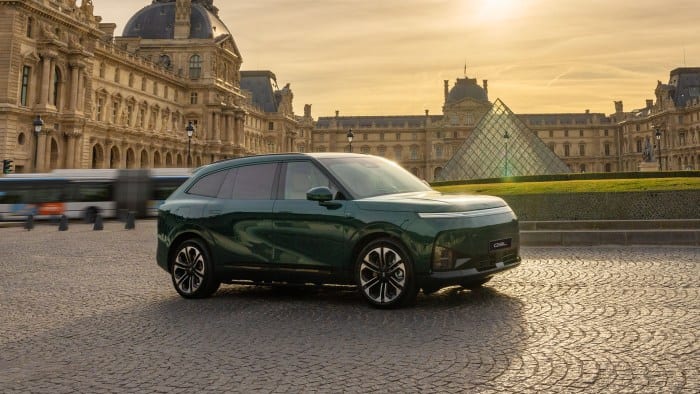
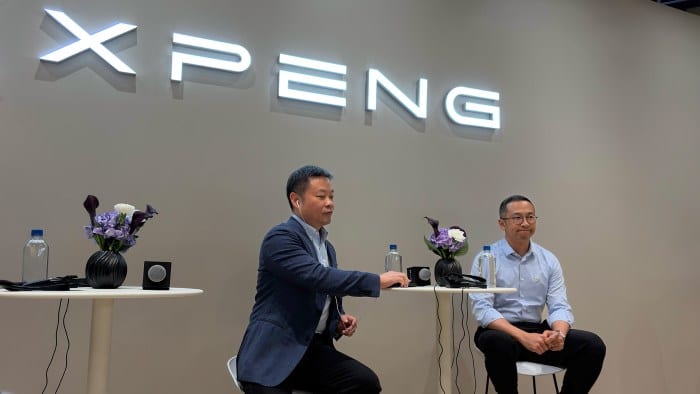
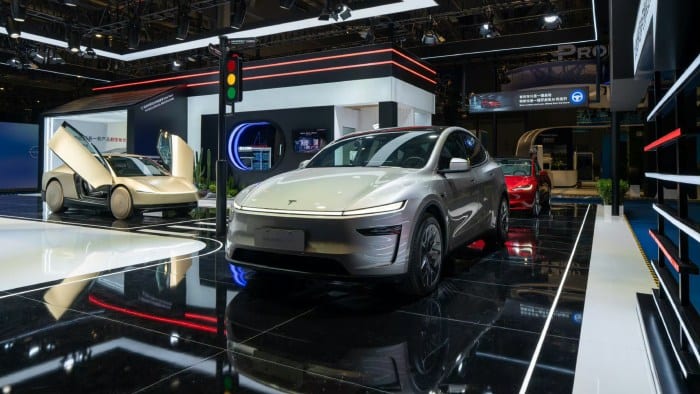
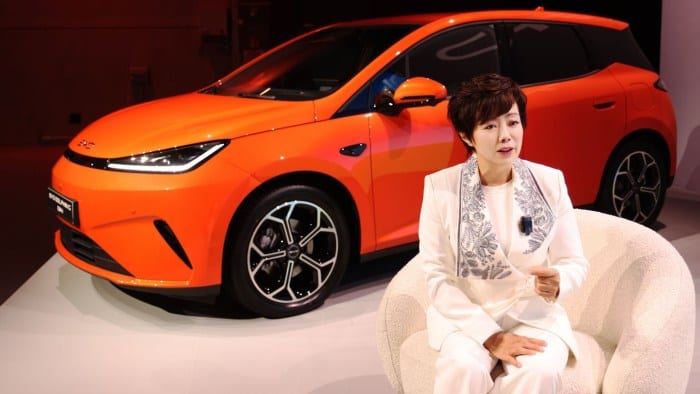
The American auto industry asked President Donald Trump to keep Chinese carmakers out of the United States, in a letter sent a week before Xi Jinping arrives in Washington with a business delegation that may include BYD and CATL.
“In advance of Chinese President Xi Jinping’s visit to Washington, we urge your administration to maintain policies that keep the door firmly shut to Chinese automakers seeking to sell, import or manufacture vehicles inside the U.S.,” reads the letter.
Reported a day later, the letter is dated Thursday and headed “Keep Trump administration ban on Chinese vehicles in America.”
Six organisations signed, representing General Motors, Toyota, Volkswagen, Ford, Hyundai, Stellantis and Tesla among others, according to Reuters: John Bozzella of the Alliance for Automotive Innovation, Matt Blunt of the American Automotive Policy Council, Paul McCarthy of MEMA, Jennifer Safavian of Autos Drive America, Mike Stanton of the National Automobile Dealers Association and Albert Gore of the Zero Emission Transportation Association.
Copies went to Treasury Secretary Scott Bessent, Commerce Secretary Howard Lutnick and Trade Representative Jamieson Greer.
It follows Trump’s comment to Fox News last week that he would be comfortable with Chinese car companies building vehicles in the United States.
Building in America
The letter addresses that proposition directly.
“Domestic assembly of Chinese vehicles doesn’t resolve the connected vehicle security threat,” it says.
“Even if built in the U.S., these factories would still rely on Chinese suppliers and Chinese components, and would be overseen by individuals with direct ties to the Chinese government,” the letter adds. “Chinese production in the U.S. would bring fewer jobs and remain reliant on foreign supply chains. Localized Chinese production will not advance the administration’s manufacturing jobs and national security agendas.”
The letter also disputes the employment argument. “Chinese automakers have zero market share in the U.S. Allowing them to open a domestic facility would provide a foothold in the U.S. market at the expense of manufacturers operating here. That would not create new American manufacturing jobs.”
The associations claim that the move would “erode the value of 17,000 auto dealerships” nationwide.
“Rather, it would shift jobs away from manufacturers that have made generational investments in the U.S. and toward companies owned and operated by the Chinese government,” the letter says. “It would erode the value of 17,000 auto dealerships in our country that benefit consumers and communities nationwide.”
It draws an explicit line between Chinese entrants and the foreign automakers already established in America, saying Chinese companies “would fundamentally differ from companies headquartered in Europe, Japan and South Korea, which operate on market principles and have invested substantially in the American economy and American workers.”
It closes on defence. “The automotive sector is foundational to our advanced manufacturing and defense base, with the capacity and workforce to respond during a national emergency. Once that base is hollowed out, it can’t be rebuilt overnight.”
What the Letter Credits
Much of the text is addressed to Trump’s own record.
It credits the administration with acting against Chinese dominance in semiconductors and critical minerals, with imposing “100 percent tariffs on Chinese vehicle imports,” and with championing the Commerce Department national security rule prohibiting Chinese connected vehicles, hardware and software.
“Those policies have worked and are the reason why the U.S. — unlike Europe, Australia, Southeast Asia, Mexico and South America — is not grappling with a massive surge in cut-rate Chinese vehicles that are not only capable of collecting and transmitting personal data back to the Chinese government but also weaken the market position of incumbent manufacturers.”
What Europe Looks Like
Registration data from the European Automobile Manufacturers’ Association show what the signatories are pointing at.
BYD registered 130,743 cars in the European Union in the first half, up 168.2% year on year, lifting its share to 2.2% from 0.9%.
That put it ahead of Tesla, which registered 124,242, and within 2,037 units of Ford, whose volumes fell 20.2% to 132,780. In June alone BYD registered 30,791 cars against 10,288 a year earlier, an increase of 199.3%.
Chery Automobile grew 268.7% to 84,987 and Leapmotor 526.7% to 48,261. SAIC Motor, owner of the MG brand, added 19.1% to 127,585.
Those four wholly Chinese-owned groups took 6.6% of EU registrations between them.
Adding Geely Group, whose brands include Volvo Cars, Polestar, Lotus, Lynk & Co, Smart and Zeekr and which registered 157,253 cars, Chinese-owned groups accounted for about 9.3% of the EU market in the half.
Hyundai Chief Executive Officer Jose Munoz made a similar comparison on Friday, telling Reuters that Chinese cars sell 30% to 40% below rivals in Italy, Spain and France, and describing Britain, which imposed no tariffs, as having “become like China.” Munoz asked Washington to impose conditions on Chinese companies rather than exclude them.
Four of Seven Candidates Build Cars or Batteries
Xi is due in Washington on September 24 for a state visit, a date Trump named in July.
Reuters, citing three people familiar with the discussions, reports seven companies under consideration for the delegation: BYD, battery makers CATL and Gotion, phone and vehicle manufacturer Xiaomi, consumer electronics group Hisense, parts supplier Wanxiang and Bank of China. Those selected are expected to attend a White House state dinner.
Bloomberg reported on Wednesday that officials including Xi’s chief of staff Cai Qi were reviewing the list and that it could change at the last minute.
Both BYD and CATL sit on the Pentagon’s list of Chinese military companies. BYD has threatened to challenge the designation and denies supporting China’s military.
CATL is appealing. Gotion is in a dispute with Michigan officials over a blocked $2.36 billion battery plant, and Wanxiang paid $53 million to settle customs violations.
China’s foreign ministry says it has no information on the delegation, and the diplomatic timetable it publishes does not include the visit.
The Existing Restrictions
Tariffs on Chinese electric vehicles run above 100%.
A rule imposed under the Biden administration in early 2025 restricts Chinese connectivity hardware and software in vehicles, covering Bluetooth, Wi-Fi, cellular and some satellite communications, which in practice bars Chinese automakers from selling or building passenger cars in the country.
The letter asks Trump to keep those measures rather than to add new ones. Its request is framed as continuity: “Thank you for standing with automakers, dealers and suppliers and sending a clear message: The U.S. government won’t allow Chinese automakers to do here what they’ve gotten away with around the world.”
Transportation Secretary Sean Duffy wrote to Ford Chief Executive Officer Jim Farley on September 8 saying the company’s dealings with CATL, Geely and BYD raised “profound concern,” and urged Ford to cut ties, citing the Marshall, Michigan plant that runs on licensed CATL technology.