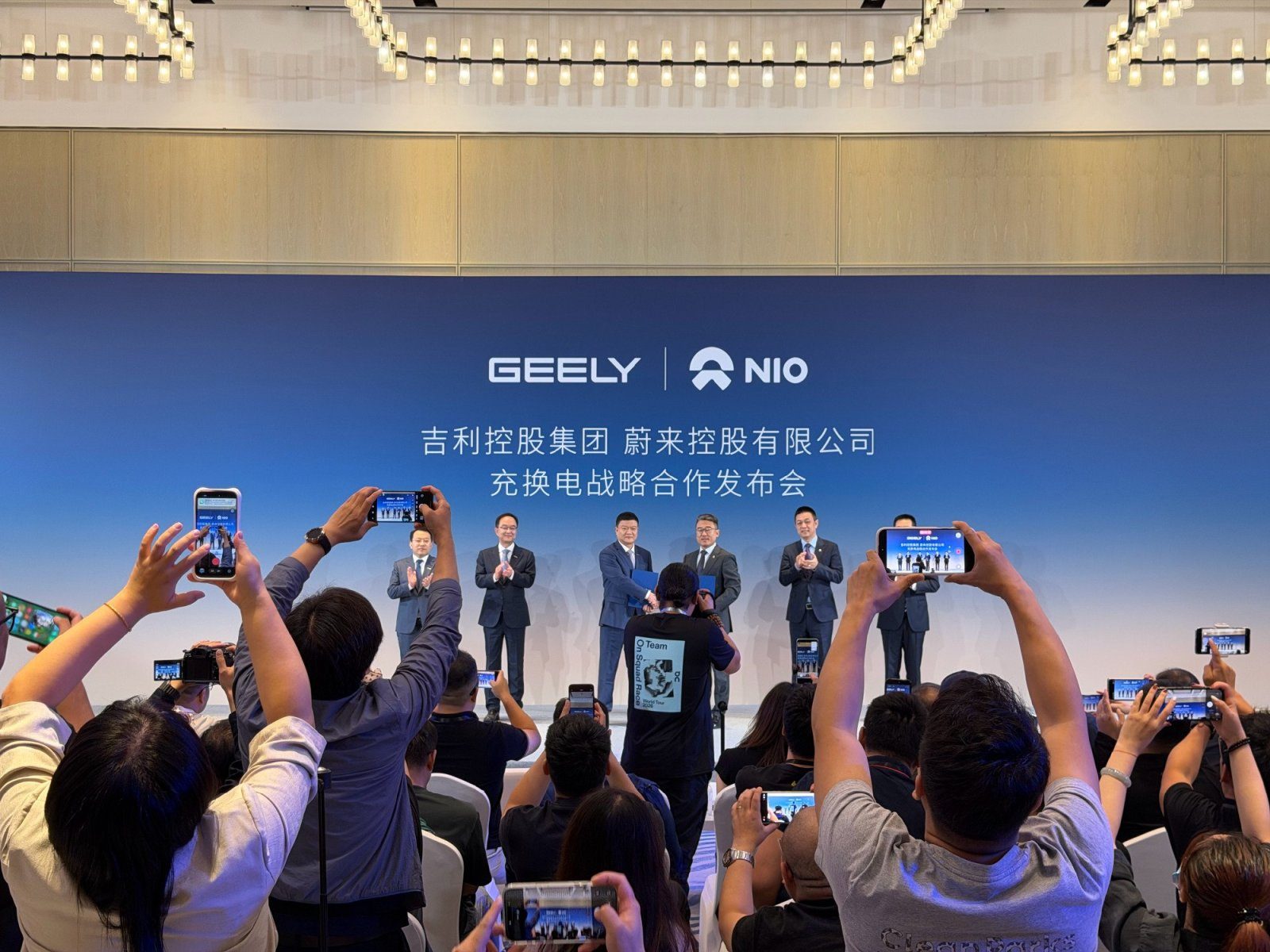

Nio‘s US-listed shares pared early gains on Monday after Geely Holding Group agreed to take a 30% stake in its battery-swapping unit, in a deal whose filing leaves several financial and commercial terms undisclosed.
The shares were edging 0.42% higher at $3.585 as of publication. They rose in pre-market trading, opened at $3.64, above Friday’s $3.57 close, and climbed as much as 2.8% to $3.67 shortly after the open.
Nio’s shares peaked in early 2021, during a rally in electric vehicle stocks that also lifted Rivian and Lucid to record highs they have not revisited since.
The broader market was lower. The S&P 500 was down 0.6% and the Nasdaq Composite 0.7% as of 12:48 p.m. ET, while Tesla fell 3.3%, Rivian 3.5%, Lucid 3% and XPeng 1.3%.
Nio’s Hong Kong-listed shares closed up 1.35% at HK$28.44.
Geely Automobile, Geely Holding’s Hong Kong-listed carmaker, closed 3.65% higher at HK$16.17 ($2.06) on a day Goldman Sachs resumed coverage of the stock with a Buy rating, while the Hang Seng Index rose 0.54%.
The Deal
A Geely Holding subsidiary will pay with all of Yiyi Internet Technology, its battery-swapping operator for commercial vehicles, plus 640 million yuan ($95.3 million) in cash, for 30% of NIO Power, Nio said in a filing.
The deal values NIO Power at about 16 billion yuan ($2.38 billion) after the investment. The cash portion, which goes into NIO Power, is equal to about 1% of Nio’s market value.
Yiyi, founded in 2017, serves taxis and ride-hailing cars and had 436 swap stations in 44 cities as of June 2025.
Nio’s stake falls to 63.6%, with an existing investor, a Wuhan venture fund, holding 6.4%.
The Wuhan fund was among investors that put 1.5 billion yuan ($223 million) into NIO Power in 2024.
In a second transaction, Nio will subscribe in cash for 10% of Haohan Energy, Geely’s charging business, which will use the proceeds to buy certain charging assets from Nio.
Haohan oversees the charging operations of Zeekr, Lotus and other Geely passenger-car brands.
The two sides will “fully connect their charging infrastructure,” Nio said in a joint statement with Geely on Monday. Both transactions are subject to regulatory clearances and other customary closing conditions.
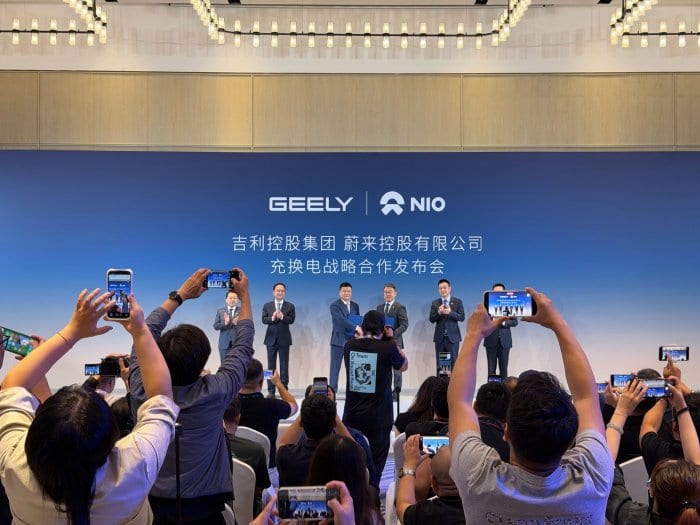
Stanley Qu, Nio’s CFO and Head of NIO Power, and Dai Qing, Rotating President of Geely Holding, exchanged the agreements in Hangzhou on Monday.
Geely Holding is the privately held parent of Hong Kong-listed Geely Automobile, and the only exchange filing on the deal came from Nio.
What Nio Said
Nio said in its filing that the transactions “reflect industry recognition of NIO’s battery swapping technologies, network and operational capabilities.”
“This partnership brings together the strengths the two sides have built over the years, with closer collaboration across technology, standards, operations, assets, and capital,” Li said in the joint statement.
He said the collaboration “is open to the broader industry” and that Nio looked forward to “more industry peers joining us.”
Speaking to reporters after the signing, Li said Nio and Geely were discussing cooperation in many areas, and that charging and swapping was one where the sums were relatively easy to work out and consensus relatively easy to reach, 21st Century Business Herald reported.
“Even our two companies will have some competition, which objectively exists, and healthy competition is not involution,” Li said.
“Before, each company validated its own technology, and now how to converge, reduce duplicated investment and waste, and raise each company’s efficiency is an important task for China’s new energy vehicle companies,” the founder stated.
“Our chargers have been open to users of all brands from the first day, and more than 85% of the electricity, in fact now 87% or 88%, goes to users of brands other than Nio,” Li said.
He added the industry’s new model for growth should be open collaboration and mutual benefit, adding that “only this way can we all really make some money.”
Li said that once the deal closes, NIO Power will run two separate swap networks, one for private cars and one built on Yiyi to serve Geely’s Cao Cao Mobility ride-hailing fleet and future robotaxis.
NIO Power aims to have 10,000 swap stations in operation by 2030, up from 4,126, and Li said Geely’s backing made Nio more confident of reaching that target.
Reaching it would take about 1,380 new stations a year, against a record 1,011 added in 2023.
Li said Nio’s swap stations, excluding chargers, had electricity demand of about 2.5 billion kWh last year, against an internal 2030 target of 10 billion kWh.
Nio has invested more than 20 billion yuan ($2.98 billion) in charging and swapping, according to the statement.
Qin said a ride-hailing car on a good swap network could save up to 90 minutes a day and raise its operating income by 15% to 20%, in what he described as “a very simple calculation,” Kuai Keji reported.
Under a battery-leasing model like Nio’s, costs over a vehicle’s life could fall by as much as 40%, he said.
What Geely Said
An said Geely began exchanges with Nio on battery swapping in November 2023, and “today we decided to deepen our cooperation to open a new chapter of joining forces in charging and swapping,” 21st Century Business Heraldreported.
He called the venture “an important platform for the two companies to respond to the national strategy, follow industry trends, protect the green environment and serve tens of millions of users.”
“Recharging networks are public infrastructure that serve society as a whole,” An said in the joint statement.
He said they “should be built together, shared openly, and connected across networks, so that users ultimately benefit the most.”
An told reporters that ultra-fast charging and battery swapping were the two main technical routes for recharging, serving different users and settings, and that they could complement each other, Jiemian reported.
He said recharging infrastructure required heavy, long-cycle investment, and that working with other companies lowered the investment risk and let networks grow faster.
An also said Cao Cao would switch fully to battery swapping, and that the robotaxi model under development would use swapping and would arrive “soon.”
Cao Cao’s Eva Cab robotaxi, unveiled in April, is due to enter mass production in 2027.
Geely said Haohan has 2,500 charging stations with more than 12,000 connectors in 232 Chinese cities, and plans more than 22,000 stations with more than 100,000 connectors by the end of 2027.
What Was Not Disclosed
The filing does not state how much cash Nio will pay for its 10% of Haohan or at what valuation. Neither side had disclosed the amount.
It does not say which charging assets Haohan will buy from Nio with that money, or how many of Nio’s 5,307 charging stations and 30,598 chargers are involved.
As a result, the net cash effect of the two transactions on Nio cannot be calculated from the documents.
Nor does the filing give Yiyi’s financials or the value assigned to it, although the terms imply about 4.2 billion yuan ($620 million) for the business.
Geely’s 30% stake may be reduced “to no less than 20%” based on NIO Power’s performance against operational milestones, the filing says, but the milestones are not disclosed.
Geely also holds an option to invest a further 640 million yuan ($95.3 million), which would take its stake to 34% and cut Nio’s to 60%.
The option runs for two years after closing, or until NIO Power signs a new funding round if that comes first.
The filing does not address governance and does not give a timetable for completion or for the regulatory approvals.
The consumer-car element is described only as “preliminary plans for the adoption of battery swapping technology,” with implementation “subject to further discussions.”
Nio’s press release says Geely Holding “will develop consumer-facing battery-swappable vehicle models,” without naming a brand, a model or a launch year.
The premium brand signed a battery-swap cooperation framework with Geely Holding in November 2023, and no Geely consumer model using Nio’s swap stations has reached the market since.
Nio has also signed swap agreements with Changan, GAC, Chery and FAW, but no model from any other carmaker has yet been connected to NIO Power’s network.
FAW, Changan, Chery and GAC were among five carmakers that unveiled 10 models for CATL‘s rival Choco-Swap standard in April 2025.
Nio does not disclose NIO Power’s revenue, profitability or the utilisation of its 4,126 swap stations, and has never reported the swap business as a separate segment.
Some individual stations are profitable, but the network as a whole has not broken even.
Onvo President Shen Fei, a former Senior VP of NIO Power, has previously put a station’s break-even point at about 50 to 60 swaps a day.
CATL, which agreed in March 2025 to invest up to 2.5 billion yuan ($372 million) in NIO Power, does not appear among the shareholders listed in the filing, whose post-deal stakes add up to 100%.
Neither company referred to that agreement on Monday.
As of publication, no Wall Street analyst covering Nio had issued a research note commenting on the agreement.
Nio’s shares are about 55% below their 52-week high of $8.02 and within a few cents of their 52-week low of $3.55.
They have fallen about 15% since August 31, the last session before Nio reported second-quarter results.
The US-listed shares are down about 95% from their all-time high of $66.99, reached intraday on January 11, 2021. The company’s market value stood at about $9 billion at midday.
Delivery Pressure
The deal comes days before Nio reports September deliveries, which will show whether it met its third-quarter guidance.
Nio needs to deliver between 36,230 and 39,230 vehicles in September to reach its guidance of 108,000 to 111,000 for the quarter, after 35,934 in July and 35,836 in August.
The company has also set a target of 40% to 50% delivery growth, which applied to 2026 means 456,000 to 489,000 vehicles from 326,028 in 2025.
Nio delivered 262,893 vehicles through August, leaving 193,500 to 226,100 for the final four months, or an average of 48,400 to 56,500 a month.
Management told analysts on September 1 that it expects monthly deliveries to average more than 40,000 in the fourth quarter.
Even at the top of September’s implied range and 40,000 a month in the fourth quarter, full-year deliveries would come to about 422,100, or growth of about 29%.
Nio has not announced any new model launches for the fourth quarter.
The EV maker said on the call that its namesake brand will add 5 Series and 6 Series models in 2027 and that Onvo will launch a major new product that year.
The European launch of Onvo was recently delayed from 2027 to “2028-2029.”
The Nio brand relies on two SUVs. The ES8 and ES9 accounted for 82.5% of the brand’s 21,174 August deliveries, and for nearly half of the group’s 35,836.
Nio is due to report September deliveries by brand on October 1. The company is expected to report third-quarter results and hold its earnings call in November, although it has not confirmed a date.