
Geely Auto Group’s mainstream Geely brand will start selling vehicles in Canada in 2027, the Chinese carmaker said, without naming a single model, price, dealer or launch city.
Geely Auto Canada has a team in place and is setting up local operations, along with a retail and service network being developed with “highly trusted and experienced partners,” according to a statement issued on Friday.
Details on the first vehicles, retail and service locations, pricing and availability will follow as the company moves toward its 2027 launch, Geely said.
Bryan Wu, Managing Director of Geely Auto Canada, called the country “an important next step in Geely Auto’s international growth” and said the brand was entering with a long-term commitment.
“Trust is earned over time, and we are committed to earning it here,” Wu said.
The brand would join a Canadian market that already sells China-built cars from two other Geely Holding brands, Polestar and Lotus, under a tariff-rate quota that has gone largely unused since its second window opened on September 1.
What Geely Announced
The statement adds little to what Geely had already shown on its Canadian website, which was live by October 2.
The website says that “our Canadian journey is coming soon, with a growing dealer network planned for key markets across the country.”
It lists no vehicles, no reservation form and no dealer, and it refers only to a “new generation of electrified vehicles.”
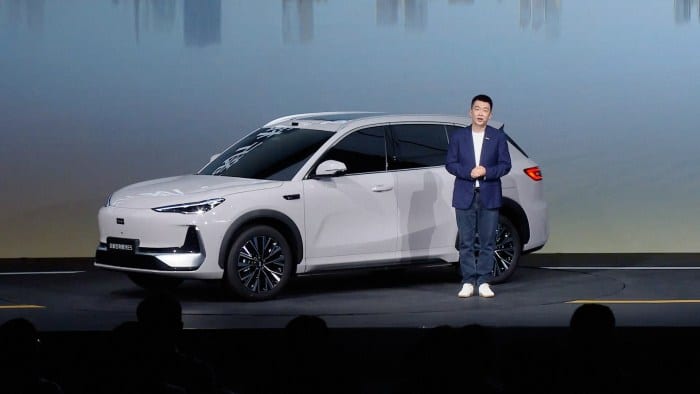
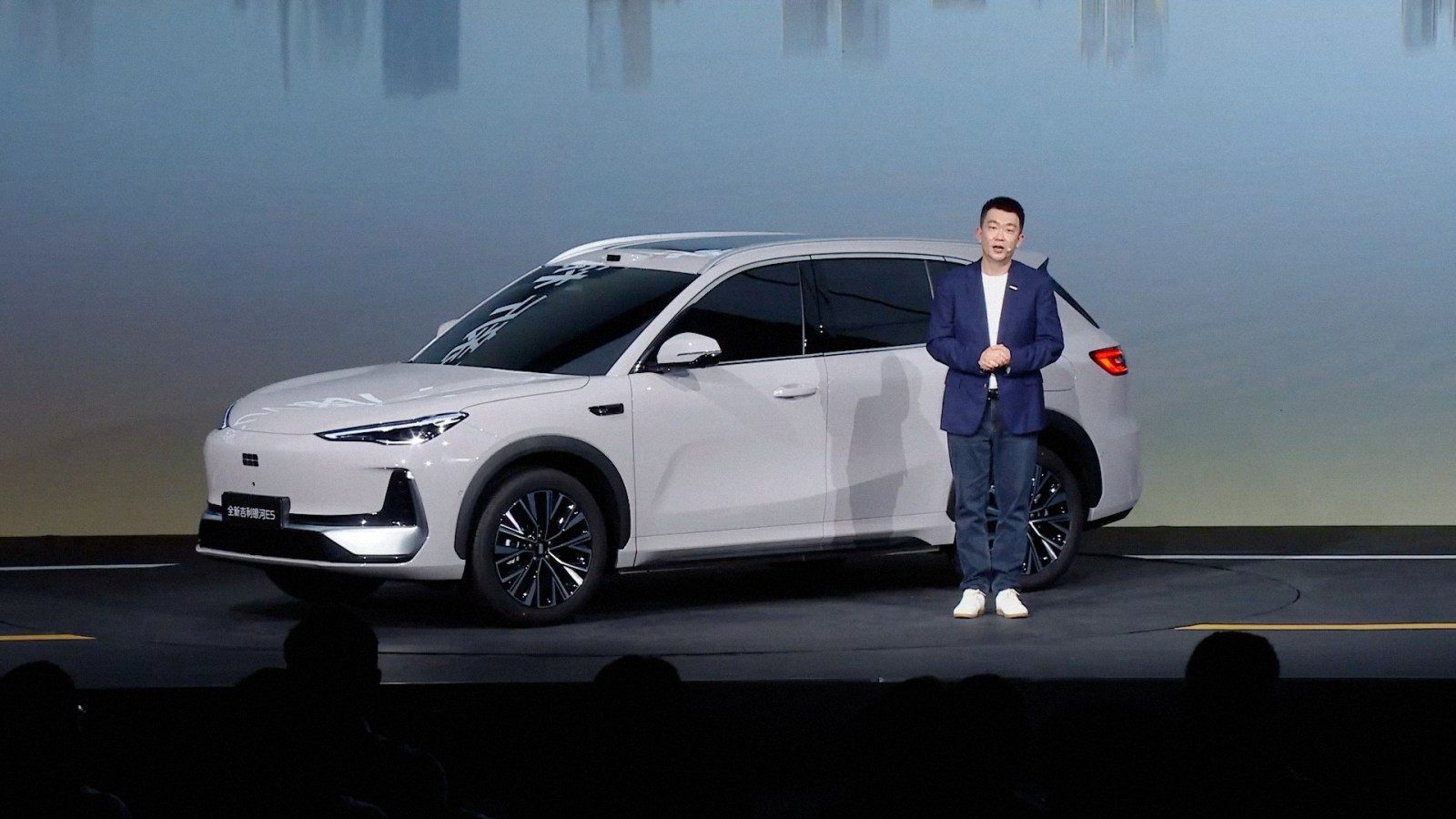
The only model the site names is the Geely E5, which is sold in China as the Galaxy E5.
Friday’s statement confirms that Geely will sell through dealers, with retail and service handled alongside local partners.
What Geely Has Not Disclosed
The lineup is the biggest gap.
Two Geely test vehicles, the EX5 electric SUV and the smaller EX2, were photographed being unloaded at Toronto Pearson airport on May 27.
A black EX5 was then filmed on a Toronto-area road wearing Ontario manufacturer plates, in a video posted to Xiaohongshu on August 27.
The word “electrified” in Geely’s Canadian materials leaves room for plug-in hybrids alongside fully electric models, and the quota notice lists the customs tariff items for hybrid and plug-in hybrid cars as well as battery-electric ones.
The first period included 259 non-plug-in hybrid SUVs, all imported in July.
Prices are also undisclosed, which leaves open whether any Geely model would fall under the quota’s affordable tier.
Geely has not said which Canadian entity will import its vehicles or whether it has applied for import permits.
Under the Global Affairs Canada notice governing the quota, the importer must be a Canadian resident and a manufacturer of EVs, or a resident agent appointed by a non-resident manufacturer.
Regulatory approval is another open question.
Neither Geely Auto, Zeekr nor Lynk & Co appeared on Transport Canada’s Appendix G list of pre-cleared manufacturers as of its October 2 update, though the list does include Zhejiang Haoqing Automobile Manufacturing, a Geely Holding unit in Chengdu.
An Conghui, who became Chairman of Geely Automobile in August, told Bloomberg in March that Canadian certification for Geely-branded vehicles was expected “soon.”
The timing within 2027 is unclear as well.
Geely has not said where its Canadian vehicles would be built.
An said in March that Geely’s globalization was mostly export-based for now and that the group would “look to localize production,” without saying whether that applied to Canada.
Industry Minister Mélanie Joly said in June that BYD, Chery and Geely were willing to explore joint ventures to build vehicles in Canada, according to The Logic.
Joly said any such venture would need majority Canadian ownership, domestic labour standards, Canadian parts and secure software, the outlet reported.
Geely has not announced any Canadian plant or partner.
It is also unclear whether Zeekr or Lynk & Co, the two other brands in Geely Auto Group, will follow, even though the Toronto leadership roles advertised in April were posted by Zeekr International and tied to the Geely Auto brand.
The Quota
Canada and China agreed on January 16 to let 49,000 China-made EVs a year into Canada at the 6.1% most-favoured-nation tariff, replacing the 100% surtax Ottawa imposed in October 2024.
Prime Minister Mark Carney said Ottawa was open to raising the quota to 70,000 within five years.
The quota year runs from March 1 to the end of February, split into two six-month periods.
The first period closed with 15,603 of its 24,500 permits used, and the 8,897 unused permits rolled into the second period, giving it 33,397.
Only 160 of those permits had been issued as of September 25, according to the latest Global Affairs Canada data EV reviewed, leaving 33,237 of the year’s 49,000 permits unused.
From March 2027, at least 10% of the quota must go to vehicles valued at C$35,000 (about $24,600) or less, rising to half by 2030.
Cars arriving in January or February 2027 would draw on the current quota year, which ends on February 28, while later arrivals would fall into the second year starting on March 1.
China-built Geely vehicles would not qualify for the federal EV rebate of up to C$5,000 (about $3,500), which is limited to vehicles built in Canada or in countries with free-trade agreements with Canada.
Geely Holding Brands Already in Canada
Geely Holding has owned Volvo Cars since 2010, and Volvo has long sold vehicles in Canada.
Polestar reintroduced the China-made Polestar 2 in Canada on June 3 at C$69,900 (about $49,100), and later cut prices across its Canadian range by up to C$15,000 (about $10,500).
Lotus launched the Wuhan-built Eletre in Canada in April from C$119,900 (about $84,200), with the first vehicles arriving in July.
South of the border, the US Commerce Department’s Bureau of Industry and Security declined on June 25 to authorize Polestar under the rule on Chinese vehicle technology, barring it from US sales from the 2027 model year, while Volvo received an authorization on May 26.
The Chinese Rivals
Chery’s Omoda & Jaecoo became the first Chinese brand to set a Canadian launch window, saying on its website that it is “coming late 2026.”
Dongfeng aims to bring its first two models to Canada as early as 2027 through distributor North World Industry, which showcased its EVs in Montreal in July.
BYD has added a “Coming Soon” notice to its Canadian website without a date, and is testing four models in Canada.
BYD engaged Dealer Solutions Mergers & Acquisitions to find sites for about 20 dealerships, starting in the Greater Toronto Area.
Geely’s 2027 date places it behind the timing Omoda & Jaecoo has given and level with Dongfeng’s target, while BYD has yet to set one.
Geely’s Scale
Geely Auto Group sold 3,024,567 vehicles in 2025, up 39%, including 1,687,767 new energy vehicles, up 90%, according to the statement.
It sold “over 2.23 million vehicles” from January to September, according to a version of the statement distributed through GlobeNewswire at 9:59 a.m. ET.
September accounted for 292,168 of those, up 7% from a year earlier, Geely Automobile said in a separate filing.
That is about 65% of the group’s 3.45 million target for 2026, leaving roughly 1.2 million vehicles to sell in the fourth quarter, or about 400,000 a month.
Geely says its vehicles are sold in more than 100 countries and regions.
Geely will give its Monjaro EM-i plug-in hybrid SUV its European debut at the Paris Motor Show on October 12.