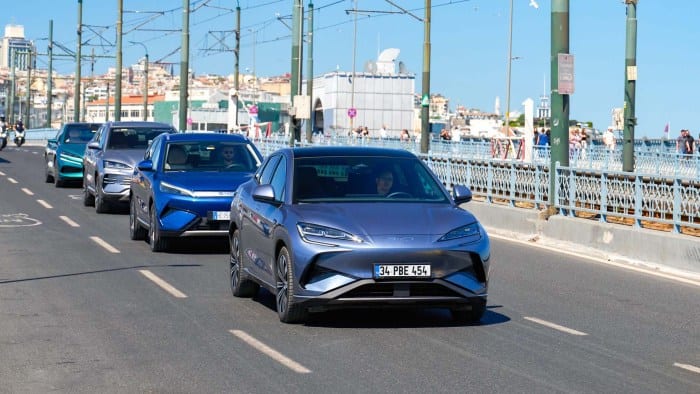

A BYD Sealion 7 has been photographed in an underground car park in Markham, Ontario, near BYD Canada’s registered office, bringing the number of models the company has been seen testing in the country to four.
The second window of Canada’s import quota for Chinese-built electric vehicles opened on September 1 with 33,397 permits. BYD has announced no launch date, models or prices.
The vehicles have been seen in Markham and Toronto in Ontario, in Montreal, and at an unspecified location in Quebec.
None of the four models — BYD Shark, Sealion 7, Sealion 06, and Ti7 — is among the vehicles BYD has filed with Transport Canada.
The Models
The fully electric mid-size SUV Sealion 7, BYD’s Tesla Model Y rival in Europe, the UK and Australia.
Photographed in Quebec in June, at a Montreal hotel in late August and in Markham this month. It is not known whether the three sightings involve the same car.
BYD’s plug-in hybrid pickup Shark, sold in Mexico and Australia, was photographed beside the Sealion 7 in Quebec in June with BYD lettering across its grille.
It is the one model seen that has no Chinese-brand competitor in Canada’s pickup market.
The fully electric SUV Sealion 06 EV was photographed in tan at the Montreal hotel in late August alongside the Sealion 7 and the Ti 7.
Ti 7. A plug-in hybrid SUV from BYD’s off-road sub-brand Fangchengbao, photographed at the Montreal hotel in late August, the first confirmed presence of the sub-brand in Canada, and again at Toronto’s Sheraton Centre in early September with a printed specification sheet on the passenger seat.
The sheet describes an all-wheel-drive plug-in hybrid with BYD’s second-generation Blade battery, a pairing BYD does not sell in China. Neither BYD Canada nor Transport Canada has confirmed the configuration.
Not the Cars on the List
BYD’s Shenzhen headquarters plant and its Xi’an plant hold listings on Transport Canada’s Appendix G pre-clearance registry, a compliance filing that precedes import and is separate from the shipment permits Global Affairs Canada issues under the quota.
Reuters reported in June that BYD had begun compliance procedures for two passenger models, one from each plant.
Appendix G works at plant level.
The Ti 7 is built at Changsha, Hefei and Jinan, none of which is listed, and Transport Canada paused new passenger-vehicle applications last year, so bringing it in at volume would need either a new listing or approval vehicle by vehicle, a route that cannot scale.
The mismatch suggests BYD is evaluating a wider range than its filings show. It does not indicate what it will sell.
The company added a “Coming Soon” notice to its Canadian website in late August.
Hiring for a Charging Network
The hiring that accompanied that notice has continued. As of Friday morning, LinkedIn showed at least 14 open BYD postings for Toronto, listed under BYD Canada and BYD North America, several of them the same role posted under both names.
The distinct positions are Regional Sales Manager, Sales Trainer, Product Manager, IT Manager, Legal Counsel, Aftersales Manager, Operations Planning Specialist, Infrastructure Business Development Manager and a Flash Charging Business Development Specialist, the newest, posted six days ago.
That last role is the first public sign that BYD intends to bring its Flash Charging network to Canada.
The posting says the specialist will support “BYD Canada’s flash charging network development” and execute “BYD’s flash charging network expansion strategy and business growth across Canada,” lead network planning, and “coordinate with the partner to manage all the flash charging station construction projects.”
The first listed duty is to research “the EV charging market size, subsidy policies, business models, and network planning of charging business in Canada” and build “cost and profit models for flash charging.”
BYD unveiled the second-generation Blade battery and its megawatt Flash Charging system in March, with a target of 20,000 stations in China by the end of 2026 and expansion abroad to follow.
The Ti 7 spec sheet photographed in Toronto described a second-generation Blade pack, the cell the system is designed for.
The Quota Runs Again
The first six-month window, from March 1 to August 31, closed with 15,603 of its 24,500 permits used, 63.7%, leaving 8,897 unused, according to Global Affairs Canada’s final utilisation report.
Under the department’s Notice 1168 of August 29, the unused permits roll into the second window, giving 33,397 available from September 1 to February 28, first come, first served.
The department publishes its utilisation report every Friday, and the update due later on Friday will be the first to show whether any permits have been drawn in the new window.
The September 4 report showed none.
The quota replaced a 100% surtax imposed in October 2024 under an agreement between Prime Minister Mark Carney and President Xi Jinping in January.
It admits 49,000 Chinese-built electric and hybrid vehicles a year at the 6.1% most-favoured-nation tariff, rising to about 70,000 by 2030. Chinese-built vehicles remain ineligible for Canada’s federal purchase rebate of up to C$5,000, which is limited to vehicles made in free-trade partner countries.
Almost all first-window imports were Shanghai-built Tesla Model 3s, on third-party reporting. China’s ambassador to Canada, Wang Di, said on June 26 that BYD and Chery had yet to ship a vehicle for sale and that he hoped they would enter in the autumn.
What BYD Has Done
BYD Canada Company Limited is registered at 60 Travail Road in Markham.
The company paused its passenger-car plans in 2024 when the surtax was announced and resumed them after the January deal. It registered its Shenzhen and Xi’an plants with Transport Canada.
Dealer Solutions Mergers & Acquisitions has been engaged to find dealership sites for a network of about 20 stores starting in the Greater Toronto Area, with its chief executive telling Reuters in June that six were targeted for the first year. BYD advertised a Toronto-based marketing manager on June 5 to lead “market entry, brand positioning, product launches, and dealer network growth.”
Executive VP Stella Li told Bloomberg in March that BYD was studying a wholly owned Canadian plant and did not believe a joint venture would work. In June, Industry Minister Mélanie Joly said BYD, Chery and Geely had told her they were willing to explore joint ventures for Canadian production.
Dealers and analysts said in May that a 49,000-unit quota shared among every China-built brand, Tesla, Volvo, Polestar and Lotus included, does not support the throughput a 20-store network needs. The first window’s 36% of permits left unused is consistent with that.
BYD has not said when it will begin sales in Canada.