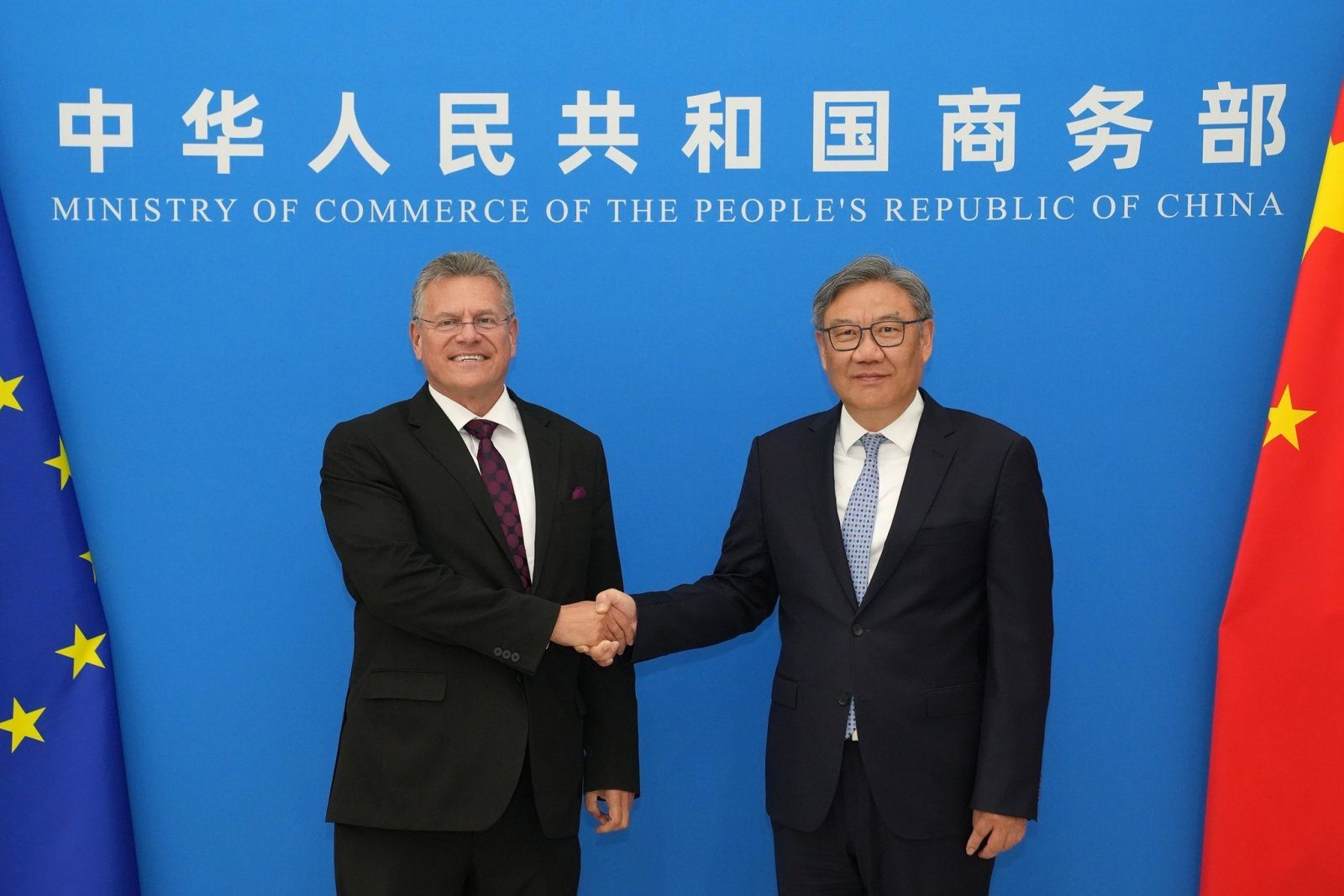

The European Union said China had agreed to cut its exports of hybrid and plug-in hybrid cars to the bloc by about half, but the joint text Beijing published after two days of talks gives no figure and says only that the two sides reached an “understanding” consistent with World Trade Organization rules.
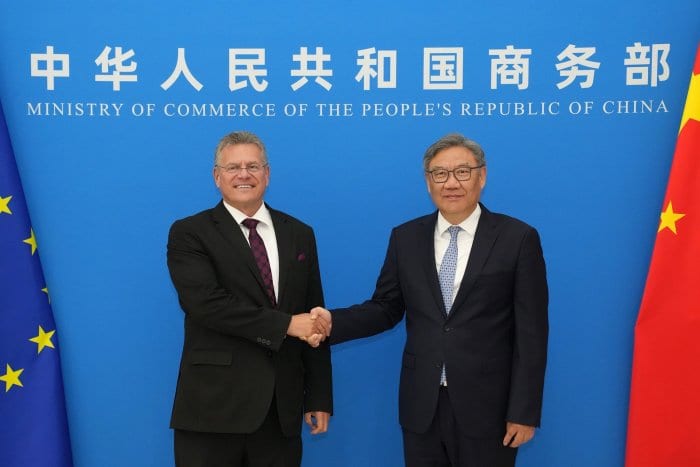
“With Minister Wang Wentao we’ve reached a shared understanding to halve HEV, PHEV exports,” Maroš Šefčovič, the European Commissioner for Trade and Economic Security, wrote on X on Friday, referring to conventional and plug-in hybrids.
He listed two other outcomes, improved access to China’s market and further easing of rare earth export licensing, and called the package “a first step.”
Speaking to reporters in Beijing minutes later, Šefčovič said the understanding “opens prospects of cutting China’s exports by more than a half.”
“In the case of hybrids and plug-in hybrids, we are talking about reducing exports from China to the European Union over four years by several million cars,” he said.
He did not say how the reduction would be enforced.
“There are different techniques,” Šefčovič said when asked how the limit would work. “If you look in recent couple of months, I think you would find the answer. But I’m sure appreciate I first need to get endorsement by the leaders,” he added.
EU leaders are due to meet in Brussels on October 15 and 16.
Chinese Carmaker Shares Rise
US-listed shares of Chinese carmakers rose in early trading on Friday after the two sides’ announcements.
While Li Auto and XPeng both produce fully electric and hybrid vehicles, the Shanghai-based premium brand Nio continues to bet only on battery-electric cars.
Li Auto was up 7.7% at $11.74, while XPeng gained 5.8% to $10.11 and Nio rose 5.4% to $3.60.
Beijing’s Text Has No Number
China’s Ministry of Commerce published a joint statement and a 16-point list of outcomes hours before Šefčovič spoke.
“Following intensive consultations, both sides reached an understanding on hybrid vehicle trade in a WTO-consistent manner,” the list says, according to an unofficial English translation released by the China Chamber of Commerce to the EU.
It does not mention a volume, a reduction, a time frame or a tariff.
The ministry had rejected a request from Brussels to cap hybrid exports on September 18.
“So-called voluntary export restraints seriously violate WTO rules and run counter to the principles of the market economy and fair competition,” a ministry spokesperson said at the time. “China firmly opposes this.”
Friday’s wording echoes the ministry’s insistence in September that any solution must comply with WTO rules.
China had not commented on Šefčovič’s figures at the time of writing.
‘First Time’ Without a Trade Fight
Šefčovič said China had agreed to the reduction without a dispute first.
“This is the first time that China has accepted to moderate its exports without going through the phase of prior trade tensions, and I very much appreciate that,” he said.
He also made clear the EU kept its options open.
“This is far from the end. It is a crucial first step, but only a first step in the process of rebalancing,” he said. “Where the dialogue cannot deliver, the EU will use its tools to ensure rebalancing.”
The 16-point list also says the two sides will continue to explore lowering tariffs on certain goods within WTO rules.
Šefčovič said that meant lower Chinese most-favored-nation tariffs on EU products including olive oil and footwear, covering trade worth 4 billion euros ($4.5 billion), according to the SCMP.
That figure is not in the Chinese text.
On rare earths, the list says China is “willing to continue facilitating” export licences for rare earths and permanent magnets through a “green channel,” while the EU will help with priority licensing cases for China involving dual-use goods.
On battery-electric cars, the two sides will continue company price undertakings and related review procedures.
A ministerial video call is planned for January and a third meeting of the consultation mechanism, set up in June, for March 2027.
From a 15% Cap to a Quota
Brussels first asked Beijing in September to limit Chinese hybrids to about 15% of the EU market, from more than a third, the Financial Times reported.
“If they will not limit their exports to our market then we will,” an EU official told the newspaper.
After China refused, the Commission weighed a temporary safeguard that would admit a set quota of Chinese hybrids at the normal 10% tariff and impose steep extra duties above it, the FT reported this week, citing two diplomats.
Šefčovič’s reference to “recent couple of months” when asked about the technique did not specify which tool he meant.
Monthly EU imports of Chinese hybrids rose from about 3,800 in October 2024 to about 50,000 in July 2026, according to the FT, after the EU’s October 2024 anti-subsidy duties on Chinese battery-electric cars left plug-in hybrids paying only the standard 10% tariff.
Those duties range from 7.8% to 35.3% on top of the 10%.
At the July rate, Chinese hybrid imports would total about 2.4 million over four years, so halving them would mean roughly 1.2 million fewer cars over the period, according to EV calculations.
Šefčovič’s “several million” therefore implies a baseline that assumes further growth, which he did not set out.
Pressure From Paris and Berlin
The talks followed rising pressure from the EU’s two largest economies.
German Vice Chancellor Lars Klingbeil called for tariffs on Chinese plug-in hybrids on September 17, and French President Emmanuel Macron and German Chancellor Friedrich Merz wrote to Commission President Ursula von der Leyen this week urging a new instrument to respond to third countries that undermine fair competition, including by immediate exclusion from the single market.
The letter did not name China.
China’s Ministry of Commerce urged France and Germany on October 6 not to encourage the EU “to resort to protectionist tools at every turn.”
Commerce Minister Wang Wentao had also lobbied European carmakers, holding talks with Mercedes-Benz Chief Executive Officer Ola Källenius as president of industry group ACEA and with Hildegard Müller, President of Germany’s VDA, in September.
BYD, which sells plug-in hybrids such as the Seal U DM-i in Europe, more than doubled its EU market share to 2.4% in the first half, according to industry group ACEA.
Handelsblatt reported in June that the Commission had prepared an anti-subsidy investigation into plug-in hybrids from BYD, Chery and SAIC.
EVs on a Separate Track
The battery-electric dispute has moved toward price agreements.
The Commission published guidance in January on how Chinese exporters can offer minimum prices instead of paying duties.
In February, it accepted the first undertaking, from Volkswagen‘s Chinese joint venture Volkswagen (Anhui), which committed to a minimum import price, to limiting its import volumes and to investing in EU electric-vehicle projects in exchange for exporting the Cupra Tavascan without duties.
The EU’s goods trade deficit with China was 360.6 billion euros ($403.8 billion) last year.