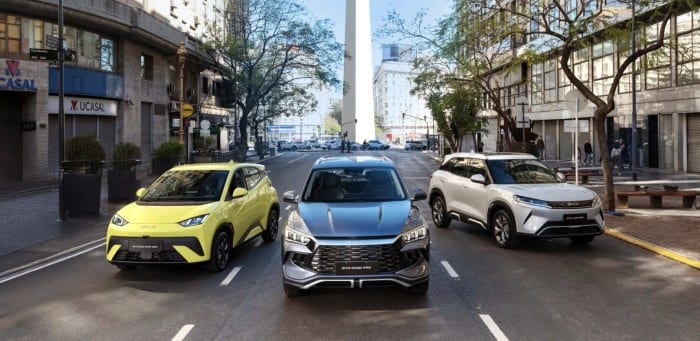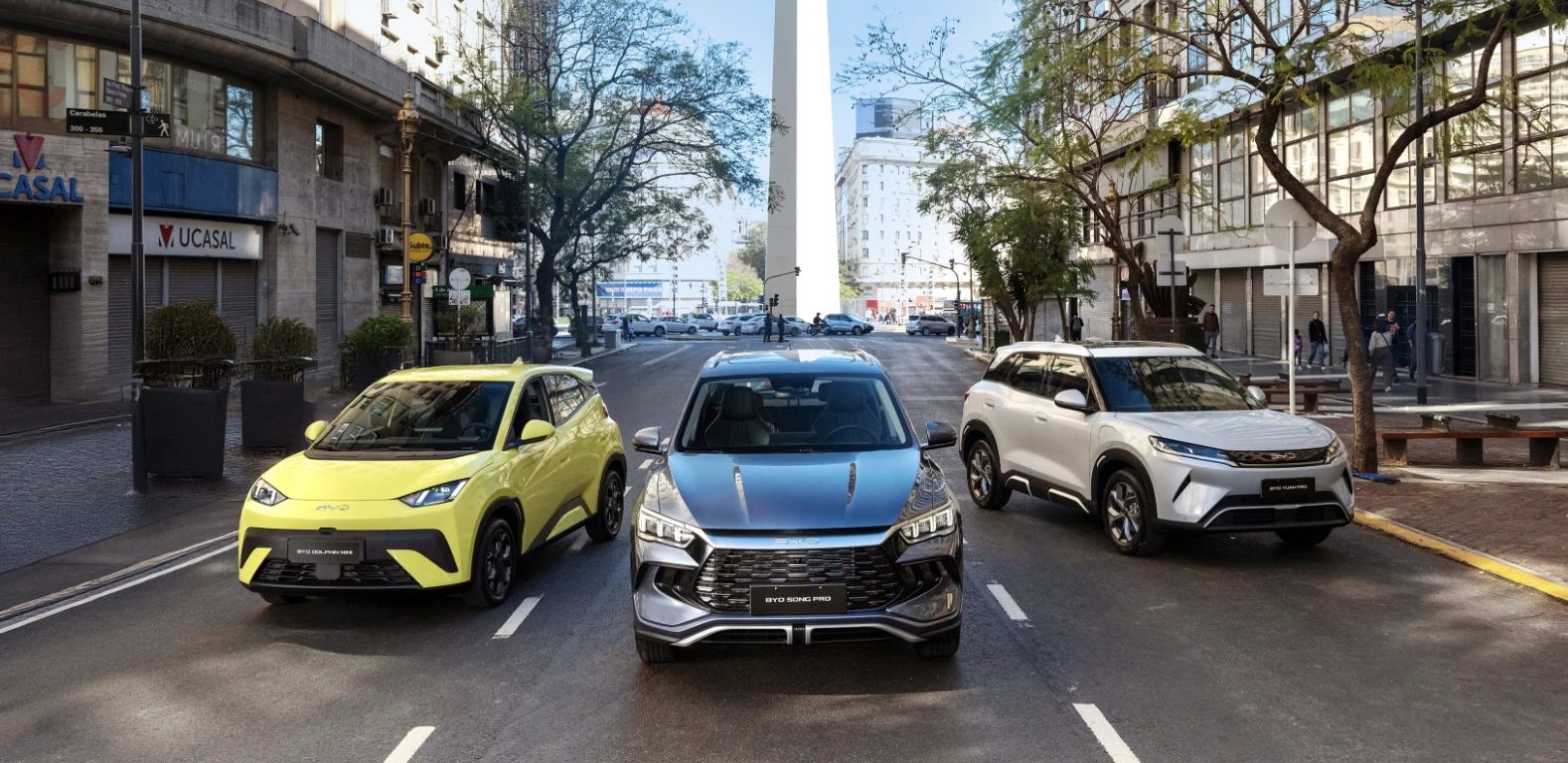

Chinese carmakers took about 12% of Argentina’s new light-vehicle registrations in September, led by BYD in ninth place, according to EV calculations based on data from dealers’ association ACARA.
At least 24 Chinese brands registered light vehicles in Argentina in September, from BYD to Geely, Chery, and Leapmotor.
The government raised the price cap for tariff-free EV imports to $35,000 from $16,000 on the last day of September.
BYD registered 1,584 vehicles in the month for a 3.4% share, ACARA data showed. That compares with 18 in September 2025, the month before the brand’s commercial launch in the country.
BAIC followed with 941 registrations in twelfth place and Chery with 809 in fourteenth.
The three brands accounted for 3,334 units, about 60% of the Chinese total.
Behind them came MG with 360, Great Wall Motor‘s Haval with 341, Jetour with 264, Changan with 154 and Leapmotorwith 147.
Year to date, BYD has registered 12,250 vehicles in Argentina.
BAIC’s nine-month total of 7,582 is up 204.3% from a year earlier, and Chery’s 4,954 is up 787.8%.
Toyota remained the market leader with 7,820 registrations and a 16.7% share.
In August, brands linked to Chinese groups registered 4,513 light vehicles, or 10.8% of the market, La Naciónreported.
Adding China-built models sold under other badges, the Ford Territory and Chevrolet Captiva, lifted that to 15.6%, the newspaper said.
Hybrids Carry the Volume
Hybrids, not battery-electric cars, make up most of the volume for the three leading Chinese brands.
Argentina registered 8,322 hybrids in September, up 161% from a year earlier, against 865 battery-electric vehicles.
Together they made up about one in five cars and light commercial vehicles.
BYD ranked third among hybrid brands with 1,019 units, behind Toyota’s 1,703 and Ford‘s 1,079.
The BAIC BJ30 hybrid, at 599 units, was the eighteenth best-selling model in the country, and the Chery Tiggo 7 followed with 588.
Ford’s hybrid volume came almost entirely from the Territory, a sport utility vehicle the US carmaker builds in China, which registered 1,072 hybrid units.
In battery-electric cars BYD’s lead is wider.
The brand accounted for 565 of the 865 registrations, about 65%, and its Dolphin Mini alone made up 495.
Battery-electric registrations rose 434% from a year earlier and reached 6,033 in the first nine months, against 688 in the same period of 2025.
Shipments and Tariffs
The surge rests on a quota that lets 50,000 hybrid and electric vehicles a year enter Argentina without the 35% tariff applied to imports from outside the Mercosur bloc.
The government awarded the 2026 quota in December after receiving requests for almost 136,000 vehicles. Importers received 30,720 units and local manufacturers 19,280.
Among Chinese brands, BYD was assigned 3,700 units, Chery 3,230, Great Wall Motor and Haval 2,656 and BAIC’s Arcfox 2,064.
Ford received the largest single allocation, 10,000 units of the Territory hybrid.
BYD brought its first dedicated shipment in January, when its own car carrier BYD Changzhou unloaded about 5,800 vehicles at Terminal Zárate, north of Buenos Aires.
The vessel can carry about 7,000 vehicles.
“If necessary we will bring more units, from China first and, when possible, from Brazil,” BYD Argentina Commercial Director Bernardo Fernández Paz said at the time.
Of the 100,000 vehicles assigned across the 2025 and 2026 quotas, 68,792 had entered the country, covering 58 models from 29 brands, the government said when it announced the new caps on September 30.
More than 31,000 awarded units have still to arrive.
Demand for the quota continues to exceed supply. When the government redistributed 865 unused units in September, it assigned them to Ford, Haval and MG and turned down 14 applicants, among them BYD, which had asked for 3,745.
Price Cap Raised for 2027
Decree 1128/2026, published in the official gazette on September 30, raised the maximum factory price for tariff-free imports to $35,000 for battery-electric vehicles and $18,000 for conventional and plug-in hybrids.
The cap for mild hybrids stays at $16,000, the level that applied to all technologies until now.
The annual quota remains 50,000 units.
The tender for the 2027 quota was due to open this week. The higher ceiling opens the scheme to more expensive electric models, including those of Tesla and several European brands, the outlet said.
Still Below 2025
The Chinese gains come in a market that is still shrinking.
Total registrations were 49,814 in September, down 11.4% from a year earlier and up 10.7% from August. The nine-month total of 435,493 is 13% below the same period of 2025.
Imported vehicles made up 69% of registrations.
“The Argentine car market is going through a change in its composition, with less national production and more imports, which reach 70% of units,” ACARA President Sebastián Beato said.
He said the market’s slowdown “has stopped” and that a change of trend is now visible.
Local output tells the other side of the story.
Argentine plants built 39,747 vehicles in September, down 15.6% from a year earlier, and exported 71% of them, according to manufacturers’ association ADEFA.
Importers’ chamber CIDOA, whose September ranking was led by BYD, BAIC and Chery, said its brands registered 7,133 vehicles in September, a 14.6% share.
“The growth we are seeing reflects a market that is recovering diversity,” CIDOA President Ernesto Cavicchioli said.