
Volvo Cars withdrew its 2026 outlook for sales volume and cash flow on Friday, 15 days after presenting investors in Stockholm with a plan for 13 new models and an 8% margin while leaving that outlook in place.
The company said it would give no new short-term guidance, after third-quarter deliveries fell 10.7% on a deepening slump in China and a slower recovery in the United States.
The Swedish carmaker, majority-owned by China’s Geely, said it “will not fulfill the previous full year 2026 outlook statements on volume and cash flow.”
The developments “will also have a significant negative impact on third quarter core earnings and cash flow,” it said in a regulatory disclosure, beyond headwinds it had already flagged on raw materials, currency and higher depreciation and amortisation.
Volvo Cars’ B shares fell as much as 7.8% to SEK 14.10 in Stockholm, their lowest since the company listed in October 2021, and were trading 3.3% lower at SEK 14.80 by mid-morning.
The stock has lost about 52% this year.
What Volvo Said Earlier
Volvo held its strategy update on September 17, when 79 of the third quarter’s 92 days had already passed.
Neither of the two releases the company published that day mentioned the 2026 outlook, the third quarter, or weakness in China and the US.
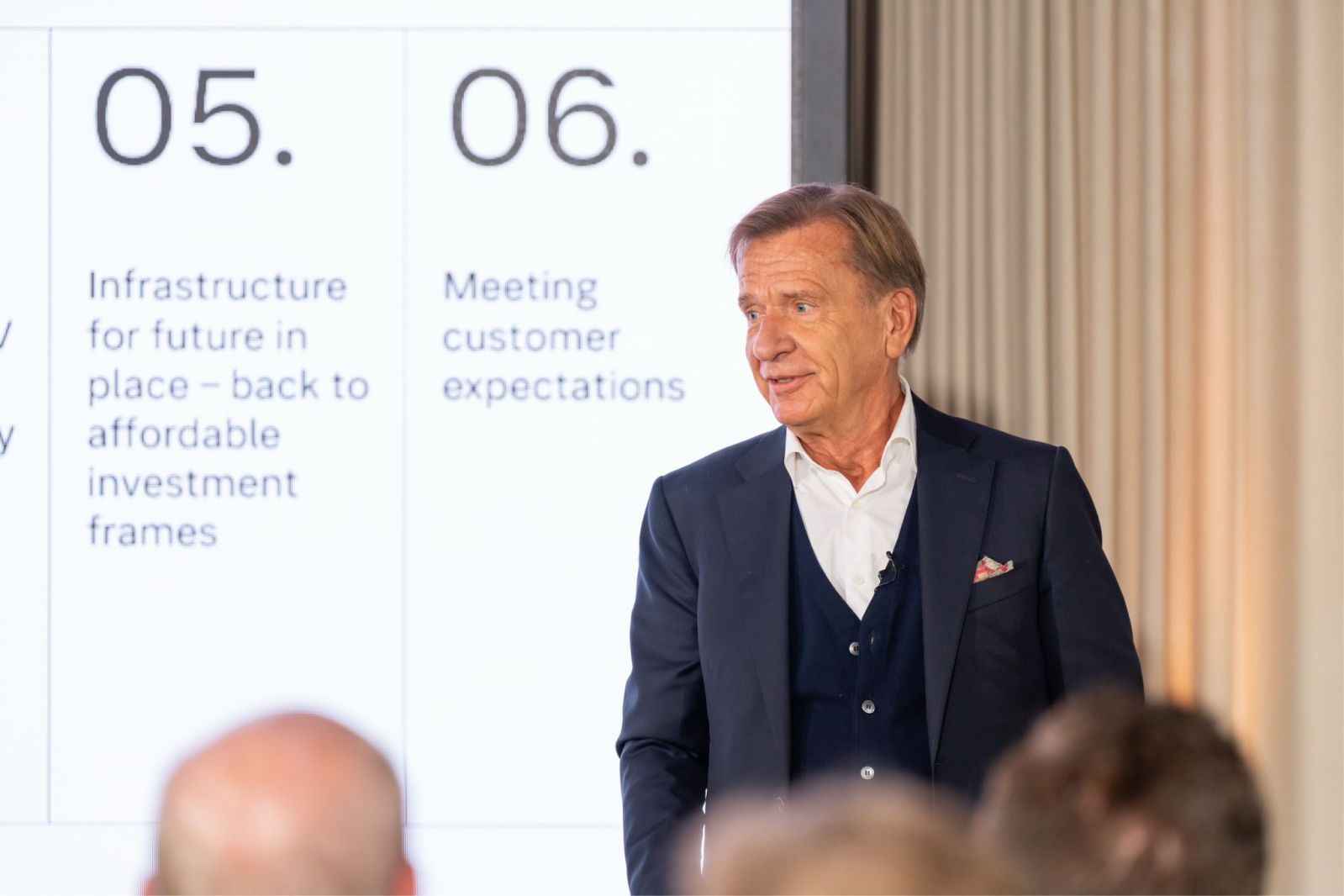
“These strengths position us for growth and increased profitability,” Chief Executive Officer Håkan Samuelsson said in one of them, describing the plan as Volvo’s “strongest product pipeline ever.”
The company also said it aimed to double its market share, and its shares rose 3% in early trading that day, according to Reuters.
The July outlook, which promised “significantly stronger sales” in the second half and free cash flow at about break-even for the year, remained Volvo’s published guidance until Friday.
Volvo had already reported on September 2 that sales fell 7.4% in the three months to August.
It held a pre-close call with analysts on September 21, four days after the strategy update, after which Citi cut its third-quarter margin estimate and cited lower volumes, discounts and raw material costs.
Friday’s disclosure does not say when Volvo concluded that the outlook could no longer be met.
Under the EU Market Abuse Regulation, which the disclosure cites, listed companies must publish inside information as soon as possible.
What Volvo Had Promised
Volvo Cars began the year saying it aimed “to come back to volume growth on a year-on-year basis for the full year,” with free cash flow “clearly better” than the SEK 2.4 billion ($240 million) it generated in 2025.
It kept both ambitions in April, when it said “the ambition for full year volume growth and cash flow remains.”
Volvo abandoned the volume growth ambition with its second-quarter report on July 17, when Samuelsson called the market “pretty bleak” and said China had deteriorated faster than expected, according to Bloomberg.
The shares fell as much as 10.6% that day.
In its place, the company forecast “significantly stronger sales during the second half of the year compared to the first half” and “a strong positive free cash flow in the late second half of the year, ending the year approximately at break even.”
Volvo projected second-half volume about 10% above the first half, Reuters reported at the time.
Friday’s statement removes those July statements without replacing them, the second cut to the outlook in 11 weeks.
“As a result of the increased market uncertainty, Volvo Cars has also taken the decision not to provide any updated short-term forward-looking statement,” the company said.
It is the second time in 18 months that Volvo Cars has withdrawn guidance, after doing so in April 2025 when it launched an SEK 18 billion ($1.8 billion) cost and cash plan.
The Q3 Results
Volvo Cars sold 141,609 vehicles in the third quarter, down from 158,615 a year earlier, according to a sales release published alongside the warning.
Sales in Greater China fell 40.6% to 20,284, and the region’s share of Volvo’s volume dropped to 14.3% from 21.5%.
Volvo blamed “growing competitive and pricing pressure from local manufacturers, as well as the subdued macroeconomic environment,” and said China’s premium market saw “a sharp double-digit decline in volumes.”
Deliveries in the Americas fell 14% to 30,777, reversing the 4% growth the region posted in the second quarter.
The company cited “continued weak consumer sentiment, increasing competitive pressure in the SUV segment and a high comparative base from last year, when sales of electrified cars rose before the expiry of consumer subsidies.”
Europe and the rest of the world rose 2% to 90,548, driven by a 51% increase in fully electric cars.
“The market downturn in China showed no signs of easing, and the recovery in the US premium segment remained below our earlier expectations,” Chief Commercial Officer Erik Severinson said.
He said the same conditions “have led third-party analysts to lower their sales forecasts for the premium car market for 2026.”
A month earlier, Severinson had said Volvo was “prioritising protecting transaction prices over volume growth” in China and the US.
The third-quarter figures include 1,621 cars from July and August that Volvo added after correcting a reporting error in China, and the year-earlier quarter was revised down by 1,899.
The Volume Target
Third-quarter sales were 17.4% below the second quarter’s 171,501 and 12.8% below the quarterly average of the first half, when Volvo sold 324,817 cars.
Sales in the first nine months come to 466,426, about 9% below a year earlier.
Matching 2025’s total of 710,042 would require about 243,600 sales in the fourth quarter, 24% more than the 195,748 Volvo sold in the last three months of 2025.
Even the softer July goal of a second half 10% above the first would need about 215,700 cars in the fourth quarter, a 10% year-on-year increase.
The Cash Problem
Free cash flow was negative SEK 10.0 billion in the first quarter and negative SEK 5.2 billion in the second, a combined outflow of SEK 15.2 billion ($1.5 billion).
Ending the year at break-even, as Volvo guided in July, would therefore have required a similar inflow in the second half, although the company did not spell out that arithmetic.
Net cash fell 62% in six months, to SEK 10.1 billion ($1.0 billion) at the end of June from SEK 26.9 billion at the end of 2025.
Volvo attributed most of the second-quarter outflow to an inventory build-up for the new EX60 at its Torslanda plant.
The company froze external hiring for office jobs this week, according to an internal memo reported by Automotive News.
Earnings
Volvo did not quantify the hit to third-quarter earnings.
The comparison is demanding, as operating income was SEK 6.4 billion ($640 million) in the third quarter of 2025, a margin of 7.4%.
In the second quarter of this year, operating income was SEK 0.8 billion ($80 million), a margin of 1.1%, on revenue of SEK 77.7 billion, below an analyst consensus of about SEK 1.3 billion cited by Bloomberg.
CFO Fredrik Hansson said in July that higher raw material prices would “start to hit in the second half,” according to Reuters.
Citi cut its third-quarter automotive margin estimate for Volvo to 0.7% from 1.9% on September 22, a day after the pre-close call, citing lower volumes, discounts, raw material costs, higher depreciation and currency effects.
The bank kept its sell rating and lowered its price target to SEK 15 from SEK 16, an estimate that predates Friday’s warning of a further hit.
EV Sales Still Growing
Fully electric sales rose 28.6% to 45,060 in the third quarter and made up 32% of deliveries, while plug-in hybrids fell 18% to 30,589.
“In Europe, we continue to see strong demand for our new cars, led by the EX60 and our recently launched long-range plug-in hybrids,” Severinson said.
Outside Europe the picture reversed, with fully electric sales down 47% in the Americas and 29.9% in China, where Volvo sold just 968 battery-electric cars in the quarter.
Long-Term Targets
Volvo said the withdrawal “has no impact on the long-term strategic ambitions” it set out 15 days earlier, including “structurally building a company delivering 8% EBIT margin.”
The margin goal has a history of slipping, as Volvo set a target of 8% to 10% by mid-decade in 2021, lowered it several times and withdrew financial guidance in 2025, according to Reuters.
It reset the target at 8% in November 2025 without a timeframe, when Hansson said collaboration with Geely and cost cuts were expected to deliver 2 to 3 percentage points of the improvement, according to Reuters.
At that strategy update on September 17, the company said it would launch 13 new models by 2030, without giving a date for reaching the margin target.
The warning also lands during a leadership handover, after the board named Škoda Auto chief Klaus Zellmer to succeed Samuelsson “no later than 1 October 2027.”
Volvo said it is “taking further decisive actions” and will give details with its third-quarter report on October 23.